Pages

Wednesday, July 6, 2022

The Outfit

Spoiler-free!

The Outfit is a movie set in the 1950's, inside a single tailor shop, where the bad guys are mobsters, and no one can be trusted, and it stars Mark Rylance, Johnny Flynn, Zoey Deutch, and Dylan O'Brien, which reads to me more like a fantasy football lineup for movie stars than a cast list that would ever actually happen. And yet—somehow—it misses the mark on feeling like a film that was made just for me. 

I can't say that makes it a bad film at all though. Far from it. It has a concise and thought-out structure to it that gives it a very intentional feel. Much like the suit that Mark Rylance's character cuts and sews throughout the story. It treats filmmaking as a structured craft more than a freeform art, and the tone that sets goes well with a plot set inside a tailor's shop. It has strong bookends, gently interwoven themes, and conversations that are deliciously subtextual and often subtly intense. And despite its neat structure, it does many things that you won't expect, that turn the plot into new and interesting directions. The overall picture is as neat and trim as a new suit. 

And yet... when you look closer, things begin to, shall we say, unravel. Some of the twists and turns may feel so completely unexpected because they couldn't reasonably happen in reality. In small things, only ever little details, the writing skirts by, making important plot changes happen on the flimsiest of foundations. Sometimes characters will tell lies that make no sense at all, yet the characters being lied to buy it without question. We the audience might notice at first but then be lulled back into the story by the character's belief, or another lie or another twist that makes us forget the last one. On and on it goes until it neatly wraps up the ending and hopes you won't remember the skimping that happened in the middle.

And as much as I enjoyed the conversation-heavy thriller aspect, and as much as I generally go for single-location stories, those things here often felt to be a waste of the cast's talent. They do a lot—particularly Mark Rylance in the lead—but never reach a point where the roles seem to be a challenge. The learning and dedication required for Rylance to become a convincing "cutter" (as he calls himself) seems like a normal Tuesday for him. Same for Johnny Flynn's underperformed and cool villainy. Same for Zoey Deutch's sweet, but tough, but sweet, but tough receptionist. Same for Dylan O'Brien's tendency to lean into the physicality of his roles. I'm a fan of all four, particularly Rylance and O'Brien, so seeing a film that exists to highlight performance keep them to this "comfort zone" was a little disappointing. But maybe that's not fair of me.

I think at the bottom of this mystery, the disconnect I feel with it is in the plot itself. Perhaps a little in the skimping of plot turns, but mostly in the turns themselves, that took the story further and further from where I wanted it to go. Maybe it's not fair to claim this as a complaint either, or maybe the story really would have served itself better by taking more predictable but more manageable turns. Regardless, the craft is undeniable, often fascinating, and worth a look.

Tuesday, July 5, 2022

Top Gun: Maverick

Spoiler-free!

The phenomenon of Top Gun: Maverick isn't that it's an exceptionally good high quality summer blockbuster—it's simply that high quality summer blockbusters haven't existed for about five years. (And even then they were a dying breed.) Likewise, the magic of Top Gun: Maverick isn't that it's the greatest gap-sequel ever made—it's more that no other sequel made so many years later has ever been able to boast of having a worthy reason to exist.

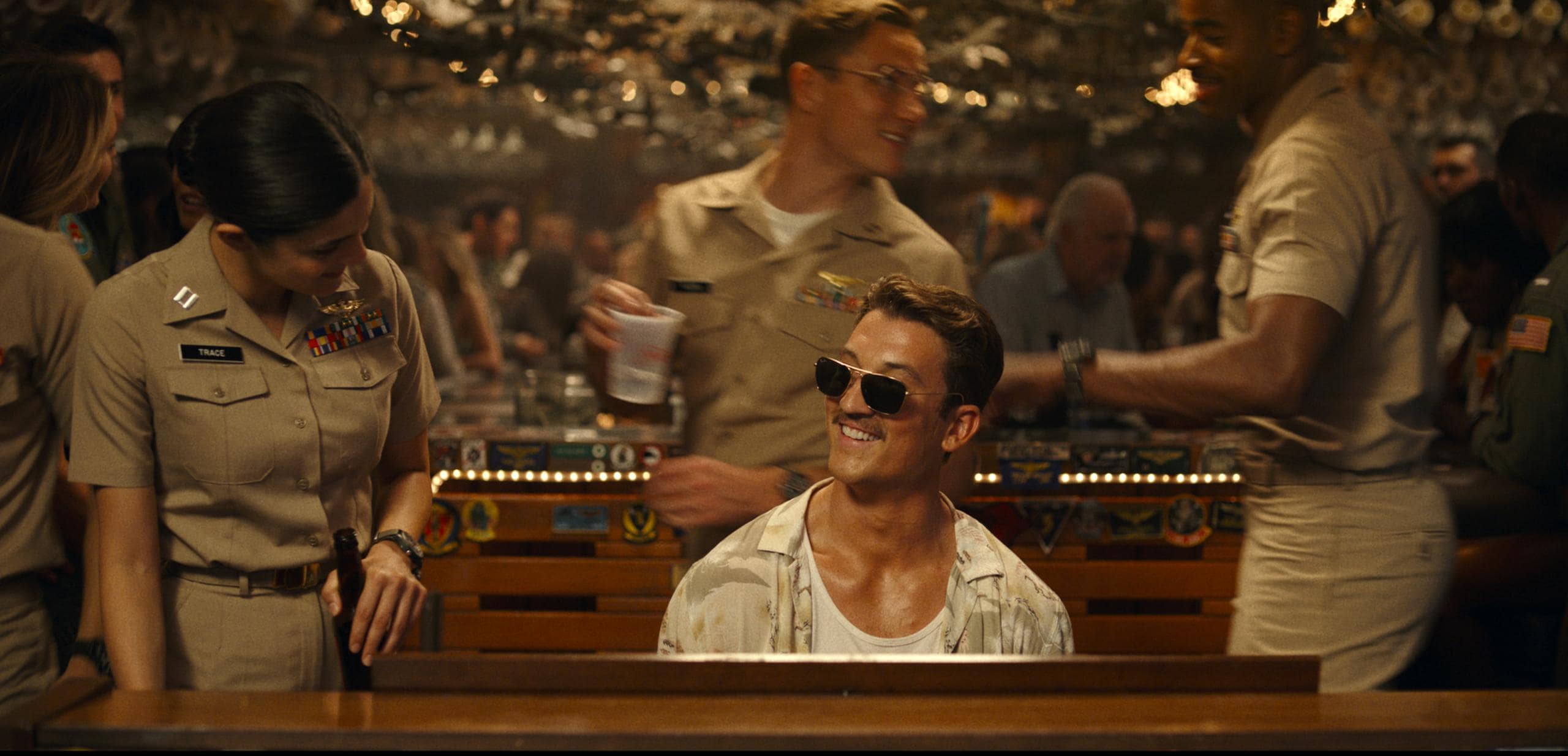
And yet here we are, our socks knocked off by another one of Tom Cruise's filmmaking efforts. He may be the last person making movies who actually cares whether his products are entertaining or not. Here, he returns as his original character, Pete Mitchell, callsign Maverick, assigned back to Top Gun to train an elite batch of aviators for a specific, daring, and possibly deadly mission. One candidate, callsign Rooster (Miles Teller) is the son of Maverick's old co-pilot who died in the first movie, and tension rises between them as Maverick struggles between his job of picking the best team to risk their lives on the mission, and his own personal mission of protecting his friend's son.

It's a pretty sweet set up, ripe for drama, but not so complex as to take away time from the entertainment of training exercises, which range from aerial dogfights to playing football on the beach. For a side plot, Maverick takes up a romance with a former flame, Jennifer Connelly, and before you know it, I was wishing Tom Cruise wasn't in the movie so much—because the one thing left unfulfilled is the dynamics between the candidates. The loose definition of their unique personalities made me wish for more. And then Hangman, the Iceman equivalent, and his antagonistic relationship with Rooster is rendered pointless by Rooster's more convincing antagonistic relationship to Maverick—but even that is put on hold for too long. When it comes due is when the movie starts to really shine.

I would have liked the movie to split time between Maverick's antics and what the candidates are up to when he's not around, but at the same time I get it. It's the Tom Cruise show because the film wouldn't exist without him. You can't begrudge him taking the spotlight, or deny that everything he does is entertaining. I just can't help but wonder if it would have been better had it been more balanced. Just a tad. In that light, it was the third act that sold the film for me. When everything comes to a head, and it starts to feel like an equal character match-up between Maverick and Rooster. This section also has most of the thrilling flying action (on which a Tom Cruise movie will never, ever skimp) and the most real stakes and tension as they take on the deadly mission.

The whole movie builds to this point, and it doesn't disappoint in any aspect. It has the realness that Cruise is known for to make you feel it—the thrill that can only come when there's also a notable lack of CGI. I got a big kick out of seeing the actors react while inside actual, actually flying fighter jets. And because everything was set up previously, the whole act is a neat series of payoff after payoff after payoff, each one more satisfying and rewarding than the last. Character drama and fun action mix together to splendid results, and an old-fashioned magic of storytelling comes to life. It's all so simple and won me over so easily that I wonder how the art was ever lost in the first place.


So, if Top Gun: Maverick is great and a phenomenon just because every other modern film is bad and worthless, that doesn't change the fact. It has the magic, and it is a phenomenon. It's dastardly entertaining in ways I thought films had forgotten to be. Not exceptional in the big picture, but certainly exceptional for its time. My hope is this: that this rare blockbuster isn't a throwback to good and entertaining movies at all—but the instigator of a resurgence.

Monday, May 9, 2022

The King's Daughter

Some spoilers. 

I swear there's a good movie in here somewhere. The question is, does the lack of it even matter? 

It's about a French girl (Kaya Scodelario) in the 1600's who's taken from her monastery home to live in King Louis XIV's palace, unaware that she's his daughter. She loves music so when she hears a strange song at night, she follows it to an underground pool where a mermaid is being held captive, waiting on an eclipse so she can be sacrificed to give the King eternal life. The girl befriends the mermaid, as well as the handsome sailor (Benjamin Walker) who caught her, and a predictable series of romantic adventure ensues.

It certainly is... special.

Except the movie is quite a mess, and those appealing ideas of fairytale romance and adventure get a little buried in the jumble. The movie spends more time with the plotting King (Pierce Brosnan) his Priest (William Hurt) and the "scientist" who's going to kill the mermaid for him. They spend a lot of time bickering about God and science, or rambling about nothing much at all. Then there's the drama between the King and the girl as he doesn't tell her she's his daughter but hires her to play music for him outside his window every morning, and then once he tells her he immediately tries to merry her off to some simpering duke, which doesn't go over well of course but doesn't really go anywhere plot-wise either except to make her realize he's not so great a dad. 

It's like the movie understood what kind of tropes would be appealing, but had no idea how to actually use them. I loved the idea of her being engaged to a bad guy while falling in love with the sailor, but we never get to see the tension and conflict that situation should raise. I don't think she even sees the duke while knowing their marriage is arranged. And the sailor only finds out about it a minute before it's not an issue anymore. The movie touches on so many tropes that I enjoy that I wasn't disappointed, but it seems to have cinematic ADHD, hoping to and fro whatever topic pops into its head in real time. Scenes end abruptly, or cut in and out without apparent reason, and don't have the stamina to find the compelling content they're obviously searching for.

Fun fact, these two are married irl, and they met filming this movie, in... *checks notes* 2014?? It was released this year, so that's 8 years on the shelf. Wild.

If I were the actors involved, I'd probably wish it had stayed on the shelf. It's a bit embarrassing. But as a movie fan, I'm glad it was released, even with all the weirdness. Brosnan and Hurt phone in their stuff, but I'm not mad about it. There's nothing in the script that's worth getting worked up for and they're entertaining without trying. Scodelario tries, bless her, but her efforts only made me laugh when paired with the clunky lines she's trying to convey. Benjamin Walker's character is very much a K-Mart brand Will Turner but still somehow manages to be halfway dashing. The cheesy romance was probably the best aspect simply because cheesy romance increases in value the cheesier it gets. Still, I can't help but think there was a path here for something a step above—more real character development over empty platitudes to give the cheese a foundation on which to thrive.

The tropey appeal cannot overcome the mess. It's badly written, badly cobbled together with bad performances, laughably modern costumes, cheap CGI, and a smattering of sweeping wonder. I enjoyed it all, but only because swashbuckling fairytales like this barely exist at all—let alone in any better realm of quality.

Tuesday, May 3, 2022

Moonfall

Spoiler-free!

The master of cinematic destruction is back with another epic world-in-peril film, and it may be my favorite of them all! 

Though no one would accuse Roland Emmerich of making high art, what he does do is put a lot of effort and money into making big, entertaining blockbusters in his specific style. And that's what I love about this movie. It doesn't do anything by half measure. The Earth is under attack again—this time by the moon itself! Once its orbit begins to degrade it's only a matter of weeks before collision. Most of the world goes into panic mode, leaving it up to disgraced astronaut Patrick Wilson, his estranged work partner Halle Berry, and a crazy internet conspiracy theorist John Bradley (who turns out to be not-so-crazy, of course) to figure out how to save the day. 

The Moon gets really close to the Earth and it looks cool. What more could you ask for???

Meanwhile they have family issues to keep the characters grounded in a sort of relatable reality, so the stakes aren't too big for us to bother to care about. Wilson has his delinquent son (Charlie Plummer), ex-wife, and her new husband (Michael Peña!), and Berry has her ex-husband and their daughter—all left behind on earth to witness the catastrophe as the leads go into space to confront the alien problem. We've seen it all before, but I've never seen it work better than under Emmerich's direction. He shows us what we want to see. Or, at least, me. The thing that tickled me the most was how he used real and strange facts about the Moon to build his plot around. Like how it "rang like a bell" when Apollo 12 launched their descent module into it. Though the movie finds fantastic and unlikely reasons for these things, there's a genuine sense of mystery and wonder there.

Visually it was good enough that I now wish I'd bothered to see it on a big screen. The Moon being so close to the Earth of course provides a stunning visual. Elsewhere green screens are incredibly obvious. But elsewhere again, the alien design and space scenes have an obvious budget and effort put in. The family drama is fairly scant and cliché, but that's not to say bad, and one or two scenes and some dedicated line delivery from solid actors is all it needs to stick. Patrick Wilson was great casting and really sells the whole story. Then there's the general destruction. My least favorite part of disaster movies, funnily enough. There are a few interesting situations for the characters to navigate, plus plenty of floods, crumbling buildings, and those scenes where someone's using a white board to illustrate what horrors will occur next. It's really classic stuff.

I'm trying and failing to think of a way this movie could have been more enjoyable for me. 

And I guess that's why I got such a big kick out of it. It's classic. Not highbrow, but doesn't talk down to its audience either. It doesn't even bother to preach on woke topics, it just gleefully focuses on all it's cool ideas, with a sweet if small family-oriented center, and in that vein, does its own thing, and does it well. I know a lot of people are down on it, but I for one am not ready for the fun to be sapped out of all our movies. Completely uncynical, involving space, and family, and sacrificial love, cool in concept and awesome to look at—MOONFALL hits the spot and checks all the boxes for what I've been craving. Maybe it was made for me alone, but either way I can't help but give it an enthusiastic recommendation!

Tuesday, April 19, 2022

Why Didn't They Ask Evans? (2022)

Spoiler-free!

It may be hidden away on Britbox, unlikely to ever be seen by many potential fans, but Hugh Laurie's take on this Agatha Christie standalone mystery may also be my favorite Christie adaptation ever, so I must tell you about it.

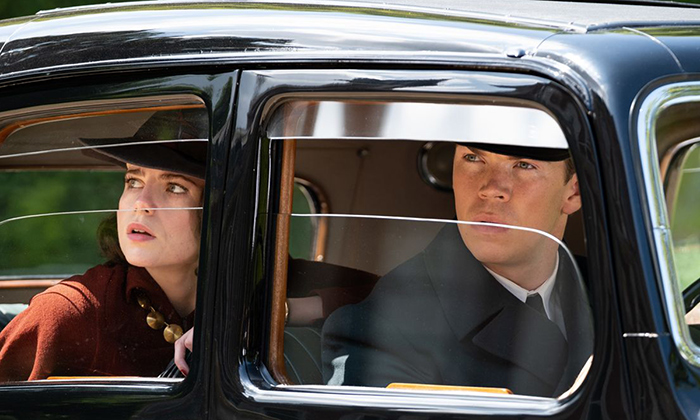
It stars Will Poulter as Bobby Jones and Lucy Boynton as Lady Frances Derwent—and right there you have half the reason why it's so much fun. While out caddying one day, Bobby stumbles upon a man who's fallen over a cliff. Before the man dies, he asks a single question: "Why didn't they ask Evans?" Bobby soon reconnects with his childhood friend, Lady "Frankie" who has a penchant for sticking her nose into situations with the kind of charm and grace that makes it forgivable, and together they are pulled into a thrilling mystery plot as they try and work out who Evan is, and who didn't ask them what.

 Frankie does most of the pulling, and Bobby most of the getting pulled. They make a great team.

Agatha Christie is known for weaving impressive and un-guessable mysteries, but the more I read and watch of her stories, the more I think it's her characters that are the most vital. Why Didn't They Ask Evans? isn't her most memorable work as far as mystery goes, but it still stands out, and is one of my favorites, even before this version came around. The simple intrigue of the central question and the duo of Frankie and Bobby are what make this story shine. Hugh Laurie understood that (he wrote and directed this, plus takes a small but key role), and he puts most of his focus on the two leads. Each of their scenes, even the ones that are just deducing and theorizing, are packed to the brim with wit and banter, great chemistry (thanks to the casting), and a grand sense of fun. 

Laurie's adapting should have poor Kenneth Branagh turning green. For one, Laurie gets three hours to tell the story instead of a movie length, so he gets to indulge in the parts of the story that are the most fun. Mostly characters as previously mentioned, but also the cozy mystery tone. There's a beautiful balance of foreboding and building suspense mixed with light, airy, distinctly British wit and comedy. Every other scene has a line to laugh at, and there's obvious thought put into clever scene construction. The lost art of set-up and pay-off. Laurie also expands some parts of the book into more cinematic sequences that won me over easily despite my tendency to prefer direct adaptation. Laurie's writing and directing sensibilities complement Christie's work rather than conflict with it, and the result is, I daresay, enhancing.

I wish Christie had written more Bobby/Frankie stories so we could get more of Poulter and Boynton together. Totally adorable. 

The only hang-up here is that so much time is spent in fun, cozy sleuthing with the two adorable bantering leads that time runs out and the mystery plot seems rushed once it comes around to the dramatic ending. The dramatic ending doesn't culminate into a grand reveal like when Poirot gathers his suspects and explains everything succinctly. It's more given to us in bite-sized pieces that don't flow like the rest of the story does. Part of that is due to Christie's structure in the book, which isn't her best, but this adaptation deviates most toward the end and loses a little of the explanation she provided. A thread or two is left hanging, and the wrap up happens so fast I was left wishing for five more minutes to revel in the success. 

I get the distinct feeling that the three-hour time limit came due, and Laurie had to choose between wrap up and explanation scenes, and some of those gloriously witty character scenes in the beginning and middle. He chose the character scenes. And as far as I'm concerned, he chose wisely. I'm completely in love with Will Poulter, Lucy Boynton, and this charming little mystery. 

Thursday, March 10, 2022

The Batman

Spoilers

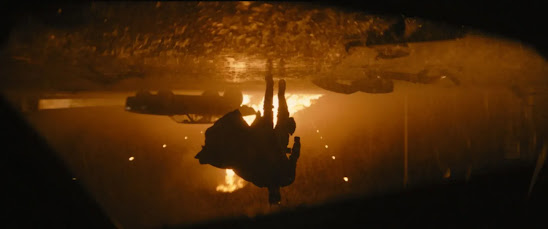
Director Matt Reeves promised us a detective Batman in a 90's grunge style noir setting, and cast the master of brooding and angst, Robert Pattinson, as his caped crusader. Well. I'm happy to report that he delivered on his promises. Nary a sliver of sunlight is seen in this movie. Gotham is looming all around, grimy and shining in the rain and harsh night lights. And the movie begins with Pattinson's early years Bruce Wayne delivering a cynical and brooding narration as he chooses which of many, many crimes he should spend his efforts on one Halloween night. The sequence caps off with the pent-up drone of Nirvana, and by then I was hooked and ready for anything.

If I have to turn off the lights in my den to see anything once I'm watching at home, it'll be worth it. This movie is dark and beautiful.

Two years into his crimefighting, this Bruce is still working out his place as a vigilante. He revels in the fact that even the idea or suggestion of his presence will repel even the pettiest of criminals. "They think I am hiding in the shadows," he says in his noir narration. "But I am the shadows." But a sense of futility is creeping in. No matter how much crime he stops, more evil is around the corner. Then—it's The Riddler's turn, played by Paul Dano with eager gusto. Appropriately, Riddler's goals are parallel with Bruce's. He begins to bring to light the corruption and scandal of wealthy and influential Gotham residents, but with the one significant difference from Batman, in that he kills them first. 

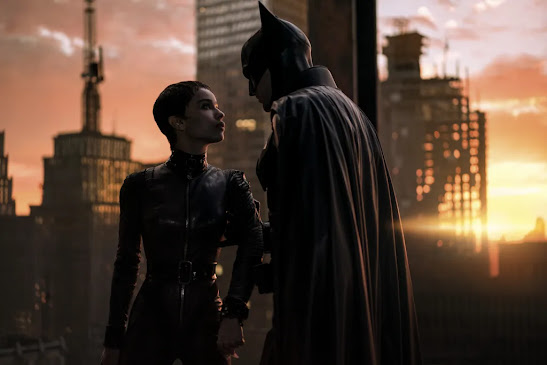
He leaves letters and clues for "The Batman" at his crime scenes, which Bruce dutifully follows with help from Gordon, (played with quiet intensity by Jeffery Wright) and Selina Kyle, (Zoe Kravitz, and the film's character highlight.) I loved the sequence where Selina and Bruce team up and infiltrate the club for information—a perfect amalgamation of noir and Batman sensibilities. But elsewhere, scenes that seem to want to mimic the disturbing factor that The Dark Knight did so eerily well played on my nerves here. The writing of Riddler's plan, motivations, and even characterization felt uninspired, as if the acting alone could carry this villain. They spend too much time on him, and the veneer begins to fall.

Besides Kravitz and Dano, (and the actor who claims to be Colin Farrell, which I'm still suspicious of) a general increase of facial emoting wouldn't have gone amiss. People feel things in noir stories, too.

Pattinson is the ideal choice for this iteration, but his performance feels restrained. Stoic Batman is fine, but I hope Bruce Wayne isn't left as a blank slate. They have a good start here. Grungy emo Bruce is different and fun in a dark way that fits the aesthetic, and I know Pattinson can dig into that—if the script and direction allows. Here, the writing keeps him one step behind the Riddler. Even when Riddler allows himself to be arrested, and even when his final plan is implemented, Batman seems there only to react, powerless to stop it. And that bothered me. I wanted Bruce's detective skills to matter to the plot. Or a satisfying moment of revelation where he "solves the case." But there isn't really, and for better or worse, it is done intentionally. 

Through his inability to stop Riddler, Bruce is forced to confront this mirror villain and consider what the difference between them is. Why doesn't Batman kill, if he's the same as Riddler in every other way? So Bruce's moment of revelation turns introspective as he realizes that the point of stopping crime isn't only about the crime itself, but to protect those against whom is the crime is being committed. At the beginning, when Batman beats up the gang of thugs with skeleton paint on their faces, their victim is every bit as afraid of Batman as they are, and Batman does nothing to dissuade his fear. But once he fails to stop Riddler's plan, he realizes it's not over, because there are still innocent people he can help. So he does. And that's what's important, and what makes him the hero rather than the villain.

The style, with bookends of narration and grunge music made me happy, but it still all comes down to character.

So even though I was hoping for a more satisfying mystery plot, and even though I tend to tune out emotionally when superhero movies resort to a city-level event for their final act, I do greatly appreciate this character arc which is beautifully minute. No massive, life-altering realization—just Bruce shifting his focus a little and seeing a ray of hope in the bleak and endless line of evil that's standing before him. I don't think this movie is perfect, but that's why I think I love it.

Monday, March 7, 2022

West Side Story (2021)

Spoilers.

Film adaptations of stage musicals always seem to be lesser. There's something about live performance that dazzles and sweeps you along in ways film simply cannot. But even in that light, Steven Spielberg's re-adaptation of West Side Story is still lesser, and can't manage to improve on the one put to screen 50 years ago.

Despite all that money. Money, it turns out, is cold and inanimate and cannot emote to entertain an audience.

It's worth noting that if you're a fan of West Side Story there no reason why you won't get enjoyment out of this one. I know when I love something, I can see any number of adaptations or versions and be happy even if they're mostly not the greatest thing ever, just because I love the story that's being told and love to see the different casts and approaches. I feel that way, in fact, about Romeo and Juliet, and from that perspective, I did have fun watching this version as it was the first time I saw West Side Story since reading Romeo and Juliet. I never realized before exactly how closely this story follows the Shakespeare. But I'm not particularly a fan of West Side Story in itself. Nothing against it, and I've never not enjoyed it, but I never felt any personal attachment. 

And that's why I needed this version to be actively good in order to impress me. Which is why I am far from impressed. Spielberg give it a good ol' Oscar-grab revamping, by spending lots of money and doing nothing creative. He casts stage veterans in bit parts (Brian D'Arcy James is there but doesn't sing???) and tones down the dancing so his Hollywood stars can keep up. Ariana DeBose as Anita was the only main casting that was actively good. She could dance, sing, and act with equal fervor, and stole the show as far as I'm concerned. Rachel Zegler had a nice voice and a good look for Maria, but her characterization felt too restrained to me. Chalk it up to inexperience behind a camera. I have no complaints about the rest—except one. 

Ho hum, here we go...

Ansel Elgort's Tony is every bit as bad as I feared it would be. And I don't dislike Elgort. He just needs the right role to work—and this isn't it. He doesn't have the look. He exudes dopiness rather than romance, and while that can be charming in the right setting (hello Baby Driver) it's a stretch here. I don't get why he was cast. His acting is nothing special either and while he can move well, Tony doesn't need to be a dancer. His singing voice sounded fine, except that there was never any power behind it. He doesn't belt or croon, he's just kind of... there. And the movie seems aware of all this, and attempts to prop him up by giving him more to do via songs that don't belong to him. Yes, they gave him Cool, the best piece in the show, and butchered it so he could have more screen time.

They also wrote in a change where Tony is freshly out of prison where he went after almost beating another kid to death in a rumble. I can see the good intention behind this addition, that it's trying to deepen Tony's character, but instead it undermines a few aspects of the story. It takes his agency, first, because he now no longer left the Jets by his own choice. Then it makes him seem too much a bad guy later—they have him fight Bernardo and beat him, but stop because he is afraid he may kill him... but then of course he does kill him a minute later and it comes across weirdly in this new light. Suddenly the focus is on Tony and his apparent personal disposition for violence rather than a general tragic look at how the gangs' cycle of violence and revenge destroys innocent lives. 

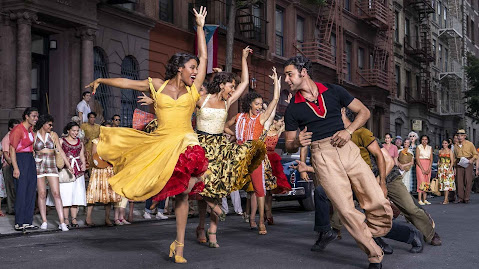
The dancing did have its moments, and I loved the costuming.

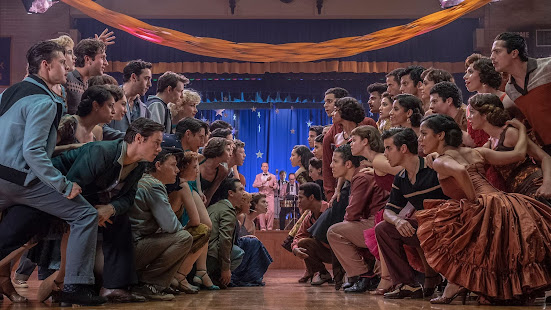
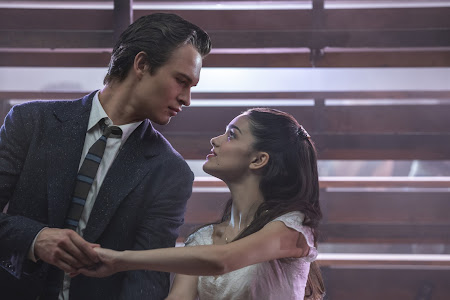
Spielberg's visual hand is where the movie finds most of its positives. It's nice to look at, expensive and often pleasantly gritty. Too much lens flare though. (J.J is supposed to copy you, Steve, not the other way round!) Some of it has that shiny CGI look to it—especially the atrocious Cool scene—but elsewhere there are real, and fun sets. I liked the balcony set up quite a lot. And there's one great shot when the gang's meet to rumble. The performance aspect of the dancing doesn't translate as well. The choreography is toned down and location hopping undercuts the songs' energy and momentum... which are usually dulled already due to the "La La Land Syndrome" where the singing is more "realistic" read: not powerful or dynamic at all. It's Broadway style music telling a Shakespearian tragedy; it needs to be larger than life, not toned down.

If there's one thing that sums up this movie's shortcoming, it's that. It sorely lacks dynamics. Both in the musical sense of fluctuating volume, and in the sense of the energy, tension, and passion that a well-assembled and performed piece can bestow on an audience. West Side Story demands dynamic storytelling, but Spielberg sacrificed the energy that a musical can bring through song and dance—cut it up and whittled it down—for the sake of realism. But so what if it's more historically accurate, if it can't make you feel? 

As I sat watching I kept thinking about the high school stage production I saw, and how that show made me feel more than this hundred-million-dollar project. Granted it was a very good high school production, but that should be a low bar for one of the most celebrated film directors ever. Instead, he cranked out yet another expensive, nice-looking, unnecessary bore, and either forgot, or didn't bother to infuse it with passion or life.