Pages

Showing posts with label Action/Adventure. Show all posts

Wednesday, December 20, 2023

Godzilla: Minus One

Horror as a genre originated from real fear—taking things we are afraid of in our real lives and turning them into something fantastic and unreal. I think all my favorite horror movies have that element to them. Some are like Crimson Peak; "The ghosts are a metaphor for the past," the characters say. And in the movie that's really all they are. Some are like 28 Days Later; people grappling with loneliness and isolation in a world where everyone you meet is either a zombie, or could turn into one at any moment. 

Metaphorical monster movies in particular stand out to me. Even if (or perhaps especially if) the metaphor is obvious or spelled out as in Jurassic Park or The Babadook, there's something about the combination of the unignorable presence of a literal monster wreaking havoc and more subtle things they represent (such as pushing the limits of science, or simple depression) that brings the fear to life. And Godzilla—the original Godzilla—is a classic example of that. A radioactive monster terrorizes Japan.

I've always understood the metaphor in my head. This movie made me understand it in my heart.

As the Godzilla character became Americanized, the metaphor shifted. It became a tool used to preach. A warning against war or the wielding of nuclear weapons perhaps, but not about the fear, and the powerlessness of being at the mercy of those things. Godzilla himself even turned into a benevolent being that represents peace, somehow. And lately, it's been nothing but a way to use CGI artists to numb audience minds for money. Godzilla go rawr, people buy ticket. 

And that, most of all, is why I love Godzilla: Minus One. It's a return to metaphorical form. And it's done gloriously. It made me feel and understand on a palpable, gut-wrenching level, the fear that Godzilla represents. And it's not even marketed as a horror movie! It's not very scary, nor dark in tone (or in lighting). It's just an action/adventure monster movie, with drama. And characters. And writing. And I mean real, honest-to-goodness, there's-cohesion-and-a-story-here kind of writing, where everything fits together and serves to enhance and balance the next element, all surrounded by artistry and understanding of the purpose and value of stories as a whole... and I... I've missed this so SO much over the past few years. 

A cohesive story is great—but can still be clinical. This one possesses that spark of passion that brings a well-conceived story to life. Really, it's more than a spark. 

Minus One follows Koichi, a failed kamikaze pilot who goes home after the war in shame to a bombed out house and no family left alive. Survivor's guilt plagues him, as do memories of a dinosaur-like creature who appeared out of the sea and killed everyone on an island outpost where he was hiding. He cannot allow himself to truly live, but neither can he turn away from life completely. He stumbles into caring for a girl named Noriko, and the orphaned baby she's become a surrogate mother for. Together they build a life and scrape by until they've found their feet. He gets a job removing sea mines from the bay. The city and the people begin to heal. But then the monster returns. And with it, the dread and the shame.

Even though the topic is depressing and the people in the story are beat down, the movie's tonal feel is incredibly broad. One of my favorite things about Japanese entertainment. The sweet/pleasantly goofy humor sparked laughs, then it seamlessly falls into the quiet character moments, or to energetic scenes, anger and joy in turn. There is a prevailing sense of hope and perseverance present, and when the monster thrills come, they do not disappoint. The awesome, boyish, "that so cool!" element is as necessary as the underlying seriousness. And neither undercuts the other. Some of the monster moments were outright stunning. I never thought I could take Godzilla seriously enough to get a jolt of fear seeing him chase down a ship. Or the dread—a true sinking sensation—as his atomic breath builds through his spine.

Those monsterverse movies, with their oodles and oodles of cash, never came close to hitting like this.

There were one or two times when I reflexively gasped, and I spent several minutes in debate with myself over who would survive and trying to figure out if a happy ending was earned, or would it be tragic, or bittersweet. I fell in love with Koichi almost instantly, understanding and sympathizing with him, hoping he'll find a way to beat both the monster and the metaphor. And all the side characters as well. They were all their own people, their personalities and arcs mattering every bit as much as their functional purpose within the plot. It feels so strange that an action flick about an atomic sea-dino could throw me so effectively and cleanly through a gauntlet of emotional ups and downs, but that is, after all, what stories are meant for—even if we've forgotten.

Monster movies at their best aren't monster movies. If the creature is a metaphor, or some fantastic extreme fictionalization of a real fear, then if it's done right, the monster can reveal a human heart even more clearly than a regular-sized movie that's only about the people. Done right, monster movies are more human than human movies. And Minus One knows that. It earns everything it reaches for (and it reaches far!) because it reaches for understanding and connection, using monster mayhem and spectacle as a means to achieve that end. There's plenty to be said for the spectacle this movie delivers, but the true beauty here—like a metaphor—isn't in what we can literally see, but in what that sight prompts us to feel and understand.

Wednesday, August 23, 2023

Sound of Freedom

It's always complicated when a work's value expected to be judged on more standards than entertainment and artistry. This movie is activism; made to shine a harsh light on the realities of child sex trafficking. I think that's a good goal, but good motivation doesn't ensure quality of the product, and I want to judge movies on artistic scales, not moral ones.

So I'm conflicted. Some was really good. And some felt more like a sermon than art.

And with that reservation, I went into this movie already closed off to it. Whether that's fair or not, that's the lens through which I write this. Aware that the goal was raised awareness and not entertainment, I found the opening scenes exploitative and uncomfortable in ways that made me angry at the movie itself, for showing young kids in sexualized situations. That's what the movie wanted; to make me angry, not to entertain. But the story, viewed outside of the movie's framing of it, isn't just about horrors and evil in the world, but about hope, and justice, and the good that fights that evil. 

I'm not usually one for true stories but this ticks the right boxes to work for me. It features a regular guy, just doing his job to the best of his ability—but far beyond what's expected of him, or what others in his position would have done. The plot is self-contained enough that it has a clear point where the goal is accomplished, and all the right places for the ups and downs, tension and release that storytelling is—but the feeling the movie evokes conflicts with all that. It shows but doesn't embody what's on paper. It effectively made me feel sick. It effectively built tension. But then when the goal was accomplished, there was no emotional effectiveness. No release. No relief. Did they mean for those moments to carry catharsis? Or was the lack an intentional choice? 

I enjoyed seeing Jim Caviezel again. I wish they'd found a more creative way of showing Tim's deeper emotions than having him monologue while misty-eyed, though.

Filmmaking 101 says that your opening shot and your closing shot are mirrors of one another. Viewing them side by side, you should be able to see what changed over the course of the story. So, Sound of Freedom opens with the little girl who is will be kidnapped, sitting on her bed, alone in a dim room, playing a drum. And in the ending, after she's rescued, she's in the same room, on the same bed, with the same lighting, playing the same drum. Except... what? There is only one change. And if you're paying attention maybe you're thinking, "she's not alone in the final shot. She's saved and restored to her family, so they're there, gathered around her and they're all happy and free." Nice idea. But no. She's alone at the end, too. The only change is that the camera pans inward at the opening, and outward at the end. And for some reason I can't move past that.

There's a lot of things I could spend time here going over. Things like writing, and performances, and production quality—but all that's sticking with me is this irresolvable question. Why? Why didn't they show her with her family at the end? Why did they make the ending just as bleak as the beginning if the story was supposed to be uplifting? And the only thing I can think of is that they thought if they made the conclusion too happy—if they released their audience and gave them their reward of catharsis—that wouldn't spark as much real-world change as they wanted, because the audience would have a sense of resolution as they left the theater. So they didn't. 

Even the tender moments have this underlying ominous dread. It's just so relentlessly heavy.

They left it focused on the darkness, even though hope was right there on the page, bleeding over from the true story in real life. The reward was there for the taking, but they sacrificed it on moral grounds. For a call to action. And no matter what good intentions they had behind that, I can't like it. It was good in a filmmaking sense. The cast was good. The characters were great. It forced me into the world it built, and it successfully accomplished its goal. But I hated watching it.

Thursday, August 10, 2023

Mission: Impossible - Dead Reckoning Part One

Fortunately, I can still say I don't hate any of the Mission: Impossible movies, and say that there's a certain amount of merit to all of them. Unfortunately, Dead Reckoning's merit isn't as prominent as the series has achieved; and more unfortunately, it doesn't have the fallback that Mission: Impossible 2 takes advantage of, where you can call the melodramatic silliness "fun" (if so inclined) and "different" (to point out that the movie certainly does try its own thing.)

It's nice when a movie can slip and still be enjoyable. But right now, a movie that doesn't slip at all is worth its weight in gold.

Dead Reckoning. Part one. One complement I can get out of the way is, even though it's a "Part One," it doesn't leave us hanging as far as feeling like we've seen a complete movie. We know there's more to see, but the movie does fulfill everything it sets out to accomplish. Director Christopher McQuarrie and Tom Cruise have now done three of these movies together, and it's unlikely they'd take an obvious misstep. No; instead, what they should have been worried about was that the groove they established in the series with Rogue Nation would too quickly become a rut. Fallout didn't pack the thematic/character punch that Rogue Nation did, but the stunts and visual entertainment was so stunning that I was willing to brush it off as a natural ebb and flow of quality. The next movie would right it.

But it didn't. And, I'm sorry to say, the action element has dropped off now, too. First, thematically, the movie is about the kind of honorable duty involved in taking a job in a secret agency that will disavow you the second you get into trouble—while sending you off to get in trouble as your job. Ethan and Co. meet up with and befriend Hayley Atwell as Grace, a highly skilled thief, and through friendship and loyalty, tempt her over to the good side. The idea is nice. "If you're going to risk your life for something, risk it for your friends and the good of the world." But while that's a simplistic enough idea, it still doesn't come through the plot so much as it is told to us (and Grace) outright through dialogue. And in so doing, it's implied that every MIF agent used to do high-skill illegal activities, got caught for it, and joined the MIF after a subsequent offer. 

Little comedy is attempted in favor of drama—which fails to land, and yet is so benign that it neither moved nor irritated me.

This series has undone the choices of past movies before, but this, I'd call ret-conning. And unnecessary. It's a small thing, maybe, and ignorable. But I like the characters here, and find the implications annoyingly simplistic, verging on outright stupidity. Anyone who's seen M:I3 knows newbie Benji lacked the constitution for illegal activity! And from the start Ethan has always been the boy scout type. It's just doesn't ring true, and you don't need them all to be ex-criminals to make joining the IMF "the right choice." In fact, it lessens Grace's character, who was unique for being a lone wolf and amoral. If all of them made the switch, why should we wonder whether she will or not? So, if the plot had been constructed to better show Grace's conversion, they could've stayed away from that regrettable "backstory." 

But the plot has its own issues to deal with in a less than ideal manner. It's crafted more to implement action set pieces and struggles to find a dynamic way toward the goal. It's a McGuffin plot, which, I admit, I don't mind at all. The action was my favorite parts, but there's no denying it's a step down from the feats this series has pulled off in the past. Tom Cruise does his thing and hurls himself off a cliff on a motorcycle, but what isn't in-camera looks faker than I've ever seen M:I look. The "ramp" he takes the motorcycle off for one; and the set piece of the falling train also has some digital elements that dampen the relentless thrill that scene is meant to impart. A few liberties with physics are taken (which must be bad if I notice it!) and a handful of other head-scratching choices. 

It's like joining the M:I movies is the movie star version of going to summer camp or something. Try something new; get out of your comfort zone for a while. (I dunno, I never went to a summer camp.)

At home, when senseless things happen in silly movies and people ask why, I like to jokingly point out that the movie needed them to so the next thing could happen. Unfortunately, that thought occurred to me a few too many times here, too. It's just not inspired; the creative juices didn't flow, and so now the story doesn't either. As a whole, it's a mess, but in small bites of compartmentalized sequences, it can be fun. Ethan and Grace's car chase sticks out as a highlight because it does what I've come to like uniquely about McQuarrie's installments: playing action and character interaction off each other. Atwell pairs well with Cruise and seems game with the stunts. And while the car chase they tag team in gets a little Buster Keaton, that's part of the charm for me. 

I could happily see a movie every three years that is exactly that—fun, sometimes silly action performed in-camera by characters who are saving the world because their friends live in it. But that's not to say there isn't better and worse ways to do it. Dead Reckoning isn't the worst ever, but there's nothing better about it, either.

Wednesday, August 9, 2023

Back to the Future

"Marty! You gotta come back with me!" "Where?"
"BACK TO THE FUTURE!"

The 80's were a great time for movies. But as far as 80's movies that fall solidly under the category of "Fun" and follow a teenaged lead, it's hard to find something truly remarkable. Movies like The Last Starfighter or Adventures in Babysitting may have a winning concept or teen appeal, but then the plots seem to spin their wheels for an hour or so without going anywhere, while the runtime is filled with character antics that grate on your nerves, fluffy, nonstarter side plots, and boring car chases. John Hughes had unique characters and romance, but what about adventure? Danger? High stakes? Back to the Future ticks every box. And it fulfills each category better than its competitors often can even fill one. 

It's easy for me to take things about it for granted. Like Marty, to start. He was established in my brain as that archetype from childhood. 80's teen. Main character. Running around, getting in and out of trouble for our enjoyment. He's the standard I hold others of the kind up to—and yet I've barely considered that's what I'm doing because I knew who and what Marty was before I knew how to define it. He seems so simple and straightforward; but watching this movie and paying attention to his characterization, it's astonishing how many moments are made to serve him. It's a plot movie. Marty is made to have an every-kid feel on purpose. But he's still so established. His life, personal dreams, girlfriend, that almost have no relevance to the time-traveling adventure. And yet, if he were never in a band, we'd never have the show-stopping Johnny B. Goode performance. And that's the best dang scene in the whole movie!

Then give it all to Michael J. Fox to play and I have to check my taking-things-for-granted tendency again. To me, they're one and the same person. And even if Fox is essentially playing himself, his balance of traits is calculated. He's goofy. But, pretty cool, actually. Charming, but with an accidental feel. He can win a beautiful girl, but he hangs out with an eccentric inventor. He's not the popular guy in school, but neither does he have to deal with bullies—unless you count the principal! We easily believe both his dumb, bumbling reactions to events, and his ability to jump into action with confident competence. The likes of Tom Holland have probably lost long hours of sleep over this characterization and how balanced and blended it all is. I think Fox has a lot to do with it. But also the writing can't be ignored. It gives him so much to work with for such a tonally light character. 

And all that being said, my favorite character has long been Crispin Glover's George McFly. What's a transformation! What awful oily hair! What sincere, aching blue eyes! Watching Marty work to gift his parents with a happier, more fulfilled life has always been the highlight of the movie for me. The time travel is the fun part—that allows us to go through the extreme ups and downs of the family drama. George and Lorraine both seem hopeless losers, but all that can turn around in one immaculately set-up, powerful moment—and then seal it with a song, a kiss, and a song—as only a true 80's movie can. After how beautifully and satisfyingly that thread concludes, I often forget that Marty still has to, you know, get back to the future and all that.

The movie really has to go to work on the third act wrapping up because of how many threads it has going. And having each one conclude in ways you don't quite expect (but that make perfect sense because the set-up was there but not projected) really makes the whole last third of the movie feel like a rollercoaster of thrills and heartwarming victory—where the highs are high and the lows are high, too. Even when we're finally allowed to settle, after all the good news is out, it's not long before they're off again, promising more and more in the next movie. Even if you don't go right into the sequel (which I rarely do) the euphoric feeling sticks. How do they do it? How do they make every subplot feel vital—and each payoff feel inevitable and also like beating the odds?

Such an interesting love story because it's not about who loves who, will-they-won't-they, but it comes from a very honest perspective: "These two HAVE to end up together. Here's how." 

All I can figure is that when every detail and facet of your story is important and useful and built upon each other, it hides which ones will be used for the next payoff. Or maybe it's all so extraordinarily entertaining that you look past the moments of set up. Because even if they weren't used to set something up, they were still good moments that elevate, deepen, and give momentum to the story. Not a second wasted. Not a moment falling short. All as a fun 80's scifi teen adventure, with all the life-or-death situations, romance, and chase sequences you could ask for. That, and Doc's wide-eyed crazy expressions, too. I love this movie; and that's one thing about it I could never take for granted.

Wednesday, December 21, 2022

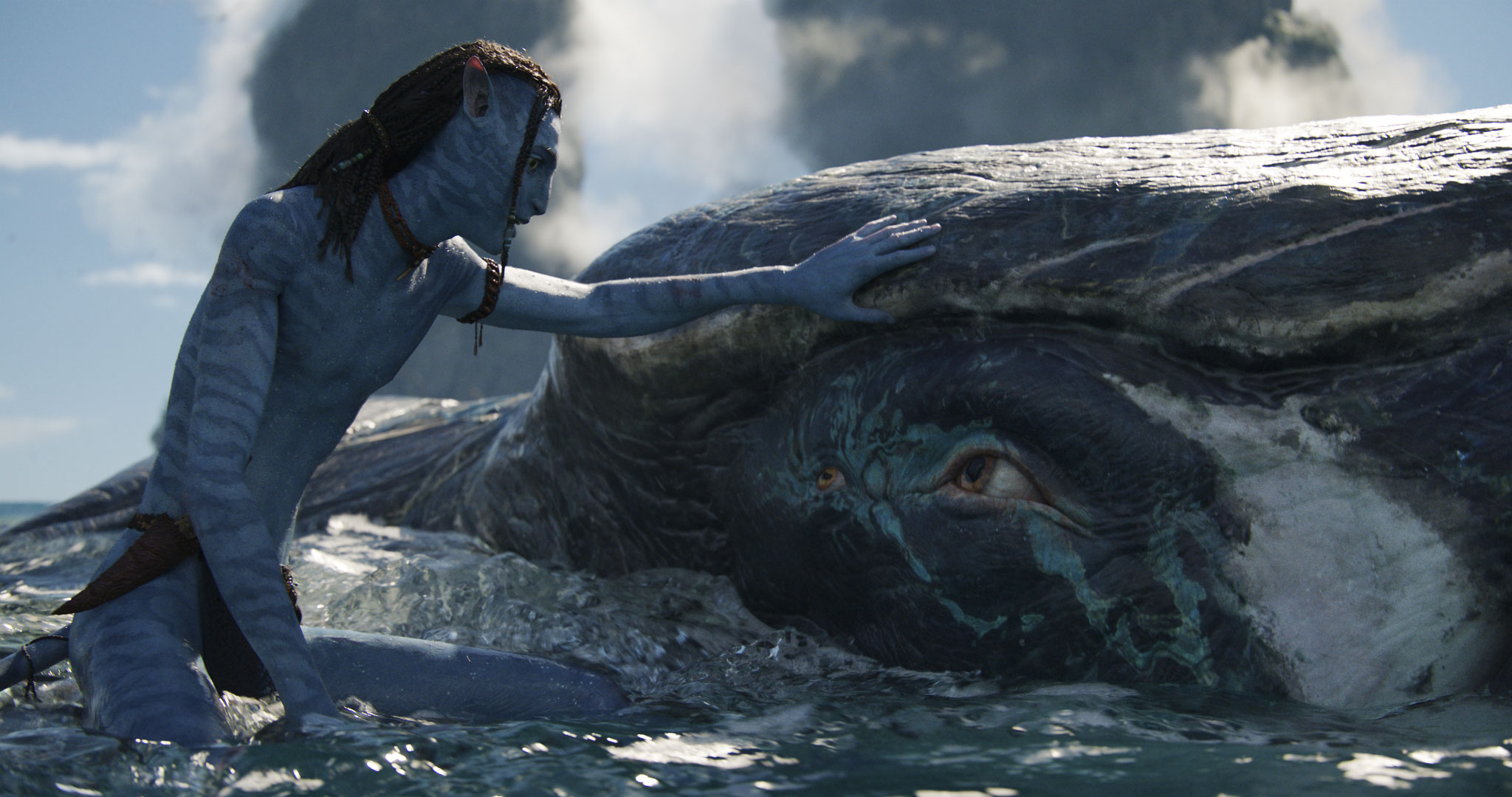
Avatar: The Way of Water

Spoiler-free!

It's been years since the original Avatar, and same goes for Jake Sully, who's formed a family and a comfortable way of life with the Na'vi. But the sky people return (surprise surprise) and a few of them are out for revenge (dun dun duun). The Avatar sequels were announced once the novelty of the original had worn off, when it was cool to trash James Cameron's space fantasy world. But this "unasked for" sequel has value which only its creator could have dreamed up—which is why it's good that he's the one telling this story and not your average cynical nitpicking filmgoer... like me.

There's nothing quite like a filmmaker who's excited about his own work.

The word that first comes to mind as I think about The Way of Water as a whole is "romantic." That might give the wrong idea, but it's the only word I have. James Cameron jumps back into the world of his own making, gushing—like a kid with a crush—hurrying to catch us up of the Sully family's life so he can bring them into a new sandbox to explore. He dutifully exposits about the status quo and sets up new characters, but despite the movie's 3-hour runtime, we get into the plot fast. He doesn't want to tell us any more than necessary, he wants to show us. To dig into the clay and sculpt and create. He has a storyteller's sensibilities and gleeful care for his story, and that excitement rubs off into every inch of the work.

That's why it's the first half of the second act that shines so well. This is the part we're all here for—the exploring of the world and culture of Pandora. It's especially fun because it focuses on the Sully kids character-wise. We get to know the second oldest, Lo'ak, as he befriends an outcast whale-like creature, and the older girl, Kiri, who's the adopted offspring of Sigourney Weaver's Avatar from the first movie. They don't explain exactly what happened there, leaving a little mystery to reveal in later sequels. She's a young teen, played by Sigourney Weaver, sulky insecure childishness and all. It must have been great fun for her. The magic of motion capture. The other new character standout for me was Spider—one of few exclusively human characters in the movie. He's a kid who "went native" and is always interacting with mo-cap characters—who are designed to be bigger than him. Another logistical and performance challenge. 

I don't care, I'll always enjoy the "making friends with animals" trope.

Despite the technology, the most impressive part for me is the worldbuilding. It reminds me of the little worlds I'd construct in my head as a child in a very specific way that I can't quite articulate. Contributing to the sense of romance? At any rate, the worldbuilding works so well because it's part of the story, not just the place in which the story takes place. Underwater exploration is accompanied with the Sully kids dipping their toes into the social hierarchy of their new peers and discovering their unique strengths. And Lo'ak's whale friend is not only vital to the plot, but serves as a character foil for him, and is introduced through a thrilling underwater attack sequence from what must be Pandora's only non-pacifist creature. At every turn, Cameron rewards our patience in sitting through 3 hours of his imagination brought to life, by using that imagination, and his skills as a filmmaker, to entertain us in return.

Even when the stakes rise and the third act rolls around, the imagination doesn't quell, and the inevitable sea battle had all the built-up character, stakes, and creative set-pieces in play to keep me from checking out as I so often do when a film's final battle starts up. Then things quiet and culminate in a more emotional, dramatic climax, which serves the theme over the movie's gleeful penchant for CGI explosions. I might say I'm surprised—that the movie won me over fast and never lost me to the end—but it's more that I'm relieved. More than relief even, it's rewarding my hope. I knew James Cameron was a filmmaker of the classic breed, but so many of his ilk have traded in their creative passion for an agenda. But no. He made a movie, and told a story. And he hits the beats of his medium with care and craftsmanship, not as a checklist around which to structure a pandering sermon.

This movie is proof then, that storytelling and movies aren't dead.

As time passes, the refreshed novelty may fade again, and I may come to see more of the flaws—which do exist here. Some was too melodramatically silly even for me to take seriously. But for me, Avatar has never been about being flawless, or high art. That's not what's valuable about it. Take away the motion-capture, the CGI, the blue people on an alien planet, and you have a simple story. The first one was about a broken man finding his place in the world. This one's about a father trying to keep his family together. Jake's world shrinks, but becomes more personal, and so feels huge. This sequel is rare in that way—it doesn't retread old ground. It adds to what came before. Not ignoring it. Not retconning it. Genuinely building onto it. Complementing it, and growing deeper. The original Avatar increases in value because of it, rather than being thrown aside to make way for the new. And room for further expansion sits out there, waiting.

I don't know where on Pandora James Cameron will go and explore next, but as long as he's in love with his world, I will be too. I can't help it. His reliable craftmanship, high imagination, and creative romance sweeps me up into the fantasy every time.

Tuesday, July 5, 2022

Top Gun: Maverick

Spoiler-free!

The phenomenon of Top Gun: Maverick isn't that it's an exceptionally good high quality summer blockbuster—it's simply that high quality summer blockbusters haven't existed for about five years. (And even then they were a dying breed.) Likewise, the magic of Top Gun: Maverick isn't that it's the greatest gap-sequel ever made—it's more that no other sequel made so many years later has ever been able to boast of having a worthy reason to exist.

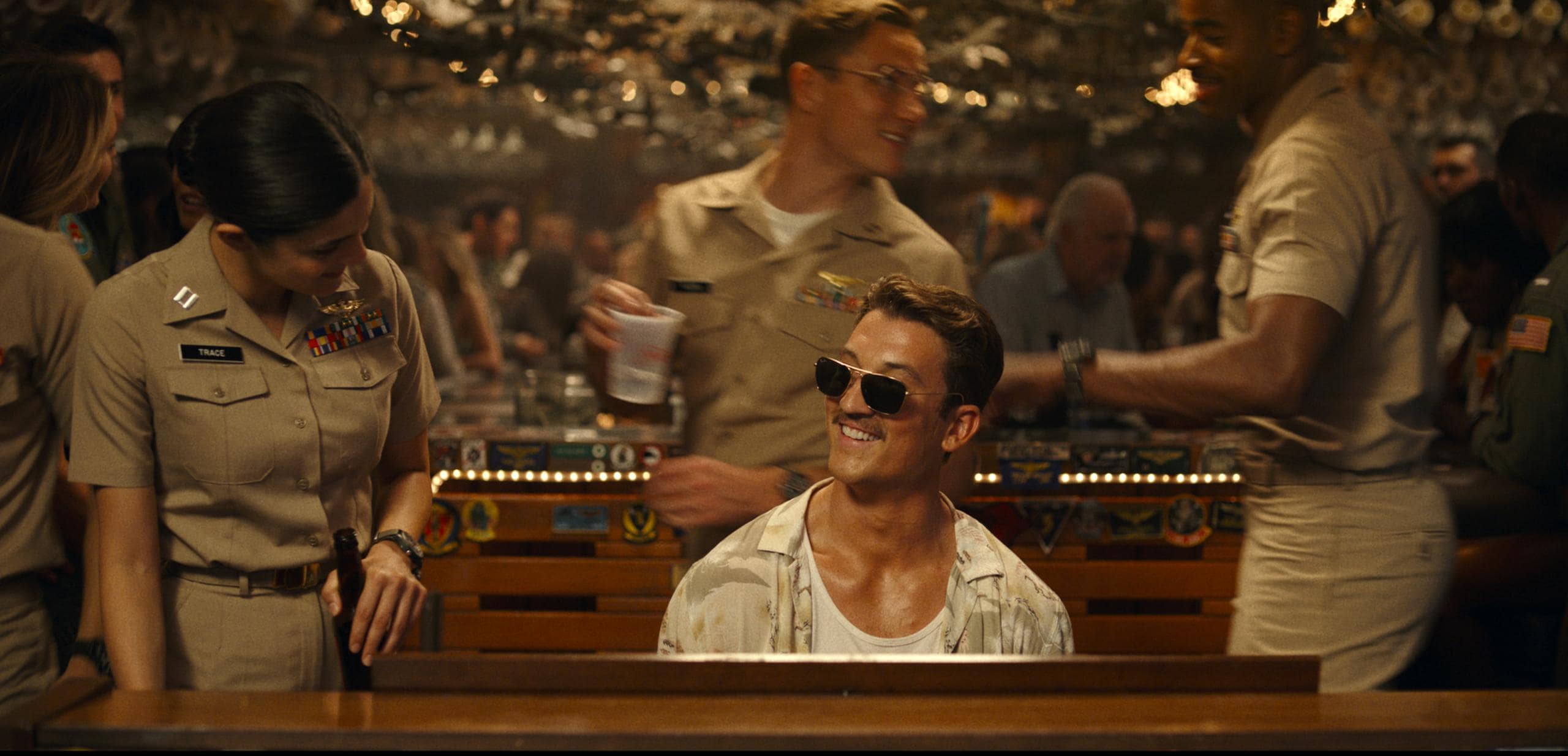
And yet here we are, our socks knocked off by another one of Tom Cruise's filmmaking efforts. He may be the last person making movies who actually cares whether his products are entertaining or not. Here, he returns as his original character, Pete Mitchell, callsign Maverick, assigned back to Top Gun to train an elite batch of aviators for a specific, daring, and possibly deadly mission. One candidate, callsign Rooster (Miles Teller) is the son of Maverick's old co-pilot who died in the first movie, and tension rises between them as Maverick struggles between his job of picking the best team to risk their lives on the mission, and his own personal mission of protecting his friend's son.

It's a pretty sweet set up, ripe for drama, but not so complex as to take away time from the entertainment of training exercises, which range from aerial dogfights to playing football on the beach. For a side plot, Maverick takes up a romance with a former flame, Jennifer Connelly, and before you know it, I was wishing Tom Cruise wasn't in the movie so much—because the one thing left unfulfilled is the dynamics between the candidates. The loose definition of their unique personalities made me wish for more. And then Hangman, the Iceman equivalent, and his antagonistic relationship with Rooster is rendered pointless by Rooster's more convincing antagonistic relationship to Maverick—but even that is put on hold for too long. When it comes due is when the movie starts to really shine.

I would have liked the movie to split time between Maverick's antics and what the candidates are up to when he's not around, but at the same time I get it. It's the Tom Cruise show because the film wouldn't exist without him. You can't begrudge him taking the spotlight, or deny that everything he does is entertaining. I just can't help but wonder if it would have been better had it been more balanced. Just a tad. In that light, it was the third act that sold the film for me. When everything comes to a head, and it starts to feel like an equal character match-up between Maverick and Rooster. This section also has most of the thrilling flying action (on which a Tom Cruise movie will never, ever skimp) and the most real stakes and tension as they take on the deadly mission.

The whole movie builds to this point, and it doesn't disappoint in any aspect. It has the realness that Cruise is known for to make you feel it—the thrill that can only come when there's also a notable lack of CGI. I got a big kick out of seeing the actors react while inside actual, actually flying fighter jets. And because everything was set up previously, the whole act is a neat series of payoff after payoff after payoff, each one more satisfying and rewarding than the last. Character drama and fun action mix together to splendid results, and an old-fashioned magic of storytelling comes to life. It's all so simple and won me over so easily that I wonder how the art was ever lost in the first place.


So, if Top Gun: Maverick is great and a phenomenon just because every other modern film is bad and worthless, that doesn't change the fact. It has the magic, and it is a phenomenon. It's dastardly entertaining in ways I thought films had forgotten to be. Not exceptional in the big picture, but certainly exceptional for its time. My hope is this: that this rare blockbuster isn't a throwback to good and entertaining movies at all—but the instigator of a resurgence.

Tuesday, May 3, 2022

Moonfall

Spoiler-free!

The master of cinematic destruction is back with another epic world-in-peril film, and it may be my favorite of them all! 

Though no one would accuse Roland Emmerich of making high art, what he does do is put a lot of effort and money into making big, entertaining blockbusters in his specific style. And that's what I love about this movie. It doesn't do anything by half measure. The Earth is under attack again—this time by the moon itself! Once its orbit begins to degrade it's only a matter of weeks before collision. Most of the world goes into panic mode, leaving it up to disgraced astronaut Patrick Wilson, his estranged work partner Halle Berry, and a crazy internet conspiracy theorist John Bradley (who turns out to be not-so-crazy, of course) to figure out how to save the day. 

The Moon gets really close to the Earth and it looks cool. What more could you ask for???

Meanwhile they have family issues to keep the characters grounded in a sort of relatable reality, so the stakes aren't too big for us to bother to care about. Wilson has his delinquent son (Charlie Plummer), ex-wife, and her new husband (Michael Peña!), and Berry has her ex-husband and their daughter—all left behind on earth to witness the catastrophe as the leads go into space to confront the alien problem. We've seen it all before, but I've never seen it work better than under Emmerich's direction. He shows us what we want to see. Or, at least, me. The thing that tickled me the most was how he used real and strange facts about the Moon to build his plot around. Like how it "rang like a bell" when Apollo 12 launched their descent module into it. Though the movie finds fantastic and unlikely reasons for these things, there's a genuine sense of mystery and wonder there.

Visually it was good enough that I now wish I'd bothered to see it on a big screen. The Moon being so close to the Earth of course provides a stunning visual. Elsewhere green screens are incredibly obvious. But elsewhere again, the alien design and space scenes have an obvious budget and effort put in. The family drama is fairly scant and cliché, but that's not to say bad, and one or two scenes and some dedicated line delivery from solid actors is all it needs to stick. Patrick Wilson was great casting and really sells the whole story. Then there's the general destruction. My least favorite part of disaster movies, funnily enough. There are a few interesting situations for the characters to navigate, plus plenty of floods, crumbling buildings, and those scenes where someone's using a white board to illustrate what horrors will occur next. It's really classic stuff.

I'm trying and failing to think of a way this movie could have been more enjoyable for me. 

And I guess that's why I got such a big kick out of it. It's classic. Not highbrow, but doesn't talk down to its audience either. It doesn't even bother to preach on woke topics, it just gleefully focuses on all it's cool ideas, with a sweet if small family-oriented center, and in that vein, does its own thing, and does it well. I know a lot of people are down on it, but I for one am not ready for the fun to be sapped out of all our movies. Completely uncynical, involving space, and family, and sacrificial love, cool in concept and awesome to look at—MOONFALL hits the spot and checks all the boxes for what I've been craving. Maybe it was made for me alone, but either way I can't help but give it an enthusiastic recommendation!

Thursday, March 10, 2022

The Batman

Spoilers

Director Matt Reeves promised us a detective Batman in a 90's grunge style noir setting, and cast the master of brooding and angst, Robert Pattinson, as his caped crusader. Well. I'm happy to report that he delivered on his promises. Nary a sliver of sunlight is seen in this movie. Gotham is looming all around, grimy and shining in the rain and harsh night lights. And the movie begins with Pattinson's early years Bruce Wayne delivering a cynical and brooding narration as he chooses which of many, many crimes he should spend his efforts on one Halloween night. The sequence caps off with the pent-up drone of Nirvana, and by then I was hooked and ready for anything.

If I have to turn off the lights in my den to see anything once I'm watching at home, it'll be worth it. This movie is dark and beautiful.

Two years into his crimefighting, this Bruce is still working out his place as a vigilante. He revels in the fact that even the idea or suggestion of his presence will repel even the pettiest of criminals. "They think I am hiding in the shadows," he says in his noir narration. "But I am the shadows." But a sense of futility is creeping in. No matter how much crime he stops, more evil is around the corner. Then—it's The Riddler's turn, played by Paul Dano with eager gusto. Appropriately, Riddler's goals are parallel with Bruce's. He begins to bring to light the corruption and scandal of wealthy and influential Gotham residents, but with the one significant difference from Batman, in that he kills them first. 

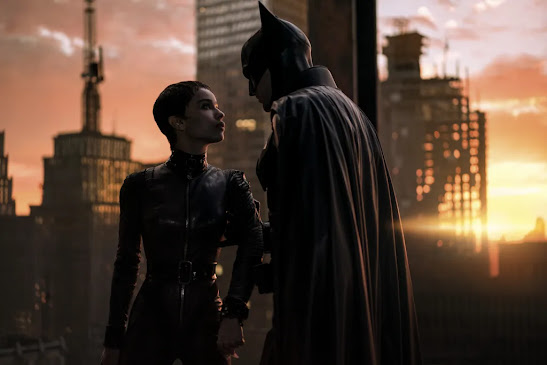
He leaves letters and clues for "The Batman" at his crime scenes, which Bruce dutifully follows with help from Gordon, (played with quiet intensity by Jeffery Wright) and Selina Kyle, (Zoe Kravitz, and the film's character highlight.) I loved the sequence where Selina and Bruce team up and infiltrate the club for information—a perfect amalgamation of noir and Batman sensibilities. But elsewhere, scenes that seem to want to mimic the disturbing factor that The Dark Knight did so eerily well played on my nerves here. The writing of Riddler's plan, motivations, and even characterization felt uninspired, as if the acting alone could carry this villain. They spend too much time on him, and the veneer begins to fall.

Besides Kravitz and Dano, (and the actor who claims to be Colin Farrell, which I'm still suspicious of) a general increase of facial emoting wouldn't have gone amiss. People feel things in noir stories, too.

Pattinson is the ideal choice for this iteration, but his performance feels restrained. Stoic Batman is fine, but I hope Bruce Wayne isn't left as a blank slate. They have a good start here. Grungy emo Bruce is different and fun in a dark way that fits the aesthetic, and I know Pattinson can dig into that—if the script and direction allows. Here, the writing keeps him one step behind the Riddler. Even when Riddler allows himself to be arrested, and even when his final plan is implemented, Batman seems there only to react, powerless to stop it. And that bothered me. I wanted Bruce's detective skills to matter to the plot. Or a satisfying moment of revelation where he "solves the case." But there isn't really, and for better or worse, it is done intentionally. 

Through his inability to stop Riddler, Bruce is forced to confront this mirror villain and consider what the difference between them is. Why doesn't Batman kill, if he's the same as Riddler in every other way? So Bruce's moment of revelation turns introspective as he realizes that the point of stopping crime isn't only about the crime itself, but to protect those against whom is the crime is being committed. At the beginning, when Batman beats up the gang of thugs with skeleton paint on their faces, their victim is every bit as afraid of Batman as they are, and Batman does nothing to dissuade his fear. But once he fails to stop Riddler's plan, he realizes it's not over, because there are still innocent people he can help. So he does. And that's what's important, and what makes him the hero rather than the villain.

The style, with bookends of narration and grunge music made me happy, but it still all comes down to character.

So even though I was hoping for a more satisfying mystery plot, and even though I tend to tune out emotionally when superhero movies resort to a city-level event for their final act, I do greatly appreciate this character arc which is beautifully minute. No massive, life-altering realization—just Bruce shifting his focus a little and seeing a ray of hope in the bleak and endless line of evil that's standing before him. I don't think this movie is perfect, but that's why I think I love it.

Sunday, January 2, 2022

Spider-Man: No Way Home

This review has SPOILERS concerning what characters appear in this movie. Plot-wise, it's spoiler-free. 

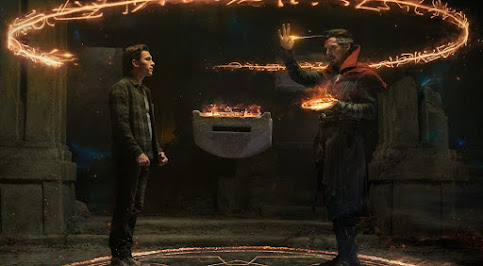
When the whole world is told that Peter Parker is Spider-Man, that doesn't turn out so well for Peter. But it's not until his best friend Ned and girlfriend MJ are tainted by association—rejected by MIT for reasons of "controversy"—that he decides to act. What he does, with help from Dr. Strange, doesn't turn out so well either. They open a rift in the multiverse, and people start filtering in who know that Peter Parker is Spider-Man. Strange, villainous people who Peter doesn't know. (But we do!)

Time for Peter to make some choices and mistakes of his own.

I've long been on the outs with the MCU. But I have maintained a hope (a faint and fading hope, as Gandalf would say) that Tom Holland could make a great Spider-Man under the right circumstances. So even though I'm not interested in the interconnected Marvel universe anymore, I wanted to continue giving Spider-Man a chance—and I'm glad I did. My favorite aspect of Homecoming was that director Jon Watts seemed to be working hard to keep Peter grounded, even through the over-sized stakes and "bigger is better" and "connect everything" worldview that the MCU brings. In this third installment, Watts connects things, makes it bigger, and ups the stakes like he's supposed to, but he also has reason to. He uses the required method to give me what I want—a Spider-Man that isn't under the thumb of the MCU.

At least, not as much. This story asks the question, "what does it REALLY mean, to be Spider-Man?" and then it answers it, by using past Sony Spider-Man's (Spider-Men?) Spider-Men as the standard to be measured by. Tobey Maguire and Andrew Garfield make real appearances, not just cameos, and they're treated with reverence and respect. Holland's Peter makes well-intentioned mistakes and tries his best and then learns from the Spider-Men that his good intentions and trying his best is the Spider-Man way. He learns that bad things happen despite his efforts but is encouraged by them to keep going, because "with great power comes great responsibility." And his efforts cease to be a joke or some fun side-gig where he gets his suits made by Iron-Man, his missions from Nick Fury, and team-mates from the famous Avengers roster. He grows into a full-fledged Spider-Man, and it's a little bit glorious. 

Holland has always been the best thing about this iteration. This movie aspires to be worthy of him.

The path taken to get him there... is a little bit messy. One by one the past hang-ups are put to rest. No more Stark glasses. No more voices inside suits. No more adults making decisions for Peter. No more villains whose real beefs are with Iron Man. No more double life. And with every step taken, the movie feels more and more like a classic Spidey film, and less like a Marvel drone. The jokes are funny sometimes. The characters are like real people, not awkward or unfunny on purpose. There are dramatic moments that aren't undercut by humor. There are humorous moments that have underlying pathos. There is an end goal throughout besides "make money with CGI." Gosh, even the more blatant fanservice moments didn't make me angry, because they were calling back to the old classics with genuine glee. 

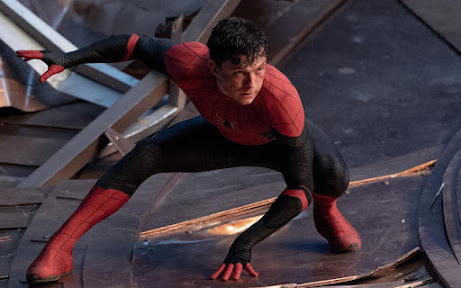
It feels messy because the movie is about cleaning up a mess—in the storyline, and in real life! The process is not streamlined. There are moments when it's a chore, but the end result is satisfying in the same way all things are when they're clean and used to be messy. And as the mess dwindles, we get a look at how Holland's Spidey works unencumbered. And he's fantastic. Peter uses his fast thinking in creative ways during the fights, and Holland's physicality plus the magic of modern effects and choreography make the action land in real and entertaining ways. And the character dynamics between him and his friends and family take on a more serious edge as he weighs the consequences of his actions and relationships. 

One of few MCU films that actually needs most of its 2 & 1/2 hour runtime. It's a big mess to clean.

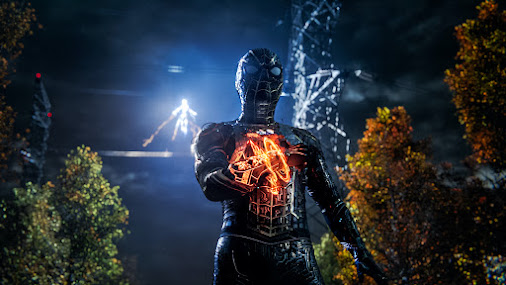
The returning villains weren't my favorite thing ever, but I appreciate that they were not turned into jokes (which was what my cynicism expected) and instead added real value to the story. Especially Alfred Molina's Doc Ock and Willem Dafoe's Goblin. Spider-Men Maguire and Garfield steal the show, so I'm glad they aren't in the whole thing. Most of the movie's best, most engaging emotion comes from them—maybe because of nostalgia, maybe not. All I know is they leave the current Spidey in a place I'd like to see more of. It feels like a set-up for a fresh start. One that already has a good cast in place, and has proved it understands the Spider-Man mantle better than past endeavors indicated, and is ready to take the character in some more conventional, classic, SPIDER-MAN directions. 

No Way Home is a messy, sprawling, fun, and ambitious film with a determined goal, real stakes, real consequences, and a real end result. It stops trying to reinvent the character and embraces what's always been this version's strengths, while bringing back some of the classic strengths of Spider-Man, as well. It has brought our friendly neighborhood Spider-Man back to his friendly neighborhood life.

Sunday, October 24, 2021

Dune

Spoiler-free!

The most immediate thought that springs to mind when I think of how to break down Denis Villeneuve's adaptation of Dune into something that can qualify how I recommend it, is that it's a movie for fans. It doesn't gatekeep; anyone can be a fan. But you must be willing to invest, and to pay attention. If it does its job right, it will bring the uninitiated into the fold, and endow satisfied customers with a desire for more—whether that comes in book form or in eagerness for a sequel. But no matter if you came as a fan, or are made into one by the experience, casual viewing is the riskiest way of journeying into Dune's vast, sandy landscape. 

I find it all a bit overwhelming even after reading the book and watching the '84 film (twice.) 

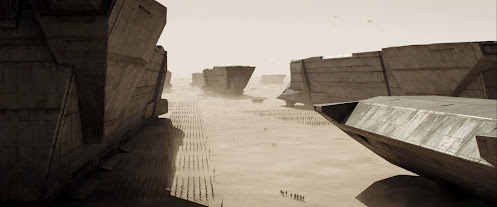
If you're not willing to invest the mental energy it takes to remember all the weird scifi names and terms, keep track of the medieval space politics, or care about characters who don't see their journey's end by the time the credits roll, then the only thing you're likely to get out of this film is a treat of big-budget visuals portraying the immense, looming and extreme fictional world. That alone is worth witnessing once, so I guess my recommendation is won. Still, with Villeneuve directing, great visuals were a shoo-in. My fear was that focus would be put on the wow-factor to the point where story and characters would suffer from boredom or pretentiousness. But no. Conversation drives the story, yet I wasn't bored for one second. And visual awe is turned up to the max, with dedication to relaying the character side of things keeping easily in stride.

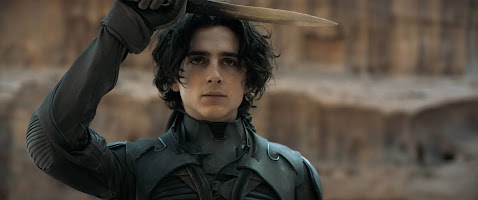
My biggest worry of all was the casting of indie darling Timothée Chalamet as the film's lead. I know he's an actor who actually puts stock into acting but there's no predicting my reaction to his roles and performances. And a Paul who comes across wrong is a fatal flaw. I was skeptical. But he proves to be a good casting choice, portraying an accurate Paul who is neither bland nor annoying. He reminded me of the book version and gives a lot, even through Villeneuve's style of preferring to film his characters still and stoic. Once I wasn't worried about the lead anymore, I knew I was in for something good, but the movie doesn't stop there.

Though it's giant, it's dedicated down to the details.

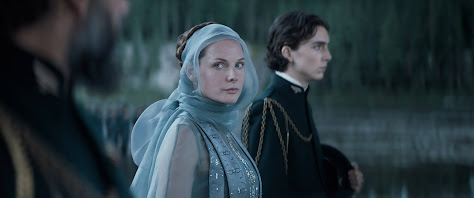
Rebecca Ferguson is a force as Lady Jessica, as she should be; everything always bubbling just under her surface, always strong; always on the edge of breaking down. She walks a beautiful line. From the outset she was my favorite casting decision and that holds. Her elegant but worn looks are perfect for the part. She's captivating. Oscar Isaac works in a role that's probably difficult to correctly balance. Stellan Skarsgård's ominously droll voice and face pairs with the intimidating character design of the villain to great effect. Jason Momoa is a surprise standout for me, his charismatic energy a welcome highlight against his subdued surroundings. Josh Brolin biding his time in my favorite book character; Javier Bardem is in full character acting mode; Zendaya has the right amount of grounded girlishness. Characters I confused with others in the book have clear personalities and outstanding looks to help differentiate. The cast is near-perfect.

The only cast member who doesn't fit into the subtle but refined vibe is Dave Bautista, whose character can be summed up as "angry" and who passively yells his lines to convey that single dimension. This is a small negative, though there aren't many more that could be called bigger. Mostly, I wished for more, though I realize that's an unreasonable ask considering the film is two and a half hours long. I wish they could have included the whole of the first book without cutting out anything or increasing the epic, steady pace (which felt to me like watching a massive river or flood flowing from a high distance—beautiful and serene even with the obvious turmoil and force on display). I think Villeneuve chose the lesser of the evils and I hope it pays off.

The scale conveyed is so enormous it's a little hard to grasp.

This is my personal favorite work from Villeneuve, though I have never considered myself a huge fan. Part of me knows his penchant for enormous scale, robust scifi worldbuilding, and calculated way of storytelling makes him ideal for trying such a difficult piece of adapting. At the same time, I've never been deeply moved by his work. And the same is true here. Seeing the scale of the world, and seeing the book transposed so cleanly to the screen, made me smile, but it didn't bring me to love the story or characters any more. The book didn't bring much emotional attachment either, so maybe it's simply not that kind of story. But a small part of me wonders if the neatness of the work, and the cool, stoic style, are holding me back from tipping from this pleased admiration into something more freely adoring.

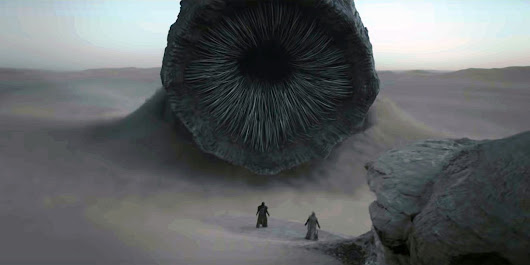
How much more astounding would this movie be if it could be everything it is, plus be wild, visceral, and psychedelic? Still, I don't want to complain. Dune had me smiling, enraptured, and dreading it ending—which it did far too soon. It was clearly thoughtfully adapted, keeping everything from the book it could while expanding it in some details, such as the vibrating, liquefying sand under the sandworms' attacks. I loved that. I loved the way The Voice is portrayed, as well as the way the book's heavy inner dialogue is adapted without the characters having literal inner dialogues. The plot was clear. The characters were given room to breathe and grow and the actors given opportunities to break out of the stoicism to have a bit of fun or bring extra intensity. And the special effects are so good I can't differentiate in-camera effects from CGI.

I don't care about fight or action scenes but there were several good ones of those, too.

I have a growing list of favorite scenes, moments, and little details, and have as much a desire to see this again (which I will, probably before I post this) as I do to see what the sequels have to hold. Dune is expansive, grand, and epic filmmaking on an unreal scale. An alien behemoth that can be approached from many angles, but my recommendation is simply that you let it sweep you along in its vast currents of sand to see the mesmerizing world it proudly and boldly puts on display for our appreciation. At the very, very least, it's an impressive and skillful craft of filmmaking.

Monday, October 11, 2021

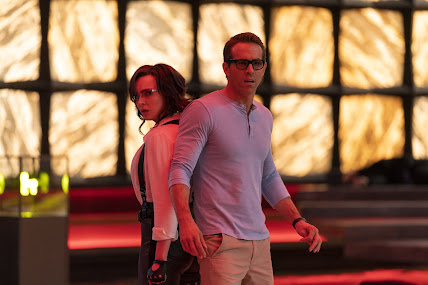
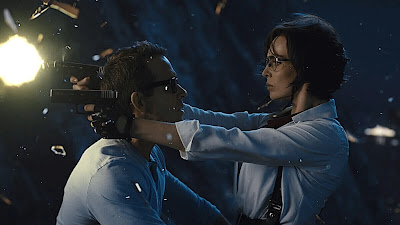
Free Guy

Spoiler-free!

What do you get when you remake The Truman Show but update it for modern day by adding elements of Ready Player One, and a bit of the Groundhog Day concept, and make Ryan Reynolds the lead?

You get a summer movie that actually feels like a summer movie.

Here's a shocker: this movie isn't two hours of Reynolds running around in a videogame world making quippy jokes. There's like, a story. And stakes. Remember those? There are characters who have goals, and an antagonist who's in their way. And they're the good guys because their goals are moral, and the antagonist is the bad guy because his goals are immoral, and the story is written so that we'll root for the good guys and have a satisfying sense of resolution if they succeed.

"No duh, Sarah, that's how movies work." Yep. It's weird. I wish I could say I wasn't starstruck by a mere coherent plotline, but here we are. And I know it's not only me. "It's deeper than I expected" is a popular comment on this film. Why? Because it has real-world characters too, with visible character arcs? Because there's an NPC in a videogame who gains self-awareness and freewill and that makes us consider what human value he has? Not exactly mind-blowing stuff here. And yet, it is. Because movies have been without basic things like moral standards, thought, or storytelling coherence for so long that we forgot how essential they are. There's a romantic subplot that's resolved for more reason than "the movie is ending now," and it felt earth-shatteringly original. 

Shawn Levy understands how to assemble a competent film. "Earth-shattering," he is not. Something else is up here.

While I appreciate that this movie returns to a certain filmmaking standard, that's not to say that it's automatically great. The spell only lasted during the runtime, and now I'm left to mull over how exceptionally sad it is that so little could feel like so much. Because sure, the movie feeds us what I've been craving, but in bites, not meal-sized portions. To say Free Guy puts in more effort than recent action-comedy flicks isn't saying anything, really. They have funny guy Ryan Reynolds at their disposal, and they let him do his thing. But too much so. More often it's more like they leave him—to ad-lib quips on top of normal scenes, instead of writing set-up and pay-off jokes for him to elevate. Most of the comedic scenes are not only unnecessary but totally humorless. (Hello Channing Tatum.)

They let Taika Waititi have fun too, and I liked hating the character. But did they think we wouldn't notice he was the bad guy unless they had him spell it out for us? "I love money, I want more money, I don't care about anything but money." We get it. A little subtlety wouldn't kill you, and would ring truer, even for an over-the-top character. And of course, they can't help but wedge in some political talking points, some that clash with the actual intent of the movie. I'd have cut 10-20 minutes from the runtime, mostly in cameos and people watching events from the real world. That got in the way. There are also three separate sequences that feel like the "final battle." One was expensive, one "funny," and one had narrative relevance. Guess which one I'd keep?

Even in action movies the last thing I care about is the action...

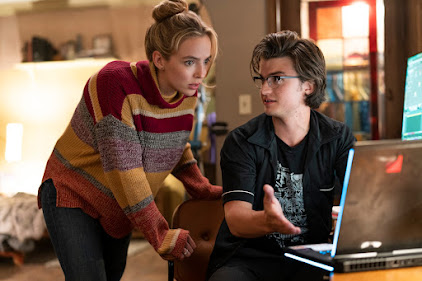
My favorite aspect was the real-people characters played by Jodie Comer and Joe Keery. They own the heart of the film, baby-sized as it is. Keery's relevance to the plot was especially a nice surprise. I was fully expecting him to be a side character meant for more jokes only. In fact, I wish there had been more real-life all around. Comer's character is even more essential on paper but doesn't feel it because we see her mostly in the game, where she lacks her real-world personality. We thought that Reynolds' star-power, the humor, and high concept actiony videogame fun was the point, but it's not, not really. It's dressing. Free Guy remembers that better than most, but not quite well enough.

Tuesday, September 7, 2021

Chaos Walking

Spoiler-free!

After two years on the shelf, Tom Holland and Daisy Ridley's team up to adapt yet another dystopian YA novel has seen the light of day. It's about a planet that makes men's thoughts appear as visible and audible fogs of color around their heads, called The Noise. And what happens when the first girl (Ridley) in Todd's (Holland) lifetime shows up, throwing their futuristic wild west town into, uh, chaos.

Actually, "Chaos Walking" is a pretty good description of the film itself. 

The YA dystopia phase was deftly put into its grave by the last effort of the Maze Runner series, The Death Cure, limping across the finish line before the race, as it were, was shut down for good. This film's producers, and director Doug Liman, though, didn't get the memo. Although to be fair they started shooting before The Death Cure was released. And it was probably wise of them to shelve it for a while, so people could forget how tired they were of the genre. Now, it feels like a throwback. Remember when Tom Holland was on top of the world? Remember when people thought Daisy Ridley might actually have a career? Remember when making a movie based on a series of books meant that sequels might get made? 

On one hand I feel like Chaos Walking would have been better off rotting on the shelf. On the other, I've always enjoyed these types of films, no matter how bad they get, and I was tickled by this flick every bit as much as I was annoyed. And boy, was I annoyed! You might be able to imagine how grating it'd be to constantly see and hear every thought of every person around you; if you watch this movie, you don't have to imagine anymore! I can't think of a better way to portray this gimmick myself, but I certainly wouldn't have tried to adapt it if this was my best solution. It's distracting. It's cluttering. It's rarely interesting, or useful. It just makes the thing a mess. I imagine it worked easily on page. I wish it had been considered more carefully in the planning stages of this film.

I feel like the story could have worked without it except for one big detail, but it is the main memorable aspect at the same time. Mostly it gets in the way. 

Besides that, the script reads a lot like you'd expect from a film banking on the success of the Maze Runner series. It's clearly a gutted version of its book counterpart, breezing over explanations and leaving confusion in its wake. All while never allowing scenes to breathe, settle, or be toned into something rich. It's action scenes and exposition scenes layered together. The action holds the most interest as they have a similar kinetic energy to The Maze Runner, and the world they take place in allows for a few creative set pieces. (I'm always on board for on-the-run adventures!) Often the exposition holds back too much, rendering itself unnecessary. Characters are cardboard-level quality, painted colorfully as a distraction. You can tell many of them served a purpose in the book—who can tell what that may have been from this.

It's the cast that does most of the leg work in selling the story. Tom Holland's try-hard attitude is admirable, but sheer willpower cannot make him become the character, Todd; he's always just Tom Holland, playing some kid in a movie. The action is his greater strength, and he sells that even harder. Daisy Ridley has literally nothing to work with in terms of character, but I don't imagine she'd have given it much more than a pretty face in an ugly wig making big eyes at everything anyway. Star Wars is over, and so is she. The supporting cast is a skilled bunch and though they don't try particularly hard, they bring out memorability in their characters. Mads Mikkelsen, Cynthia Erivo... Nick Jonas (Haha just kidding!) and particularly David Oyelowo, who's a wonderfully intimidating character that ends in underwhelming disappointment.

Clearly Tom's trying to prove himself as Nathan Drake here, but what's Daisy gunning for? Leeloo in some secret lumberjack remake of The Fifth Element?

And speaking of disappointment, that's what I was expecting from this movie, and little more. But the thing about disappointment is, you can't be disappointed unless there are hopes of good to be let down. Chaos Walking provides both the hope, and the potential, and then the disappointment in turn. I could easily dismiss it as a too-little-to-late addition to a dead genre and leave it at that, but the fact is I genuinely liked some of the bones beneath the chaos. And while that's a solid positive, it's sadly a positive that only results in deeper disappointment.

Sunday, July 4, 2021

The Tomorrow War

Spoiler-free!

Chris Pratt's first time producing a film is exactly the sort of movie we'd expect him to produce. It casts him as a nice but slightly malcontented suburban dad, wishing for a little bit more to life in the year 2022. Then people from 2051 show up, saying that they're losing a war with evil aliens in their time, and ask for help fighting them. It's not long before a worldwide draft is instituted... and we all know Pratt eventually gets his chance to "be more" as he wishes.

Wish granted! You get to risk your life to save humanity itself! Probably more than he had in mind...

This is a blockbuster flick, no doubt about it, and the movie is proud of that fact. But it's also a time-travel oriented scifi movie, and it takes pains to explain itself on those fronts. It includes neat details in its worldbuilding, like, the people who travel back in time are young (not born yet in 2022) and they only recruit people who die before 2051. Cuz, you know, the space-time continuum. It's explains its time-travel method succinctly, and it's not without holes and paradoxes, but the rules are clear, and that's all we ask for.

Scientific explanations breezed-through, the movie gets right into the action. It's about sending nearly-untrained civilians into battle with animalistic aliens that shoot spikes out of tentacles (not to mention their sharp teeth) so there's a lot of general mayhem, but fortunately Pratt's character served in the army before, so he takes the lead and is assigned a mission, which leads to more specific encounters catered to the movie's needs of plot-momentum, and memorable action set pieces. None of the action was outstanding, but the aliens were cool and frightening, and the characters fighting them weren't cardboard cutouts, so it did the job being entertaining.

Surprise surprise, stakes that are imbedded in the plot are more effective than tacked on ones!

I can take or leave action most of the time. Unless it's Tom Cruise doing impossible feats on screen, it's hard to impress me. But no matter the genre I always go in for characters. And it's been a while since a brazenly extra-buttered-popcorn blockbuster presented characters that I cared two straws about. It helps that Chris Pratt is Chris Pratt. His acting consists mostly of hamming dramatic looks for the camera, but his own genuine personality bleeds through so well that it works anyway. Next to him, Yvonne Strahovski and J.K. Simmons are good and fantastic actors respectively, and they bring their characters to life as well. Between the three of them (and Edwin Hodge who was good but needed more screen time) they imbed the action with stakes worth caring about.

It got to the end, and I really was leaning closer to the screen, wondering what was going to happen. Most of the plot was predictable—I'm proud of myself for calling one slight twist early on—but the way they do the predictable things were always fresh and unexpected. The predictability played into the traditional blockbuster feel. It had a Cowboys and Aliens vibe to me, another movie that knows how outlandish it's being, but still goes in 100% and makes it all work. The three-act structure is clean and by-the-book which I love to see in movies like this, and it doesn't fall apart in the final act. In fact, the final act was my favorite section of the movie altogether.

Sad that cliché has become a dirty word. I want to say this movie was cliché and mean it as a recommendation!

Every blockbuster should go out on a bang. Even if it drives home its message with a heavier, less nuanced hand, that's better than having no message, or having a pandering sermon instead of something uplifting. And pulling off a few clichéd maneuvers is infinitely preferable to robotically manufactured originality. This movie goes by an outdated playbook, and I couldn't be happier. There's heart, humor, characters with arcs, a plot that a human person with human feelings made up with their human imagination, and Chris Pratt lends his warm affability to the whole ordeal. A genuine blockbuster in 2021. Time travel is real after all!