Pages

Showing posts with label Fantasy. Show all posts

Wednesday, December 21, 2022

Avatar: The Way of Water

Spoiler-free!

It's been years since the original Avatar, and same goes for Jake Sully, who's formed a family and a comfortable way of life with the Na'vi. But the sky people return (surprise surprise) and a few of them are out for revenge (dun dun duun). The Avatar sequels were announced once the novelty of the original had worn off, when it was cool to trash James Cameron's space fantasy world. But this "unasked for" sequel has value which only its creator could have dreamed up—which is why it's good that he's the one telling this story and not your average cynical nitpicking filmgoer... like me.

There's nothing quite like a filmmaker who's excited about his own work.

The word that first comes to mind as I think about The Way of Water as a whole is "romantic." That might give the wrong idea, but it's the only word I have. James Cameron jumps back into the world of his own making, gushing—like a kid with a crush—hurrying to catch us up of the Sully family's life so he can bring them into a new sandbox to explore. He dutifully exposits about the status quo and sets up new characters, but despite the movie's 3-hour runtime, we get into the plot fast. He doesn't want to tell us any more than necessary, he wants to show us. To dig into the clay and sculpt and create. He has a storyteller's sensibilities and gleeful care for his story, and that excitement rubs off into every inch of the work.

That's why it's the first half of the second act that shines so well. This is the part we're all here for—the exploring of the world and culture of Pandora. It's especially fun because it focuses on the Sully kids character-wise. We get to know the second oldest, Lo'ak, as he befriends an outcast whale-like creature, and the older girl, Kiri, who's the adopted offspring of Sigourney Weaver's Avatar from the first movie. They don't explain exactly what happened there, leaving a little mystery to reveal in later sequels. She's a young teen, played by Sigourney Weaver, sulky insecure childishness and all. It must have been great fun for her. The magic of motion capture. The other new character standout for me was Spider—one of few exclusively human characters in the movie. He's a kid who "went native" and is always interacting with mo-cap characters—who are designed to be bigger than him. Another logistical and performance challenge. 
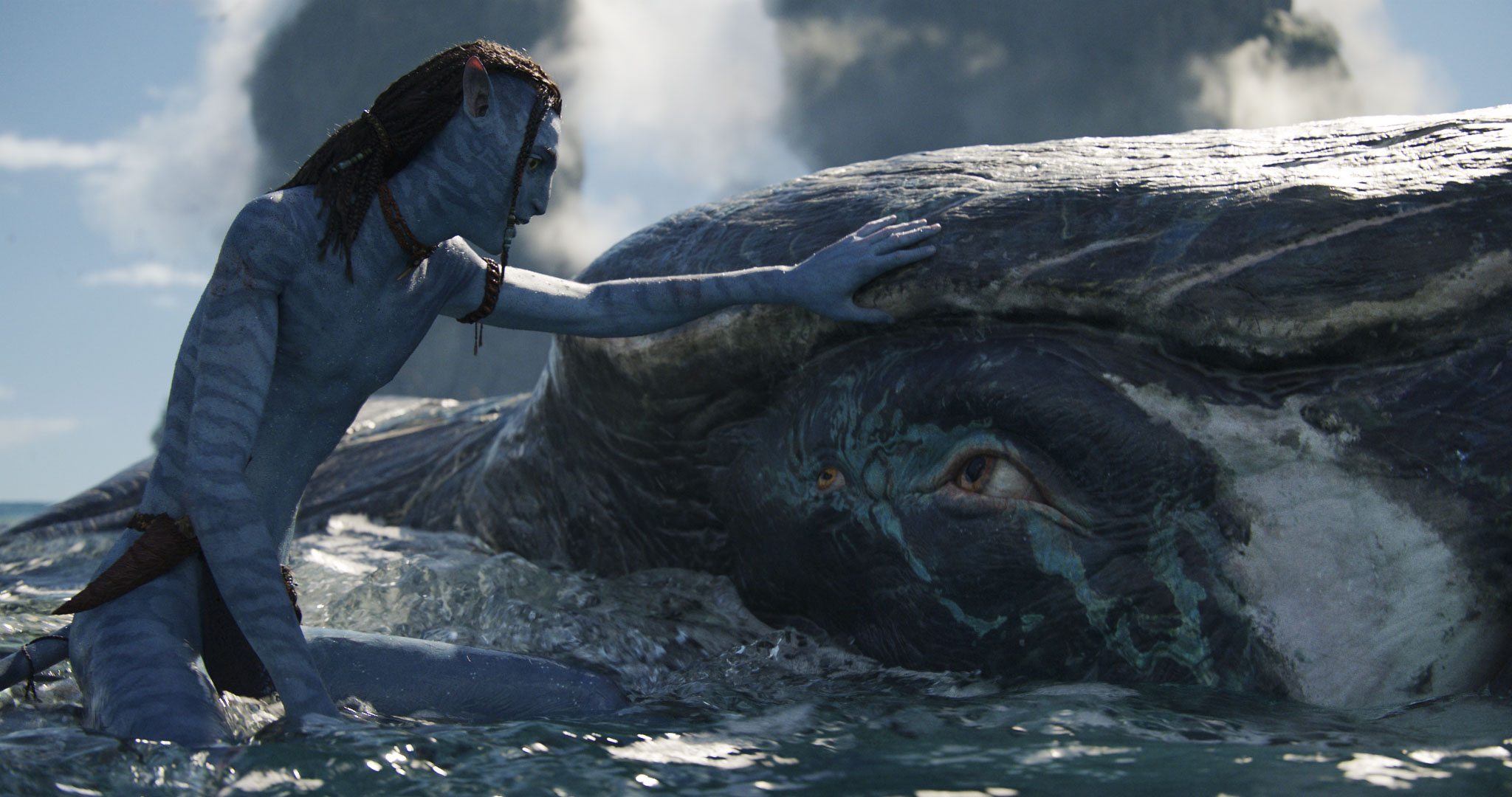
I don't care, I'll always enjoy the "making friends with animals" trope.

Despite the technology, the most impressive part for me is the worldbuilding. It reminds me of the little worlds I'd construct in my head as a child in a very specific way that I can't quite articulate. Contributing to the sense of romance? At any rate, the worldbuilding works so well because it's part of the story, not just the place in which the story takes place. Underwater exploration is accompanied with the Sully kids dipping their toes into the social hierarchy of their new peers and discovering their unique strengths. And Lo'ak's whale friend is not only vital to the plot, but serves as a character foil for him, and is introduced through a thrilling underwater attack sequence from what must be Pandora's only non-pacifist creature. At every turn, Cameron rewards our patience in sitting through 3 hours of his imagination brought to life, by using that imagination, and his skills as a filmmaker, to entertain us in return.

Even when the stakes rise and the third act rolls around, the imagination doesn't quell, and the inevitable sea battle had all the built-up character, stakes, and creative set-pieces in play to keep me from checking out as I so often do when a film's final battle starts up. Then things quiet and culminate in a more emotional, dramatic climax, which serves the theme over the movie's gleeful penchant for CGI explosions. I might say I'm surprised—that the movie won me over fast and never lost me to the end—but it's more that I'm relieved. More than relief even, it's rewarding my hope. I knew James Cameron was a filmmaker of the classic breed, but so many of his ilk have traded in their creative passion for an agenda. But no. He made a movie, and told a story. And he hits the beats of his medium with care and craftsmanship, not as a checklist around which to structure a pandering sermon.

This movie is proof then, that storytelling and movies aren't dead.

As time passes, the refreshed novelty may fade again, and I may come to see more of the flaws—which do exist here. Some was too melodramatically silly even for me to take seriously. But for me, Avatar has never been about being flawless, or high art. That's not what's valuable about it. Take away the motion-capture, the CGI, the blue people on an alien planet, and you have a simple story. The first one was about a broken man finding his place in the world. This one's about a father trying to keep his family together. Jake's world shrinks, but becomes more personal, and so feels huge. This sequel is rare in that way—it doesn't retread old ground. It adds to what came before. Not ignoring it. Not retconning it. Genuinely building onto it. Complementing it, and growing deeper. The original Avatar increases in value because of it, rather than being thrown aside to make way for the new. And room for further expansion sits out there, waiting.

I don't know where on Pandora James Cameron will go and explore next, but as long as he's in love with his world, I will be too. I can't help it. His reliable craftmanship, high imagination, and creative romance sweeps me up into the fantasy every time.

Friday, August 12, 2022

The Cursed

Not your grandad's werewolf story. Actually, it's more like your great-great grandad's werewolf story, and that's exactly what makes it stand out. Watching it, I could almost believe that it was adapted from some gothic horror story written in the late 1800's, when the story is set.

Sean Ellis wrote, directed, and did his own cinematography work. 

Originally titled Eight for Silver, referencing the old nursery rhyme, because silver naturally plays an important role. But changed to the more mundane The Cursed because the plot also heavily features a curse set on an old English estate by a band of gypsies who are murdered when they try to stake a claim on the land. The movie takes its time in getting started, establishing the Laurent family and showing the ill-advised murders in grisly detail, as well as the set of silver wolf's teeth a gypsy witch fashions for the curse. It's not until the children dig up the teeth and one of them gets bitten, subsequently disappearing, that the story's hero comes on scene—McBride, a pathologist, who has experience in these strange circumstances.

From there McBride drives the story, the setup so thorough and detailed that the plot glides along effortlessly on its strength. We know many beats of the story already; people will be attacked, the survivors changing too, until McBride closes in on the beast and discovers how to stop it. A classic in many ways. There's appeal in a classic story told well for me, but there's also a fresh appeal in this one's approach. Details of the creature design, origin and behavior which bring out the eerie and bleak style of horror. The character of the family involved. And most of all for me, the period setting, and location. The house, the village and the surrounding woods all make for a memorable, creepy, and gorgeous visual for the story to live in—a crucial element for gothic tales.

The imagery of the silver teeth was a great touch. There are many good details like that.

I have a soft spot for the sort of low-tech horror that happens here. Someone taking the time to load their muzzleloader rifle before firing an important shot brings the same sort of suspense as a modern-day scene wishes it could when it makes characters suddenly clumsy in their panic to load something that should take two seconds. The army takes days to arrive unlike modern cops, so there is no need to fabricate a reason why outside help doesn't come. Suddenly a single threat becomes so monstrous that you wonder how it will ever be dealt with. A great example of how less is more. Without having to overblow the horror element to get attention, the film has plenty of spare time to spend on character and lore development. 

While it's not my new favorite movie or anything, I'm at a loss for any significant flaw here. The one thing that comes to mind is that Boyd Holbrook isn't British, and that is apparent when he speaks next to his British castmates. He errs on the subtle side mostly which is smart, but sometimes he'll say something that just plain sounds wrong. I enjoy watching Holbrook far too much to care though. And as far as performance goes, everyone hits the spot. Besides the spotty accent, Holbrook feels every bit the gothic horror hero, balancing that simple and able determination of old-fashioned leads with the undercurrent of past wounds that keeps audiences engaged. Kelly Reilly's soft strength is perfect for the mother, as is complex coldness Alistair Petrie brings to the father. The children are excellent, and the supporting cast a vital and winning addition.

The daughter's old timey accent was flawless.

The slow, depressed gothic approach to the horror element won't be for people looking for a more intense, action-heavy, or scream-inducing horror experience, but it gets the tone exactly right for my tastes. It's the sort of movie you can dig into—and one that digs into you right back. The ending seals it all into a neat and emotionally resonate package, leading me to the observation that this is a story of singular vision; written, directed, and even shot by the same man. And with minimal interference, his vision comes through with deft skill and purposeful heart. I would praise it for that even if I didn't find much personal worth in the story itself. The Cursed or Eight for Silver, whatever it is called, this monster movie of old-fashioned sensibilities is worth seeking out.

Monday, May 9, 2022

The King's Daughter

Some spoilers. 

I swear there's a good movie in here somewhere. The question is, does the lack of it even matter? 

It's about a French girl (Kaya Scodelario) in the 1600's who's taken from her monastery home to live in King Louis XIV's palace, unaware that she's his daughter. She loves music so when she hears a strange song at night, she follows it to an underground pool where a mermaid is being held captive, waiting on an eclipse so she can be sacrificed to give the King eternal life. The girl befriends the mermaid, as well as the handsome sailor (Benjamin Walker) who caught her, and a predictable series of romantic adventure ensues.

It certainly is... special.

Except the movie is quite a mess, and those appealing ideas of fairytale romance and adventure get a little buried in the jumble. The movie spends more time with the plotting King (Pierce Brosnan) his Priest (William Hurt) and the "scientist" who's going to kill the mermaid for him. They spend a lot of time bickering about God and science, or rambling about nothing much at all. Then there's the drama between the King and the girl as he doesn't tell her she's his daughter but hires her to play music for him outside his window every morning, and then once he tells her he immediately tries to merry her off to some simpering duke, which doesn't go over well of course but doesn't really go anywhere plot-wise either except to make her realize he's not so great a dad. 

It's like the movie understood what kind of tropes would be appealing, but had no idea how to actually use them. I loved the idea of her being engaged to a bad guy while falling in love with the sailor, but we never get to see the tension and conflict that situation should raise. I don't think she even sees the duke while knowing their marriage is arranged. And the sailor only finds out about it a minute before it's not an issue anymore. The movie touches on so many tropes that I enjoy that I wasn't disappointed, but it seems to have cinematic ADHD, hoping to and fro whatever topic pops into its head in real time. Scenes end abruptly, or cut in and out without apparent reason, and don't have the stamina to find the compelling content they're obviously searching for.

Fun fact, these two are married irl, and they met filming this movie, in... *checks notes* 2014?? It was released this year, so that's 8 years on the shelf. Wild.

If I were the actors involved, I'd probably wish it had stayed on the shelf. It's a bit embarrassing. But as a movie fan, I'm glad it was released, even with all the weirdness. Brosnan and Hurt phone in their stuff, but I'm not mad about it. There's nothing in the script that's worth getting worked up for and they're entertaining without trying. Scodelario tries, bless her, but her efforts only made me laugh when paired with the clunky lines she's trying to convey. Benjamin Walker's character is very much a K-Mart brand Will Turner but still somehow manages to be halfway dashing. The cheesy romance was probably the best aspect simply because cheesy romance increases in value the cheesier it gets. Still, I can't help but think there was a path here for something a step above—more real character development over empty platitudes to give the cheese a foundation on which to thrive.

The tropey appeal cannot overcome the mess. It's badly written, badly cobbled together with bad performances, laughably modern costumes, cheap CGI, and a smattering of sweeping wonder. I enjoyed it all, but only because swashbuckling fairytales like this barely exist at all—let alone in any better realm of quality.

Tuesday, September 7, 2021

Chaos Walking

Spoiler-free!

After two years on the shelf, Tom Holland and Daisy Ridley's team up to adapt yet another dystopian YA novel has seen the light of day. It's about a planet that makes men's thoughts appear as visible and audible fogs of color around their heads, called The Noise. And what happens when the first girl (Ridley) in Todd's (Holland) lifetime shows up, throwing their futuristic wild west town into, uh, chaos.

Actually, "Chaos Walking" is a pretty good description of the film itself. 

The YA dystopia phase was deftly put into its grave by the last effort of the Maze Runner series, The Death Cure, limping across the finish line before the race, as it were, was shut down for good. This film's producers, and director Doug Liman, though, didn't get the memo. Although to be fair they started shooting before The Death Cure was released. And it was probably wise of them to shelve it for a while, so people could forget how tired they were of the genre. Now, it feels like a throwback. Remember when Tom Holland was on top of the world? Remember when people thought Daisy Ridley might actually have a career? Remember when making a movie based on a series of books meant that sequels might get made? 

On one hand I feel like Chaos Walking would have been better off rotting on the shelf. On the other, I've always enjoyed these types of films, no matter how bad they get, and I was tickled by this flick every bit as much as I was annoyed. And boy, was I annoyed! You might be able to imagine how grating it'd be to constantly see and hear every thought of every person around you; if you watch this movie, you don't have to imagine anymore! I can't think of a better way to portray this gimmick myself, but I certainly wouldn't have tried to adapt it if this was my best solution. It's distracting. It's cluttering. It's rarely interesting, or useful. It just makes the thing a mess. I imagine it worked easily on page. I wish it had been considered more carefully in the planning stages of this film.

I feel like the story could have worked without it except for one big detail, but it is the main memorable aspect at the same time. Mostly it gets in the way. 

Besides that, the script reads a lot like you'd expect from a film banking on the success of the Maze Runner series. It's clearly a gutted version of its book counterpart, breezing over explanations and leaving confusion in its wake. All while never allowing scenes to breathe, settle, or be toned into something rich. It's action scenes and exposition scenes layered together. The action holds the most interest as they have a similar kinetic energy to The Maze Runner, and the world they take place in allows for a few creative set pieces. (I'm always on board for on-the-run adventures!) Often the exposition holds back too much, rendering itself unnecessary. Characters are cardboard-level quality, painted colorfully as a distraction. You can tell many of them served a purpose in the book—who can tell what that may have been from this.

It's the cast that does most of the leg work in selling the story. Tom Holland's try-hard attitude is admirable, but sheer willpower cannot make him become the character, Todd; he's always just Tom Holland, playing some kid in a movie. The action is his greater strength, and he sells that even harder. Daisy Ridley has literally nothing to work with in terms of character, but I don't imagine she'd have given it much more than a pretty face in an ugly wig making big eyes at everything anyway. Star Wars is over, and so is she. The supporting cast is a skilled bunch and though they don't try particularly hard, they bring out memorability in their characters. Mads Mikkelsen, Cynthia Erivo... Nick Jonas (Haha just kidding!) and particularly David Oyelowo, who's a wonderfully intimidating character that ends in underwhelming disappointment.

Clearly Tom's trying to prove himself as Nathan Drake here, but what's Daisy gunning for? Leeloo in some secret lumberjack remake of The Fifth Element?

And speaking of disappointment, that's what I was expecting from this movie, and little more. But the thing about disappointment is, you can't be disappointed unless there are hopes of good to be let down. Chaos Walking provides both the hope, and the potential, and then the disappointment in turn. I could easily dismiss it as a too-little-to-late addition to a dead genre and leave it at that, but the fact is I genuinely liked some of the bones beneath the chaos. And while that's a solid positive, it's sadly a positive that only results in deeper disappointment.

Sunday, July 12, 2020

The Old Guard

Spoiler-free!

A group of immortals, (Charlize Theron, Matthias Schoenaerts, Marwan Kenzari, and Luca Marinelli) whose bodies heal themselves from any injury, go around the world and get themselves in dangerous situations in the two-fold hope that they'll do some good in the world... and that maybe someday they'll die.

If that sounds like an interesting, exciting flick to you, then I'm sorry to report: that isn't what actually happens in the movie. That is the premise of the characters' existence, only. The plot of the movie is that a new immortal (KiKi Layne) becomes known to them in a vision directly after they mess up on one of those said missions and get some bad guys on their tail. (Chiwetel Ejiofor, Harry Melling) They have to find and recruit her to their ranks before facing down the baddies who want to study them for a cure for death.

My one hope was that it'd be better than Bloodshot. No dice.

Even that sounds more exciting than the movie winds up being. It's Deadpool without the comedy, and half the action. It's a long series of droning conversations about things that are more ambiguous than deep, inter-cut occasionally with quota-filling fight scenes that do nothing to drive the plot forward. Sometimes action happens off screen, then when the character who witnessed it relates the event to the others, the movie flashes back so we can see it, too. It's desperate to put in as much action as possible, but it can't keep itself from those meaningless conversations in which people who are hundreds of years old act like whiny children, cynical of their own existence.

There really aren't any positive sides to it for me, but if you tend to enjoy action -- fight scenes with hands, guns, and swords kind of stuff, complete with improbable choreography -- then this movie does have that going for it. Shaky cam has finally, and thankfully, died, so you can see what's going on in the film, and none of the set pieces are too extravagant to need an excess of CGI. A good thing, because the CGI isn't great. (when is it ever?) Still, the fights aren't particularly exciting, filmed typically, and without stakes in the narrative to back it up.

They spend the whole movie telling us why we should care, and never give us a reason to.

The film opens on the group complaining, and arguing over whether they should take another "case", which made me instantly not care about them. There's only four yet they're developed so shallowly. Charlize is the whiny leader, Matthias is handsome, and the other two are gay. (And Marwan was Jafar in that awful live action Aladdin!) That's it. The new girl isn't better developed, but she starts off on a good, likable foot. She's a marine who's killed in action, and once she wakes up, the confused reaction and mistrust from her unit is the most compelling slice of story the film has to offer. I wish they'd focused the story down to her.

Instead they fight nonthreatening or uncommitted bad guys (or their red-shirt henchmen with laughably bad training) until the plot is resolved because enough people have been killed to render it inert. And the new group goes off again, to do their thing of exotic locations and extreme, daring, dangerous missions for the good of mankind. Wouldn't that have been nice to see. Clearly a sequel is desired. But now we've been disappointed and bored out of wanting one.

Monday, April 6, 2020

Onward

Spoiler-free!

In a fantasy realm where magic had faded from popular existence, two elf brothers, Barley and Ian, get a present from their father, who died before Ian was born. In the package, a wizard staff, a Phoenix Gem, and instructions for a spell -- a spell that will bring their dad back for 24 hours. Barley is a history buff and obsessed with magic, but it's Ian who makes the spell work... well, halfway. The gem explodes and their dad is just a pair of khakis, so the boys set out on a quest to find another Phoenix Gem and finish the spell before their time is up.

DID SOMEONE SAY "QUEST"??? SIGN ME UP.

I've been tired of Disney Pixar for about ten years, so it's about time for a revival! I knew the moment I saw the poster -- where high fantasy is blended with urban fantasy -- that I had a great chance of loving it, and I was right. Even if the story wasn't great I would have still enjoyed the distinctly fantasy world building, down to things like small dragons kept as pets instead of dogs, Valor being a van model, and angry fairies in motorcycle gangs eating Pixy Stix by the straw-full. That stuff was creative and fun, and the exact kind of attention to detail that I love to see in Pixar, but this is, in my opinion, the best Pixar fare since 2008, and has more working for it than an exciting and fleshed-out world.

Tom Holland plays Ian, and Barley is Chris Pratt. Two charming and talented actors, and their characters are the main reason this film works as well as it does. The way they're written and played. Pratt has first-rate hilarious line-delivery, and if anyone can make awkwardness likable, it's Tom Holland. The way the two characters' personalities clash and complement each other is heavenly, and you get lost in their easy conversations, whether they're arguing, having fun, in the middle of action, or anything in between. Ian is the main protagonist, and he makes a check list of things he wants to improve about himself.  Then, each stop along their quest pushes him unaware toward his goal.

I found it pleasantly predictable in many ways, but it had some wonderfully unexpected moments too, when it needed them.

And Barley could have easily fallen into the comic relief character trap (considering how effortlessly hilarious he is) but instead the character is fleshed out in some unexpectedly mature ways. He seems like the kind of guy that doesn't take anything seriously, but then there's the bridge scene -- or the hilariously epic "Rise to Valhalla" moment -- where his seriousness is truly serious, but still funny. Humor isn't something you turn on when it's comedy time and off when it's serious time. He's just genuine, and therefore can be both. And that's how the whole film is. It never announces it's time to switch gears; it's a constant flow of adventure, with all the ups and downs it needs present, but not showcased or ballooned to unnatural proportions.

Pixar has finally come up with an original story that appeals to me as an adult. Sure, it's still a kiddie film, not intellectually complex, and follows a basic and straightforward story structure, but every beat it hits is earned. It got a toe in the door with the fantasy world, then swept me up for the ride in a way I haven't allowed myself to go on with Pixar since Toy Story 3 introduced me to the gross feel of emotional manipulation. But Onward feels right in every way: The quest-style structure of little adventure vignettes built on top of each other... the way every detail is set up for later but not in an obvious way... a conflict that comes naturally from the core of the characters -- and a resolution that hits home because the story speaks for itself and doesn't need to be forced.

I see people dismiss it as "B-tier Pixar" and wonder when they forgot to value stories for the joy they bring.

I'm happy to know Pixar is still capable of winning storytelling along with its usual features of unique premises and beautiful animation. Onward is everything a great and worthy adventure should be -- full of Heart's Fire, you might say; and light, charming humor; and warm characters; and sweeping glorious fun; and inspired world building. And no, perhaps it won't appeal to everyone as strongly as it does me. But that, I think, is the great thing about Pixar. At their best, they send risky, niche stories out into the wild, and every once in a while, we wind up with something magical.

Thursday, September 19, 2019

It Chapter Two

Spoiler-free!

What's more likely to be a great movie -- one that ends with the characters making a promise to return and fight the evil again whenever it may return, or one in which all they do is make good on that promise?

Directed, once again, by Andy Muschietti.

Given that Chapter Two and Chapter One come from the same singular book, Chapter Two has no real right to feel so much like a sequel. Ideally it should have a "Part 2" flavor. If the filmmakers knew how successful Chapter One would be, I bet they would have filmed both parts at once. Then the de-aging of the child actors wouldn't have been necessary, and the story could have been developed to flow better between the two films. As it is, the two parts feel out of sync with each other. One being bigger in size, and the other more compact yet weighty with substance.

Much like what happened with Season 2 of Stranger Things, this sequel is painfully aware of the wild success of its predecessor. You can see it in the kids' performances, who are much less organic here. Like they're putting on a show for an audience instead of digging into honesty and stretching their acting chops. And while the adults don't come across that way at all, their script does it for them on occasion, with throwaway callback lines. Such as when they go in the well house and Bev dryly proclaims, "Beep beep, Richie." Another thing the adults have going for them; they're way better at delivering comedy.

As a result, the adult's version feels lighter in tone.

Laughs came freely; as for scares, it hit Not Scary At All for me. They tried to match scary-levels with Chapter One, but the method degraded slightly; there are a lot -- and I mean a lot of jump-scare moments. And every single one of them follows the exact same pattern. 1. Thing might be scary. 2. Thing is maybe not so scary after all. 3. Pause pause pause... 4. THING IS SCARY! Inevitably, the thing morphs into CGI, half the time with aspects of Pennywise's face pasted on it. I actually prefer when horror film don't scare me, but it does bother me that so much time was spent of these ultimately useless moments.

From my perspective "scary" is a lot less important than simply "effective." And the only times these moments were effective is when it led to an actual kill. Those are the ones that take their time to craft the creepiness and the dread. The most effective part of the movie was waiting for a jump scare while the camera lingered on Bill Skarsgård, motionless, drooling, his one eye pointing out to the side. No CGI, just an effective performance, given time to breathe and settle before it bursts. Other horror elements were more varying degrees of cool, or neat, or messed-up, which works fine for me. Overcrowding and rushing were the problems there.

But casting was a resounding win!

I think it's universally acknowledged that the casting here is pitch perfect. Even the well-known actors, Jessica Chastain, James McAvoy, and Bill Hader are fantastically spot-on. Isaiah Mustafa, Jay Ryan, James Ransone, and Andy Bean were clearly cast more for their accurate appearances, but also deliver wonderfully on the performance side. Hader steals almost too many scenes, and my favorite was Ransone as Eddie. The best scene in the whole movie was their meeting up and having dinner. Their reactions to seeing each other again and how the nail the same feel and dynamic their kid counterparts did.

A better version of this film is out in the cosmos somewhere. I don't know how it works, but it likely required at least some changes to the first movie. It's a hefty story to swing in just two movies, so one great film and one slightly less-so isn't a disappointing result, especially if you consider less pleasant alternatives. This two-part series avoided disaster by breaking up repetitive material with elevating moments from a brilliant cast, and regular interludes of real, fascinating, quality content. My only real regret is that Chapter One ended in a more satisfying and thematically potent way.

No more floating, but I sure do hope Bill Skarsgård gets all the roles he could wish for after this!

The best ending of a series ideally belongs at the very end. But I loved Chapter One as is, so if that movie's greatness required this one to fall slightly short, I'll take it and be happy. Since this continuation isn't necessary to get a complete and satisfying story, there's no harm done either way. It Chapter Two is like the cherry on top of a giant sundae, or a red balloon in the hand of a clown; it doesn't add much in terms of substance, but it sure does complete the picture nicely.

Friday, June 7, 2019

The Ash Lad: In the Hall of the Mountain King

Spoiler-free!

In a fairytale kingdom, there is a legend: if the princess doesn't marry by her 18th birthday, a troll will steal her and make her marry him. Well, the headstrong princess, Kristin (Eili Harboe), doesn't want to marry. And no one believes the legend anyway. With a pompous idiot Prince Fredrik (Allan Hyde) as her only option, she runs away. In the forest, she runs into Espen (Vebjørn Enger) and he gives her food. When he goes home to his father and brothers Per (Mads Sjøgård Pettersen) and Pål (Elias Holmen Sørensen) with all the food eaten, we learn that he has a bad habit of being unable or unwilling to get anything done. His family leaves him home alone while they go hunting, and by morning the house has burned down. Oops.

About time I found another gem in the less-explored corners of Amazon Prime!

Then the pompous Prince Fredrik comes by asking if anyone's seen a beautiful girl. The king has offered a reward for her rescue: her hand, and half the kingdom to rule. Espen's father sends Per and PÃ¥l to search for her -- it's their only hope of saving their farm -- and he tells Espen to go and never come back. But Espen knows the girl he met was the princess. He thinks he can find her, and if he saves the farm, perhaps his father will forgive him for burning down the house; for being an Ash Lad. So, he sets off after his bothers, determined to do something for once, and determined not to mess it up. Grand and fantastic adventures ensue.

In a way it's very comparable with The Voyage of the Dawn Treader. And more the book than the film adaptation. Though there's no sailing, there's a similar fantasy flavor, and the adventures are done in little vignettes where the brothers get into a situation, get out, and then get into another. And they all have that exclusive fairytale quality -- helping an old woman whose long nose is stuck in the crack of a chopping block -- escaping enchantments -- finding a magical sword -- and map -- and of course dealing with Prince Fredrik. Eventually shifting into troll territory in the third act. Throughout, the brothers' relationship is explored as Per doubts Espen's ability. Slowly, he proves himself.

Turns out he's a pretty great adventurer!

That was the main highlight of the movie for me. Much of the traditionally styled plot you can see coming, but their dynamic propelled the whole story. Stories with that extra effort are great by themselves, and this movie couldn't have been the gem it is without that meaningful personal side. But in the end, if the surrounding world of production doesn't work, neither will the story, and it's the winning combination of those two sides that makes this flick worth its praise. The performances are entertaining and energetic, making the characters easy to love or hate (depending on intent), and the world is beautiful; saturated richly, and filmed on locations to give a sprawling sense of adventure.

The troll is kept hidden mostly but not in a blatant, we-don't-have-enough-money-to-show-it kind of way. The effects on it are noticeably CGI, but not any worse than, say, the giants in Jack the Giant Slayer, and the troll design has more personality, too, not looking like a mass of flat brown lumps. In short, this movie is made of good quality material. No, it's not a multi-million-dollar Disney project, but all that means is it doesn't look flat and dull or have its heart and soul green-screened out. Visually this movie is wonderful; bright and lovely, not flashy or overdone, just as real as possible. I love that. And ja, it's in Norwegian. I love that, too.

I found it in December but couldn't watch it until Amazon added an original, non-dubbed version. 

They just don't make satisfying fantasy films in America anymore. They're all scifi without the science, not magic and myths, or are too serious, or real-world, or trying to reinvent the genre. I've been feeling a horrible deficiency of highly adventurous fantasy -- the kind of fantasy that soars, and transports you, pure and clean and with a heartfelt message on the side -- and The Ash Lad fills that void to perfection. A grand, magical, and uplifting adventure.

And there's a sequel coming! I have no idea when it'll be available to me, but I anticipate the day with glee.

Thursday, June 6, 2019

Godzilla: King of the Monsters

Spoiler-free!

In this sequel to the 2014 Godzilla, the King is back -- here to protect the Earth yet again by fighting off even more Titans (giant monsters sleeping under the Earth). The human side is filled with the returning cast of Sally Hawkins and Ken Watanabe's scientists, and new faces in Bradley Whitford, Charles Dance, and Ziyi Zhang, and a new starring central family in Kyle Chandler, Vera Farmiga, and Millie Bobby Brown.

That roar = fingernails on a chalkboard x 1000. My ears are still ringing.

I would like to say that it doesn't matter what the humans are up to because we have epic monster battles to get to, but that isn't true. And I'd like to say that the apocalyptic rampaging is insignificant compared to the heart of the matter which is the human characters and their personal struggles -- but I can't say that either. This movie is a mixture, and both sides suffer for it. There's more of the monsters this time than in 2014, and that takes away from replicating the calculated character journeys, but they couldn't do away with the humans altogether, so their side is focused on often, though in a more going-through-the-motions, shorthanded style to allow for more destruction.

I always want to care more for the human characters in movies, and I did care for the central family here. They had a complex dynamic on page but the longer the film went on, the more plot holes opened up and began leaking soul everywhere. In the end they hang on but only just; and I liked the characters less in the end than in the beginning. I really wanted to like Kyle Chandler, doing his usual Distant Dad Who Cares bit, but so much of the significant actions are given to everyone else surrounding him. It makes sense when they're technically more capable, but if there was a human lead, he was it, and he got to be heroic in only one instance.

He was also in King Kong (2005) and this movie is in the same universe as Kong: Skull Island. Idk why I think that's cool.

Vera Farmiga got most of the character arcing, but her arc was too complicated for the movie to pull off in the time allotted, and it felt cheapened in the end. Millie's character wasn't much to speak of -- a normal brand of good -- but she brings so much natural energy to her every moment of screen time. She's a star. Or she would be, if they existed these days. She's the kind of person who doesn't need a unique character to disappear into -- she can carry a movie like a classic leading lady. Charles Dance is Charles Dance; excellent. Bradley Whitford is a scene-stealer, but when is her not? And Sally and Ken are given respectable focus but take too much away from others (like Kyle) and the film would've been improved without them.

Okay, the people are out of the way -- now for more monstrous things. High carnage has its thrilling moments but overall the result seems less than was promised. Four unique beasts is "better" than the last movie's three, but scaling back was necessary to prevent an incoherent mess. I saw this movie because I figured if I wanted to ever see it, a big screen would be ideal. But the epic visuals promised in the trailer were a let-down. Events take place disproportionately in the dark and rain, so the "epic" cinematography is monochromatic and distant, then the "in-the-battle" shots are hectic and grainy. And that gorgeous shot of Mothra under the waterfall? That's the extent of her looking beautiful. Elsewhere she glows so brightly it "over-exposes" the camera, or she doesn't glow at all and looks dull.

Shots of her glowing as she flies around are treated like the Second Coming, complete with hilarious angel choruses. Elsewhere in blatant yet confusing symbolism, we have this shot. 

The 2014 made everything dark and rainy too, but that movie was about ambiance, mystery, following the people as they follow the wake of the monsters, rarely having direct contact with them. I was bored by that film at times, but in retrospect I appreciate what it was trying to do. This movie attempts to course-correct -- they heard the 2014 was too slow-paced, so they speed things up, but they over-correct and fall into ridiculous territory too many times. Godzilla isn't some force of nature in creature form anymore, he's some kind of sentient being who does his noble duty of protecting the Earth because he's good and wise or something. He'll make expressions in this movie that make him almost humanoid. It weird and too much for me.

The coolest thing about the 2014 was the return to gritty realism. This movie keeps that in its physical aspects like the visuals and the dialogue and serious tone, but it's so over-the-top and silly in what happens, it all seems disingenuous. I have nothing against silly and over-blown monster madness (I loved Kong: Skull Island after all!) but this film doesn't embrace the silliness, it pretends that it's not. It's not the seriousness or the silliness that's a problem, but the dissonant combination that indicates this movie had no clear or determined vision for what it wanted to be.

Try to please everyone and you'll wind up being middling all-around. 

Another victim of catering to the common denominator of fans. If that's all it wanted, I certainly can't say anything against the plan. It's appealing enough to please those who want to be, and has enough moments of interest to keep those on the fence from frustration. The only problem is it may not make much of a profit at this rate, so perhaps cheap gratification on a big budget wasn't the best plan after all. Oh well, the Earth goes on turning. Fictionally, that may be all due to Godzilla, but in the real world, the King of the Monsters is just another passing blip -- to be enjoyed and forgotten.

Wednesday, April 24, 2019

The Man Who Killed Don Quixote

Spoiler-free!

When Toby (Adam Driver) was in film school, he made a student film in Spain and cast locals to act. Among them was a shoemaker (Jonathan Pryce) who really became Don Quixote in the role, and a girl (Joana Ribeiro) with whom Toby had an innocent fling. Ten years later Toby is in Spain again, filming another iteration of Quixote -- this time for a vodka commercial. He's having an affair with The Boss's (Stellan Skarsgård) wife (Olga Kurylenko), flirting with the script girl whose name he can't remember, and is, on the whole, a careless money-obsessed cynic.

I guess that means it's time for life-restoring adventures!

He happens upon a copy of his old film, discovers that the village he shot in is nearby, goes for a visit to revel in the simpler, more romantic time in his life, and discovers that everything's changed and it's all his fault. For one, the girl, encouraged by his insistence that she could make it big, set off to do so and instead fell into prostitution. And the old shoemaker? He went crazy and never stopped acting like he was Don Quixote. In fact, he really believes he really is Don Quixote de la Mancha -- and when he sees Toby again, he mistakes him for his squire Sancho. Next thing Toby knows, he's off having quixotic adventures with the old man, in the bizarre and fantastic fever-dream style of Terry Gilliam.

I'm no expert on Terry Gilliam's writing/directing style, but this feels like him through and through -- and whether you'll enjoy it probably rides on whether or not you enjoy that specific style. You might enjoy it a little more of you like, say, Adam Driver, who's great, and why wouldn't you like a movie more for his presence? But Gilliam's style is so present and has to be the ultimate deciding factor. If you've seen Brazil, it felt like a modern fantasy version of that to me. There's darkness and comedy, relentless craziness, and brief, valuable moments of sincerity; all tightly packed together. It honestly did feel like experiencing a fever-dream.

Like. Honestly. It's WEIRD.

I enjoy fever dreams because they're completely bonkers logically, but you accept their premises without a second thought. But they also get frustrating easily, and this film lines up there, too. I did watch it twice because my rental was for a week, and so I should say that the second viewing was much more relaxed. I noticed great details embedded in the hectic frames. Still, besides the initial crazed vibe, most of the episodic adventures of the second act give off a persistent ambling feeling -- like all the pointless rabbit trails that prevent you from getting to your dream's goal. Once the third act gets going though, everything focuses again and delivers on all the first act's promises.

And even in that middle section there are great moments, both of the comic and the dramatic variety. The comedy is mostly the natural result of the extravagant and ridiculous situations Toby gets into, but there were a few particular lines or visual gags that felt like real comedy and made me laugh. Everything happens a such a relentless pace, it often verged on losing me completely -- but right before that would happen it always seemed to stop for a quiet moment, just brief enough do I could take a breath and it was off again. It was impressive how it kept up energy, but at the same time runs the risk of losing the less determined viewers along the way.

Yeah, it's crazy. Decidedly crazy. But it's distinctly charming too.

Funny Adam Driver is a blast. He's the straight man to Jonathan Pryce's dramatic lunatic and their developing dynamic is both interesting and amusing. But sincere, romantic Adam Driver is why I'm here. Toby's arc of restoring chivalry to his life is what holds all the wacky adventures together, and Driver sometimes turns on a dime from silly to deep, and then back again. Anyone who's seen the new Star Wars series knows he has talent, but he's seriously wasted on action-heavy blockbusters. This movie is physical and practically the definition of "hijinks ensued" but because of the small scale, it never distracts too much from the characters involved. 

It was great seeing him and Pryce pair up and constantly dominate the screen. And while Driver is fantastic, Pryce absolutely gets lost in the role. I technically knew it was Jonathan Pryce of course, but there was never even a flicker in which I saw him as such. He was this bizarre old man, Don Quixote. And he was the shy and weary shoemaker. I'm sure the appearance and costumes helped his cause, but no matter how you slice it, this is character acting at its finest. Joana Ribeiro as Angelica the girl impresses too, and Stellan SkarsgÃ¥rd and Olga Kurylenko plenty fun, but don't have particularly intricate roles. 

This is the Driver and Pryce show. 

Not a film that will appeal to all. It's crusty and covered in dried mud -- like Toby's face -- but it seems the more I familiarize myself with it, the less the relentless craziness feels abrasive and overwhelming, and the more the sweetness and character moments feel warm; and the more the detailed humor becomes apparent. I guess it's the sort of movie that you have to be willing to invest a little time into. There's a lot to unpack, a lot to love, and a lot that's just overly prominent packaging. A facade that tones down as investment deepens.

Not everyone will be willing to put the time in, and the rewards may vary. But hey, Terry Gilliam was invested for thirty years, bringing this story to life. After all that, the two hours and twelve minutes it takes to experience the result is nothing short of a grand, adventuresome privilege. 

Saturday, April 20, 2019

The Kid Who Would Be KIng

Spoiler-free!

The Arthurian legend, reworked for modern pre-teens, rife with charming messages of chivalry, understanding and forgiveness, moral codes, and standing up against the forces of evil! A classic kid's movie in that it's made with kids purely in mind, yet made well and smartly enough that adults will get a good kick out of it, too.

Written and directed by Joe Cornish.

The new king is Alex, played by the son of Andy Serkis, Louis Ashbourne Serkis. Alex is a bit of a nerd but has a clear nobility and desire to do right, and Louis is comfortable on screen, playing both the drama and the comedy with engaging skill. His fellows are Dean Chaumoo as Bedders his best friend -- and Rhianna Dorris as Kaye and Tom Taylor (of The Dark Tower) as Lance, who are the school bullies to start out. One of my favorite aspects of the movie was how they joined sides and had to learn to work together despite their long past of dislike and cruelty. While most films glorify retribution against bullies, this one sees them as humans with their own hurts, in need of a little grace and patience.

Also on the good side, and there to guide the children, is the wizard Merlin, played by two. Patrick Stewart takes him on from time to time to use his gravitas and wise-sounding voice to get across a particularly dramatic moment, but most of the time he is played by Angus Imrie when he takes teenage form. This guy is the more characterized version of the character, and is, to be perfectly honest, my absolute favorite thing about the movie altogether. His quirky appearance and energetic persona are wonderfully otherworldly and hilarious, he gets all the scene-stealing laugh-lines, and the hand motions he does to do magic is brilliant. (Doctor Strange eat your heart out!) Oh, and he sneezes to turn into an owl.

As much as I like him, I think it would've been better off if Patrick Stewart hadn't been there at all. 

The threat comes from villainess Morgana played in whispering dramatics by the lovely Rebecca Ferguson. She does her best to chew scenery, but ultimately doesn't have enough physical screen time to make a real impression as a character. But the threat she poses is enough, and her fiery army of undead skeletons that attack nightly are more than enough to keep up excitement. They're CGI, and passable in design, but the real great aspect of their appearances is the clever sequences designed around them. There's no possibility of epic hand to hand combat since the heroes are normal kids played by kids, so instead there are genuinely thought-out sequences with smart solutions to the attacks.

Also impressively smart is the script as a whole. The humor isn't rude or cheap for kiddie's laughs or overly fabricated. There are funny situations and not everything is forced into being a joke. This natural humor slides effortlessly in and out with the drama which is catered to be engaging and sympathetic to the younger crowd. (For me, I merely enjoyed it, not feeling much personal connection.) The plot takes some directions that I didn't expect, but always seemed to go in the most exciting direction. It hits classic storytelling beats, keeps the fun going at pace, and ends up climatically.

It gives off classic adventure vibes, like the fodder of my childhood.

It reminds me of a good and successful version of A Wrinkle In Time -- except in fantasy adventure instead of scifi adventure. But where AWIT was so bogged down in teachable moments that it never took a single step off the ground, The Kid Who Would be King soars in adventuresome glee. It has fun telling a classic story, and teaches some great, universal lessons along the way too. And though it wouldn't be at all a pain for most adults to sit through, it's not a movie for adults. I don't have anything bad to say about it, because I think it was what it wanted to be -- and wanted to be what it should have been. But it's for me ten to fifteen years ago, not now.

Now all I can hope is that the kids who would fall for it today get a chance to see it and take its unifying themes to heart as they enjoy the questful ride. Actually, there is one reaction I would've had back in the day that I still had -- I desperately want to learn how to do Merlin's Magic Hand Choreography!

Thursday, April 11, 2019

Unicorn Store

Spoilers.

Kit loves sparkles and pastel colors and unicorns. And art! She goes to college and takes a class from a prestigious professor, known for his photo-realistic paintings of cardboard boxes with sticks propped inside them. Wow. One day a class does self-portraits, everyone standing by their work to show its accuracy. Kit covers herself in glitter and paint... then the canvas... and then the wall around the canvass. Then, as one of the judges shakes his head and gives her low marks, her childish smile turns to hurt confusion.

The solution here is obvious: don't take that art class, woman! Find one that fits you!

The whole movie takes this over the top naive stance on self-expression. If you can get past, accept, or suspend your belief for an hour and thirty-one minutes as scenario by scenario goes by in this fashion, you may get a thing or two out of this movie. One is enjoyment, plain and simple. This is the easiest. The other is a message. The movie is certainly trying to convey one, but your mileage may vary. For me, I occasionally suspended belief and got a decent amount of enjoyment out of Brie Larson's rather vain foray into the directing world.

There really is a decent amount of charm here and it had me laughing out loud on occasion -- you know, those singular "HA"'s that burst out from time to time -- because of the cynical and frustrated yet naive worldview the movie and Kit have. There are quite a few good lines and ridiculous scenarios to mine, so even when they're not rich they give out plenty. Larson has good delivery, and surrounds herself with genuinely funny people like the comic genius Bradley Whitford, Joan Cusack, Samuel L. Jackson, even Karan Soni, and Mamoudou Athie, the resident newbie, fits in with the humor level. There are also a few noticeable moments of creative directing, and nothing comes across as particularly awkward, once you get past the premise.

When has Joan Cusack or Bradley Whitford ever not made something better by their presence? 

At the core of this movie is supposed to be a girl -- a woman who's still a child, who still wants childish things and clings to her girlish dreams, but knows that something is wrong and needs to change. I can get behind that. She's self-centered and ignores the good things she has in pursuit of what she thinks she needs -- the unicorn. (Oh yeah, Samuel Jackson is trying to sell her one, but she had to prove herself worthy first. That's the plot.) But she doesn't need a unicorn per se, she just needs love, and for some reason doesn't notice that's something she already has and is merely pushing away.

The journey to her discovering this should be easy enough, but it gets muddled up in its own tangle of sequins and rainbow-colored streamers. Distracted by how cutesy it is, and how magical its premise is. And by bemoaning how art degrees are useless and boring jobs are boring and full of awful people. If I cared about all those things, it might've had an excuse in my eyes. But I didn't. We know she won't end up with a unicorn, yet the movie is so intent on the magical idea of it that it waits for the last possible second for her to realize and decide so; robbing her of a much more heroic moment of self-denial that would have completed her arc in an honestly fulfilling way.

Also, why the aversion to romance? I liked her and Not Pictured Boyfriend Material. But they barely held hands! 

In the end, I wasn't sure if she learned her lesson or not. We assume so, because it's the end, a cute song is playing and she's happy -- but while I spent the whole movie knowing exactly what the theme was aiming to say, the credits started scrolling by and I realized it never actually said it. Not outright, and not in passing. I derived it from the set-up, but in the end only saw the empty space where it was meant to go. I'm not sure what happened or where it got lost, but the mildly funny and charming journey was all there was. Cute enough in a pinch, but lacking true magic.

Monday, March 4, 2019

The Man Who Killed Hitler and Then The Bigfoot

Spoiler-free!

There's something special about this one. A tale of an American hero who secretly assassinated Hitler during WWII, and then thirty or so years later is hired by the American and Canadians governments to kill another danger to the world in secret -- Bigfoot.

Written and directed by Robert D. Krzykowski.

The title really does say it all. Beyond the words even, the blatant subtext implies a legendary type of fantasy. And the no-nonsense wording endows the tale with a straightforward seriousness. It is all that. But at the same time, it's absurd. Its comedy is dark, high-brow, and embedded in the details and straight delivery -- yet it's all so ridiculous. It felt distinctly like a legend in the way they feel impossible yet are told with such succinct confidence that you halfway believe it anyway. The fairytale quality. A handful of movies have obtained it in various ways -- Tim Burton films mostly. None that I've seen do it quite in this niche though.

The Man is Calvin Barr, played by Sam Elliott when he's older, and Aidan Turner when he's younger. Elliott edges out being the lead and more THE character out of the two portrayals, but when Turner is doing his part, you don't actively miss Elliott. They share a grand character, and each have their share of grand moments. They match each other excellently. Turner does an American accent but doesn't do the impression thing which would have to be tempting when sharing a role with Sam Elliott. Instead they genuinely feel like the same person at very different stages of his life. As the scenes switch back and forth between times, you wonder and imagine what might've happened in the gap that leads him to where he is. And eventually of course, we find out.

With a mustache they look remarkably similar.

Supporting characters are fun, though only Calvin's brother (Larry Miller) and girlfriend in the 40's (Caitlin FitzGerald) get more than one scene. Those two play dramatic roles important to the plot. There's also cameo type bits: Ron Livingston and Rizwan Manji are the men who ask Calvin to come and kill the Bigfoot. Ellar Coltrane plays a convenience store clerk in one of my favorite scenes. That scene feels exactly like when you're miraculously able hold in a smile while something hilarious is happening. There's also a Russian man who tells Calvin's fortune by giving him a shave before he sets off to assassinate Hitler in what is probably my favorite scene of all. The whole movie is compiled of distinct scenes. Each one feels important and necessary, but the why of it is strangely hard to define.

What's in the box he keeps under his bed? Why can't he seem to find the pebble in his shoe? Is there a determinable deeper meaning here conveyed through symbolism, or are we simply meant to take what we pick up? A few times while he's giving a deep speech it feels like the movie brushes up against a theme, but it flashes too quickly to give us a firm grasp, like a forgotten memory that you almost remember. I don't say this as a bad thing or good. It feels natural because of how individually each scene and sequence exists, but at the same time I was eager to understand what it was saying in certain terms, and after two viewings it still feels ambiguous. Sincere and deep, but undefined.

I didn't mention that there's romance in this movie. Well there is.

What I decidedly liked I desperately wish there had been more of. Only one thing absolutely satisfied my appetite for the specific taste this movie possessed, and that was the cinematography. Absolutely, incredibly, beautiful in a way that makes me giddy to see. It was epic and dramatic, but not in a blockbustery, overblown way. It was simplified, simple, and stoic. From the silhouettes against raging fire or evening sky, to plain close-ups where Sam Elliott looks over his glasses at someone and turns for a moment into a work of art. I loved the look of this tale. Then, they start out with the makings of a great soundtrack but lose interest once the movie gets going. I wish so much that they'd kept that up.

The last thing I loved that I wanted more of was the surrealist elements. So many movies could easily count technically as surreal. Fantasy and objectively strange things abound and have become normal in art. But here, it takes on a tone of surrealism that makes you take notice of the uncanny and the strange in the same way you might if you encountered them in real life. Probably a harder thing to accomplish that it might seem. The feeling comes and goes here, in varying degrees of strength -- a mirror imaged clock as opposed to battling the Bigfoot on a cliff -- and for my money could have happened twice as often. Those were the places and the ways this film shines.

The only significant flaw was that it should've been even more of the strange way it was.

Simple, real-life, far-fetched fantasy. A fiercely unique juxtaposition of seriousness and absurdity, yet pleasant and welcoming in tone; somehow it all mixes together with help from many breathtaking views, several memorable moments, and two endearing performances. The Man Who Killed Hitler and Then The Bigfoot may not be quite the stuff legends are made of, but since it is about the stuff legends are made of, some of that legendary status rubs off -- and even the brief and modest picture that results is gratifying.