
Spoilers
Director Matt Reeves promised us a detective Batman in a 90's grunge style noir setting, and cast the master of brooding and angst, Robert Pattinson, as his caped crusader. Well. I'm happy to report that he delivered on his promises. Nary a sliver of sunlight is seen in this movie. Gotham is looming all around, grimy and shining in the rain and harsh night lights. And the movie begins with Pattinson's early years Bruce Wayne delivering a cynical and brooding narration as he chooses which of many, many crimes he should spend his efforts on one Halloween night. The sequence caps off with the pent-up drone of Nirvana, and by then I was hooked and ready for anything.
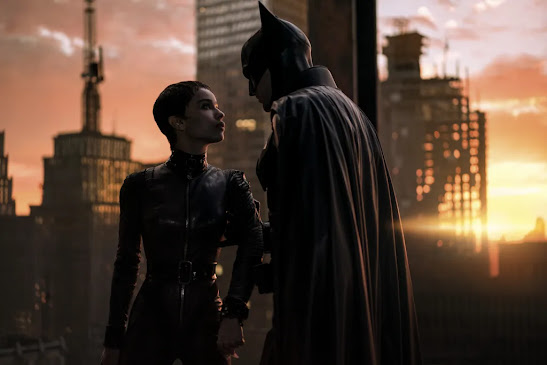 |
| If I have to turn off the lights in my den to see anything once I'm watching at home, it'll be worth it. This movie is dark and beautiful. |
Two years into his crimefighting, this Bruce is still working out his place as a vigilante. He revels in the fact that even the idea or suggestion of his presence will repel even the pettiest of criminals. "They think I am hiding in the shadows," he says in his noir narration. "But I am the shadows." But a sense of futility is creeping in. No matter how much crime he stops, more evil is around the corner. Then—it's The Riddler's turn, played by Paul Dano with eager gusto. Appropriately, Riddler's goals are parallel with Bruce's. He begins to bring to light the corruption and scandal of wealthy and influential Gotham residents, but with the one significant difference from Batman, in that he kills them first.
He leaves letters and clues for "The Batman" at his crime scenes, which Bruce dutifully follows with help from Gordon, (played with quiet intensity by Jeffery Wright) and Selina Kyle, (Zoe Kravitz, and the film's character highlight.) I loved the sequence where Selina and Bruce team up and infiltrate the club for information—a perfect amalgamation of noir and Batman sensibilities. But elsewhere, scenes that seem to want to mimic the disturbing factor that The Dark Knight did so eerily well played on my nerves here. The writing of Riddler's plan, motivations, and even characterization felt uninspired, as if the acting alone could carry this villain. They spend too much time on him, and the veneer begins to fall.
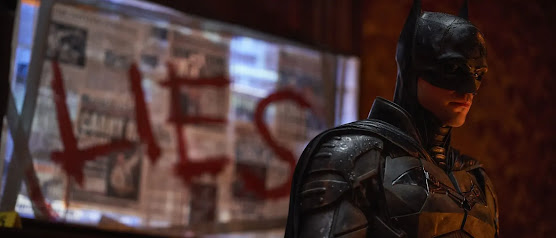 |
| Besides Kravitz and Dano, (and the actor who claims to be Colin Farrell, which I'm still suspicious of) a general increase of facial emoting wouldn't have gone amiss. People feel things in noir stories, too. |
Pattinson is the ideal choice for this iteration, but his performance feels restrained. Stoic Batman is fine, but I hope Bruce Wayne isn't left as a blank slate. They have a good start here. Grungy emo Bruce is different and fun in a dark way that fits the aesthetic, and I know Pattinson can dig into that—if the script and direction allows. Here, the writing keeps him one step behind the Riddler. Even when Riddler allows himself to be arrested, and even when his final plan is implemented, Batman seems there only to react, powerless to stop it. And that bothered me. I wanted Bruce's detective skills to matter to the plot. Or a satisfying moment of revelation where he "solves the case." But there isn't really, and for better or worse, it is done intentionally.
Through his inability to stop Riddler, Bruce is forced to confront this mirror villain and consider what the difference between them is. Why doesn't Batman kill, if he's the same as Riddler in every other way? So Bruce's moment of revelation turns introspective as he realizes that the point of stopping crime isn't only about the crime itself, but to protect those against whom is the crime is being committed. At the beginning, when Batman beats up the gang of thugs with skeleton paint on their faces, their victim is every bit as afraid of Batman as they are, and Batman does nothing to dissuade his fear. But once he fails to stop Riddler's plan, he realizes it's not over, because there are still innocent people he can help. So he does. And that's what's important, and what makes him the hero rather than the villain.
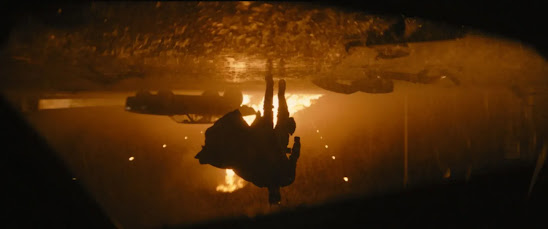 |
| The style, with bookends of narration and grunge music made me happy, but it still all comes down to character. |
So even though I was hoping for a more satisfying mystery plot, and even though I tend to tune out emotionally when superhero movies resort to a city-level event for their final act, I do greatly appreciate this character arc which is beautifully minute. No massive, life-altering realization—just Bruce shifting his focus a little and seeing a ray of hope in the bleak and endless line of evil that's standing before him. I don't think this movie is perfect, but that's why I think I love it.


