Pages

Showing posts with label Horror. Show all posts

Wednesday, January 29, 2025

Wolf Man

This intimate take on a werewolf story is wonderfully parsed-down. Centering around a family of dad, mom, and daughter, a remote farmhouse, and vast woods. There's a werewolf in there somewhere. Not hard to guess. And the transformation aspect is a body-horror metaphor that drives the family drama. Not hard to see coming, either. Which isn't to say it's not good. I like horror movies where the monster is a metaphor. (The last movie I liked enough to review here was Godzilla Minus One.) But it isn't to say it is good, either. Predictability doesn't necessarily dampen a movie's impact, nor does including a plain metaphor guarantee it. 

Directed by Leigh Whannel, with Christopher Abbott in the lead.

It seems to me that Wolf Man's problem is the clash of two good ideas. On one hand, there's the plain-spoken and effectively drawn metaphor of turning into the wolf-man being likened to having a genetic disease. On the other, a theme, equally as plain-spoken, that a father's job is to protect his children. I can imagine holding those two elements in my hands and feeling the storytelling glee of combining them in a beautiful, meaningful and clever way. And it does start out this way. We see the similarities between the dad and his father, who was protective but cold and angry, in how he tries to be a protector, but not like his father was, and yet fails into it from time to time. And when the dad is scratched by a strange creature in the woods and slowly begins to change, obvious parallels of a degenerative disease come into play in some interesting and horror-ific ways.

Here is where the movie had its most effective storytelling. How it shifts from the dad's confused and false perspective to the mom's equally confused but terrified and real one. How it slowly builds on, and has thoughtful reveals of, each aspect of his condition. The way these moments are filmed and portrayed, especially visually, but even taking into account more than the visual aspect of film, felt unique to me. And the building drama in this section is sweet and sad, juxtaposed with dread and discomfort. Here we wonder what will happen, while simultaneously knowing, and we can't turn away.

I love that it used practical effect but not in a show-off way. Kept me immersed.

But when the progress reaches a head, plot decisions must be made and implemented. In the moment, I was invested in the turns taken in this section, but I lost that thread of dreadful understanding which the story had provided so effectively earlier. Here is where the story's theme should start to become a thing proved (or disproved) instead of merely said. But instead of interweaving with the metaphor, it seems to get lost in the shuffle of moving parts and ending set-up, and is, as far as I can tell, wrapped up before the finale even starts. But without this theme to add new perspective, what interest or deeper meaning is there in a clear metaphor with an inevitable conclusion?

The story falters instantly. From there, some classic horror storytelling takes over, with plenty of good moments as far as technical filmmaking goes. Jump scares, gore, dramatic suspense, practical effects achieving some solid but not gratuitous body horror—all things we're here to see—but all getting drier and drier as the movie flounders to build a thematic ending from scratch in a fraction of runtime. In the end, the theme and the metaphor aren't a clever combination of two unique human realities portrayed in the fantastical form of a monster. The metaphor just is what it plainly is. And the theme is what the metaphor is, too, adding nothing new. Unlike with the wolf-man himself, a transformation I was disappointed to witness.

Wednesday, December 20, 2023

Godzilla: Minus One

Horror as a genre originated from real fear—taking things we are afraid of in our real lives and turning them into something fantastic and unreal. I think all my favorite horror movies have that element to them. Some are like Crimson Peak; "The ghosts are a metaphor for the past," the characters say. And in the movie that's really all they are. Some are like 28 Days Later; people grappling with loneliness and isolation in a world where everyone you meet is either a zombie, or could turn into one at any moment. 

Metaphorical monster movies in particular stand out to me. Even if (or perhaps especially if) the metaphor is obvious or spelled out as in Jurassic Park or The Babadook, there's something about the combination of the unignorable presence of a literal monster wreaking havoc and more subtle things they represent (such as pushing the limits of science, or simple depression) that brings the fear to life. And Godzilla—the original Godzilla—is a classic example of that. A radioactive monster terrorizes Japan.

I've always understood the metaphor in my head. This movie made me understand it in my heart.

As the Godzilla character became Americanized, the metaphor shifted. It became a tool used to preach. A warning against war or the wielding of nuclear weapons perhaps, but not about the fear, and the powerlessness of being at the mercy of those things. Godzilla himself even turned into a benevolent being that represents peace, somehow. And lately, it's been nothing but a way to use CGI artists to numb audience minds for money. Godzilla go rawr, people buy ticket. 

And that, most of all, is why I love Godzilla: Minus One. It's a return to metaphorical form. And it's done gloriously. It made me feel and understand on a palpable, gut-wrenching level, the fear that Godzilla represents. And it's not even marketed as a horror movie! It's not very scary, nor dark in tone (or in lighting). It's just an action/adventure monster movie, with drama. And characters. And writing. And I mean real, honest-to-goodness, there's-cohesion-and-a-story-here kind of writing, where everything fits together and serves to enhance and balance the next element, all surrounded by artistry and understanding of the purpose and value of stories as a whole... and I... I've missed this so SO much over the past few years. 

A cohesive story is great—but can still be clinical. This one possesses that spark of passion that brings a well-conceived story to life. Really, it's more than a spark. 

Minus One follows Koichi, a failed kamikaze pilot who goes home after the war in shame to a bombed out house and no family left alive. Survivor's guilt plagues him, as do memories of a dinosaur-like creature who appeared out of the sea and killed everyone on an island outpost where he was hiding. He cannot allow himself to truly live, but neither can he turn away from life completely. He stumbles into caring for a girl named Noriko, and the orphaned baby she's become a surrogate mother for. Together they build a life and scrape by until they've found their feet. He gets a job removing sea mines from the bay. The city and the people begin to heal. But then the monster returns. And with it, the dread and the shame.

Even though the topic is depressing and the people in the story are beat down, the movie's tonal feel is incredibly broad. One of my favorite things about Japanese entertainment. The sweet/pleasantly goofy humor sparked laughs, then it seamlessly falls into the quiet character moments, or to energetic scenes, anger and joy in turn. There is a prevailing sense of hope and perseverance present, and when the monster thrills come, they do not disappoint. The awesome, boyish, "that so cool!" element is as necessary as the underlying seriousness. And neither undercuts the other. Some of the monster moments were outright stunning. I never thought I could take Godzilla seriously enough to get a jolt of fear seeing him chase down a ship. Or the dread—a true sinking sensation—as his atomic breath builds through his spine.

Those monsterverse movies, with their oodles and oodles of cash, never came close to hitting like this.

There were one or two times when I reflexively gasped, and I spent several minutes in debate with myself over who would survive and trying to figure out if a happy ending was earned, or would it be tragic, or bittersweet. I fell in love with Koichi almost instantly, understanding and sympathizing with him, hoping he'll find a way to beat both the monster and the metaphor. And all the side characters as well. They were all their own people, their personalities and arcs mattering every bit as much as their functional purpose within the plot. It feels so strange that an action flick about an atomic sea-dino could throw me so effectively and cleanly through a gauntlet of emotional ups and downs, but that is, after all, what stories are meant for—even if we've forgotten.

Monster movies at their best aren't monster movies. If the creature is a metaphor, or some fantastic extreme fictionalization of a real fear, then if it's done right, the monster can reveal a human heart even more clearly than a regular-sized movie that's only about the people. Done right, monster movies are more human than human movies. And Minus One knows that. It earns everything it reaches for (and it reaches far!) because it reaches for understanding and connection, using monster mayhem and spectacle as a means to achieve that end. There's plenty to be said for the spectacle this movie delivers, but the true beauty here—like a metaphor—isn't in what we can literally see, but in what that sight prompts us to feel and understand.

Wednesday, September 7, 2022

The Black Phone

Spoiler-free!

After dodging the bullet that was Doctor Strange and the Multiverse of Madness, writer/director Scott Derrickson returned to doing his own thing his own way, and that's what The Black Phone is. A horror movie; with dark lighting and his signature uncomfortable tone. It plays out like a writing exercise for practicing setup and payoff, and I fully approve.

Adapted by Derrickson and Robert Cargill from a short story by Joe Hill.

The plot is set in the 70's, in an anywhere town with anybody families, where a pedophile serial killer is on the loose—Ethan Hawke, taking his usual charm and twisting it to creepy effect. 13-year-old Finney (Mason Thames), and his sister Gwen (Madeleine McGraw) see the missing posters, hear the news, and see empty seats appear in the school classrooms, but no one really knows what to do about it. Gwen has dreams where she can see the kidnapped kids, and she thinks they may be clues sent to her from Jesus, but their dad (Jeremy Davies, a great role for him, though not heavily featured) doesn't want her turning out like their mom who thought she was psychic but was really just crazy. He forbids her from talking about the dreams.

But then, Finney gets taken. In the basement of the Grabber's house is a phone with the cord cut. Sometimes it still rings, though. And when Finney answers it, the disembodied spirits of the Grabber's victims give him advice on how to survive; and how to escape. Each time he tries a plan and it fails, another kid calls with another plan. On the outside, Gwen dreams clues as to his whereabouts, and a detective, believing in her abilities, helps her search. You can see where this is going. It builds, and builds, and builds, and we wait for the inevitable showdown. It's simple; basic, even. And I suppose that might be a criticism in some eyes, but not to me. 

I think the best, most thrilling horror movies are the simple ones. Simple can be hard to pull off.

It impresses me when a movie shows me what it's doing and yet I'm still anxiously hoping I haven't been tricked when those last twists and turns come down the pike. We're made to think we are in the know about everything, but we aren't really—and once we're wrong once, then comes the thrill of worry that we're wrong about everything. Derrickson isn't making high art here, but he has respect for his craft and knows what's winning about his genre. So he packs his work full of horror thrills. Extreme situations, menacing villains, dread, suspense; the dark, twisted implications left just unsaid, weak protagonists who find strength, and even casual musings on spiritual elements.

The only thing that's "missing" is gore, or reveling in violence, and that makes me like it even more. It may not be high art but it's tasteful. And thoughtful. You get the sense that it spurs from the uncomfortable fears and nightmares of its creators, rather than a lazy penchant for jump-scares and splashing blood. The supernatural brings a handful of frightening moments, but unlike most supernatural horror, the supernatural here is a force for good. Gwen's down-to-earth faith in Jesus is mixed in and at home with the more typical supernatural horror elements of ghosts and psychicism. 

If you like to mull over on movies, this one isn't lacking there either, though it doesn't demand it

What underlying beliefs or fears inspired the plot can be interesting, but the main appeal lies, simply, in the plot itself. It's sharp structure, classic themes, efficient pacing, and ever-patient planning. Plus characters to root for, be sad for, see change, or just plain despise—all packed together in a premise and tone that unnerves, unsettles, and thrills. The performances are roundly good, and the production quality high, but the strength of writing is what brings the winning concept home. The Black Phone is a simple, focused effort of pure entertainment.

Friday, August 12, 2022

The Cursed

Not your grandad's werewolf story. Actually, it's more like your great-great grandad's werewolf story, and that's exactly what makes it stand out. Watching it, I could almost believe that it was adapted from some gothic horror story written in the late 1800's, when the story is set.

Sean Ellis wrote, directed, and did his own cinematography work. 

Originally titled Eight for Silver, referencing the old nursery rhyme, because silver naturally plays an important role. But changed to the more mundane The Cursed because the plot also heavily features a curse set on an old English estate by a band of gypsies who are murdered when they try to stake a claim on the land. The movie takes its time in getting started, establishing the Laurent family and showing the ill-advised murders in grisly detail, as well as the set of silver wolf's teeth a gypsy witch fashions for the curse. It's not until the children dig up the teeth and one of them gets bitten, subsequently disappearing, that the story's hero comes on scene—McBride, a pathologist, who has experience in these strange circumstances.

From there McBride drives the story, the setup so thorough and detailed that the plot glides along effortlessly on its strength. We know many beats of the story already; people will be attacked, the survivors changing too, until McBride closes in on the beast and discovers how to stop it. A classic in many ways. There's appeal in a classic story told well for me, but there's also a fresh appeal in this one's approach. Details of the creature design, origin and behavior which bring out the eerie and bleak style of horror. The character of the family involved. And most of all for me, the period setting, and location. The house, the village and the surrounding woods all make for a memorable, creepy, and gorgeous visual for the story to live in—a crucial element for gothic tales.

The imagery of the silver teeth was a great touch. There are many good details like that.

I have a soft spot for the sort of low-tech horror that happens here. Someone taking the time to load their muzzleloader rifle before firing an important shot brings the same sort of suspense as a modern-day scene wishes it could when it makes characters suddenly clumsy in their panic to load something that should take two seconds. The army takes days to arrive unlike modern cops, so there is no need to fabricate a reason why outside help doesn't come. Suddenly a single threat becomes so monstrous that you wonder how it will ever be dealt with. A great example of how less is more. Without having to overblow the horror element to get attention, the film has plenty of spare time to spend on character and lore development. 

While it's not my new favorite movie or anything, I'm at a loss for any significant flaw here. The one thing that comes to mind is that Boyd Holbrook isn't British, and that is apparent when he speaks next to his British castmates. He errs on the subtle side mostly which is smart, but sometimes he'll say something that just plain sounds wrong. I enjoy watching Holbrook far too much to care though. And as far as performance goes, everyone hits the spot. Besides the spotty accent, Holbrook feels every bit the gothic horror hero, balancing that simple and able determination of old-fashioned leads with the undercurrent of past wounds that keeps audiences engaged. Kelly Reilly's soft strength is perfect for the mother, as is complex coldness Alistair Petrie brings to the father. The children are excellent, and the supporting cast a vital and winning addition.

The daughter's old timey accent was flawless.

The slow, depressed gothic approach to the horror element won't be for people looking for a more intense, action-heavy, or scream-inducing horror experience, but it gets the tone exactly right for my tastes. It's the sort of movie you can dig into—and one that digs into you right back. The ending seals it all into a neat and emotionally resonate package, leading me to the observation that this is a story of singular vision; written, directed, and even shot by the same man. And with minimal interference, his vision comes through with deft skill and purposeful heart. I would praise it for that even if I didn't find much personal worth in the story itself. The Cursed or Eight for Silver, whatever it is called, this monster movie of old-fashioned sensibilities is worth seeking out.

Sunday, September 26, 2021

A Quiet Place Part II

Some spoilers, for this and A Quiet Place.

If you call it a "Part 2" it's easier to make people swallow that it's not just another unnecessary sequel. Heck, even I got drawn in, and I despise the idea of sequels as a rule. What got me interested though, was adding Cillian Murphy to the cast to fill the hole John Krasinski's character leaves. Krasinski is still directing though, and this time he's also writing the whole thing. For the first movie he bought and tweaked an original script, and now he's trying his hand at expanding the story alone.

It's debatable whether the story wants expanding in the first place, let alone if the continuation settled on is any good.

We pick up exactly where we left off (after a flashback prologue). Emily Blunt and children leave their farmhouse to find one of their neighbors whose fire they would see from their water tower. This is Emmett (Cillian Murphy), but he's not as interested in playing father figure and man-of-the-house as the Abbott family wishes. He's already lost his family and is now a Joel from The Last of Us, lone wolf type character. However, Regan (Millicent Simmonds) has her hearing aid device that incapacitates the aliens and when she finds a radio station that is still broadcasting, she's determined to use it to help other survivors fight back. When she leaves alone, Emmett finds himself going after her, and then along with her, despite his protests.

The story splits then into two plotlines. The one with Regan and Emmett is interesting; straightforward in its goal, with ample opportunities for exploration. The one with Evelyn (Emily Blunt), Marcus (Noah Jupe) and the baby, however, is small potatoes, with no goal at all other than to survive when the aliens inevitably find them (after a year and a half they're still terrible at living quietly.) It tries to give Marcus an opportunity to become a man, but must make him even more of a frightened useless child first to make the change clear. It smacks of fishing for story filler rather than letting the story push along at a natural pace. Because both plotlines were focused on equally despite unequal value, neither was developed fully.

Abandoning Emily Blunt's plotline altogether would've been a crazy, bold, and I think rewarding, move.

The Emmett-Regan plotline could have been a movie all in itself, but it had corners cut to make room for the pointless other plotline. Everything happens too fast for them, and comes too easily. The two have a lot of potential together, and I liked their chemistry, but they slip too quickly into a father-daughter dynamic, especially after Regan's rough relationship with Lee, turned to deep loyalty. She initially rejects even the idea of Emmett becoming even a temporary protector. Then warms to him after one incident. They also have a language barrier, in that he cannot sign. This is got over easily and is never an issue in high-stakes situations. Then an evil tribe of cannibals is set up as a non-alien threat, but only amounts to one scene once they show up. 

It's rush, rush, rush, and then it's over and I can list on one hand the important things that were accomplished. I don't even need all five fingers! If it needed to end at that point to allow Part III all the plot it needs to wrap things up, then why not let this story sit back more and develop relationships? Why not explore the themes of family further, instead of leaving themes out altogether? Did Krasinski not realize those were the things that made the first one good? Or is he simply incapable of creating on that level? He is a good director, but he needs a good script with clear purpose, else his movies lack direction, and those satisfying moments of resolution that made A Quiet Place stand out.

"More of the same," but only superficially, isn't really more of the same, is it?

I feel like A Quiet Place Part II's only purpose was to set up the pieces for A Quiet Place Part III, so I guess I'll hang on and see how the payoff goes. Despite the definite downgrade in writing, this movie maintains its winning premise, with the same intense alien thriller feel to it, and tentatively expands the lore on its featured creatures. The mortal flaw is simply that it's lazier; messy next to the lovingly crafted original. Even with nothing to do Emily Blunt is good. Millicent Simmonds steps up her game to great results, and Cillian Murphy is a vital addition that makes the whole endeavor better than it has a right to be. If nothing else, I'll watch Part III to see more of him. 

Wednesday, June 30, 2021

The Conjuring: The Devil Made Me Do It

Spoilers.

The Conjuring movies have a draw and a repellent for me, and they are one and the same: that they are based on real-life stories. I believe in the supernatural—in demon-possession and ill-meaning sprits and hauntings. So, I am fascinated. And a bit creeped-out. But fascinated. There are few definable rules to the subject, but mostly it's a dark unknown, full of potential for exploring by way of fiction. And that's why, despite reservations, I've come to be a fan of The Conjuring movies.

Well. Up till now... 

Not only is this the most poorly made of the three films, it's also the only one in which the real-life element is thrown out the window. Of course, the first two were embellished (to put it mildly) and sometimes heavily added to to make a longer, and more cinematic, story. But parts that did have claims on reality were the same parts that gave the films their draw. The supernatural. The haunted house and demon possession of the first film. The girl being oppressed in the second, with the levitating and teleporting and the old man speaking out her mouth. So, what's true about The Devil Made Me Do It?

Arne Johnson (Ruairi O'Connor) has a brother (Julian Hilliard) who's possessed by a demon. After the Warrens (Patrick Wilson and Vera Farmiga) are called in to exorcise him, the demon moves from the brother to him. Afterwards, he murders his landlord, and then claims that, well, the devil made him do it. But that doesn't quite do it, does it? Whether you believe the true stories of the first two films or not, the claims are scary. Reports of seeing a witch with a head that looked like a tangle of cobwebs. The little girl falling asleep in one place and waking in another. The old man's voice coming from inside her. What's scary about this story? Nothing, really. It's a loose, undetailed set of facts. There's no inherent fear. It must be invented.

"What if there's a demon/ghost in the water mattress?!?!" "HoW sCaRy!!"

There's no haunting element, so the movie brings in a witch character that curses the family and then begins to telepathically stalk the Warrens when Loraine accidentally makes contact with her. In one fell swoop the movie forgoes whatever little grasp on reality it had. It allows its witch to animate dead bodies for a cheap scare or two. Then with the planting of one little totem, she gains the ability to literally control minds and make people see whatever she wants. The only thing more annoying than this is that her mind control spell is broken by the power of love. No exorcism. No mention of God or application of His power. No rules. No reality. Just hogwash.

It's even understood in the narrative that there was no demonic possession at all; that Arne was tricked by the mind control to commit murder—which means that the movie doesn't even accept the true story's premise. And despite my being a horror lightweight, I was more scared watching The Conjuring for the third time than I was watching this. Ed and Lorraine's character story is contrived and silly—if the Hallmark channel turned horror—while the rest plays out like an unfinished sketchbook from some not-particularly-creative tween who's determined to write a hit creepypasta. A series of vignettes, with no build or significance, that continuously fall flat, until the runtime is over-filled and all is quickly solved by magic.

I doubt the real Arne was demon-possessed. Especially if it supposedly left him after the murder like they claim in the film. Demons don't just up and leave. It was more likely a successful ploy to get a lessened sentence.

For what it's worth I do believe a demon could drive a person to commit murder, but even so they still would have to have chosen to give in and do it, so this movie's title isn't a viable defense in my book. As for the crime of having made this film? "The devil made me do it" is the ONLY defense I'll accept.

Saturday, November 28, 2020

The New Mutants

This review contains some mild spoilers.

The New Mutants is exactly what you'd expect a big superhero studio to dole out for the upcoming generation. A politically correct, agenda-pushing cast of characters set against a backdrop of plot that is appealing in trailer form, but once seen up-close is too flimsy to hold up to repeat viewings. A cutting-edge technique to sell theater tickets... by 2017's standards.

I heard somewhere they released the original cut. But where were the faces in the wall from the original trailer?

I doubt it would have gone over well on it's original, April 2018 release date either, but I admit, there was a certain disappointment for me in realizing it really was just another half-baked entry into the superhero base. I was misled, perhaps by my own wishful thinking, or naiveté, or that Pink Floyd song they played in the trailer. "Disappointed but not surprised" will be my mantra for this review. Why, after all, put effort into the whole movie when you can just throw some big names together in a fun premise, and then cut corners until it's releasable? 

The premise really is a winner. The kids are in this old mental hospital and treated like rehab patients as they learn how to control their powers and stop being a danger to themselves and society. After that, it falls apart. The lead is Dani (Blu Hunt), an American Indian who accidentally wiped out her reservation in her sleep by manifesting a giant bear composed of fear. (She doesn't know it was her until later but it's no surprise to anyone who's seen an X-Men movie.) Charlie Heaton is dirty southern boy who accidentally killed his dad when he panicked in the coal mines. Maisie Williams is a devout catholic who accidentally mauled her priest to death when he tried to burn her for shapeshifting. Henry Zaga is a rich kid who accidentally burned his girlfriend alive...

Noticing a pattern? WELL.

...and Anya Taylor Joy is a cold-hearted Russian girl who created an alternate plane of existence in her mind that she can disappear into at will, which she used it to hide from creepy faceless smilers who'd come to abuse here until she got fed up with hiding and methodically murdered them all with her magical sword, invulnerable armored arm, glowing eyes, and tiny pet dragon. Yeah. There's a clear pattern until we come to her. Honestly, I'm baffled as to why the movie wasn't about her. There's a lot of implication mental questions that go into her story that would've been more interesting to unravel than a literal fear bear.

But anyway, the kids are in mutant rehab, and they fight, and bond, and tell each other their backstories one by one; but of course there's something else more sinister going on. It takes too long to get to the sinister things though, since there isn't much of it to fill the runtime. And the build-up is dry and empty. It wants to be a gothic horror—creepy, slow, and subtle—but it also wants to be a teenage drama—relatable, deep, and moral. The two don't mesh. I love the gothic horror idea but neither make it past the foundational stage, which leads me to bemoan the lack of realized potential. A typical reaction for me, I know, but it's a typical problem for a movie like this to have. 

I'll just revert to what I imagined it'd be like now...

If only if only if only. I knew I'd be disappointed; after three years of waiting and imagining what I wanted, I could hardly be otherwise. But that doesn't mean I would've liked it sans those pent-up expectations. Without the excitement and straight-up DETERMINATION I had to see this movie, I barely would've noticed it. I wouldn't have seen it yet, and probably wouldn't bother for a long time, if ever. Then I would've forgotten it instantly and moved on to the next thing—which is what I did. Except I got to enjoy anticipating. There's worthy joy to be had in anticipation. It's just too bad when—after all that effort and delay—that's all the film could conjure.

Tuesday, June 16, 2020

The Invisible Man

Spoiler-free!

Cecilia (Elizabeth Moss) escapes from her abusive rich scientist boyfriend Adrian (Oliver Jackson-Cohen) and holes up with her friends (Aldis Hodge and Storm Reid) in their house in abject terror. She's sure he'll find her; he said she could never leave him. Finally, her sister (Harriet Dyer) brings the news that Adrian has killed himself, and everything's okay now. Tentatively, she starts to feel more comfortable. But why does she still feel like she's being watched? Slowly she discovers the truth; Adrian isn't dead, he's just invisible. Either that, or she's crazy!

This modern re-imagining comes from Leigh Whannell, the writer/director of Upgrade.

I loved Upgrade and was hoping The Invisible Man would be a similar, self-contained and lean thriller. It's not, but it doesn't totally fail to produce a palpable style of its own either. That being said, cleaner plotting could have only been an improvement. There are several threads that I waited to get answers on that were simply ignored--as if I wasn't supposed to expect explanations at all. I was out of sync with the movie's direction. And that came through with Cecilia's decisions sometimes, too. The movie is good to not expound on her every inner thought, but she often did things where her reasoning was foreign to me. It took the movie in unexpected directions, but also left me playing catch-up more than once.

The good comes directly from the premise. A stalking ex with bad intentions that the heroine literally cannot see. The best scenes are the ones where you know he's there--somewhere!--but cannot tell where. These scenes play like horror movie that have slow rising tension that leads to a chilling moment, and one step closer to breaking for the protagonist. And seeing that from what's technically a science fiction thriller is a pleasantly unique experience. I wish more of the film had been like that, because when the movie is less restrained, it leaps over into ridiculous territory for a frustrating decline of smarts and quality. 

We're told that Adrian is a genius, but the way he turns Cecilia's sister and friends against her is so mind-bogglingly simple that it belongs in A Cinderella Story 7: A Disney Channel Original, not movies with rational adults as characters. This movie sacrifices reason and the semblance of reality to heighten the stakes and tension, but for me, it deflated my investment in the story. What I wound up enjoying instead was the technical aspects of the film. Style, the building of tension, acting, and the unique appeal of the scenes where evidence the invisible man is present. Even that decays; but ultimately the final act sets everything back on track and closes the film out in a concise way, in line with the best of the film.

I liked when the camera would show you all this extra space like this and ask that you look for what's not there. 

It ended so well that I almost forgot about all the threads I wanted answers for but wound up being skimmed-over plot holes. I wouldn't mind so much, but several of the unanswered questions are asked by the movie itself. Whether it was meant to be tidy or not, the messiness was a distraction to me, and a detriment to the film. Yet Cecilia is a good character and Moss plays her engagingly, on the line between sure and insane. The insanity seeps over to the audience with strong visual design, and several well-crafted moments. In short, the movie delivers what it promises--just not 100% of the time. And you'd think a film that has cracked the code to invisibility would be more adept at hiding its flaws. 

Wednesday, March 11, 2020

Color Out of Space

Spoiler-free!

This is a weird one, and that makes me happy. Modernizing the horror short story by the master of cosmic horror, H.P. Lovecraft, Color Out of Space tells of a mysterious event that takes place on an alpaca farm, where a meteorite lands and begins to alter the life around it.

Directed by Richard Stanley.

The event is witnessed by Ward (Elliot Knight) who stumbles across the farm as he does a survey of water tables in the secluded woods of Arkham County. The farm residents are the Gardner's, father Nathan (Nicholas Cage) mother Theresa (Joely Richardson) daughter Lavinia (Madeleine Arthur), and two sons, Benny (Brendan Meyer) and Jack (Julian Hilliard). After the meteorite crashes in their front yard they begin to experience an exponential growth of strange and disturbing happenings, that we know will lead nowhere good.

We don't get many straight-up H.P. Lovecraft movies, so I knew I was going to watch this no matter how bad it was, but I am genuinely impressed at how good an adaptation this is. It's set modern-day and there are a handful of other detail changes done, but with Lovecraft, the appeal isn't in exactly what happens, but the feel evoked -- and this felt every bit like the Lovecraftian menagerie of epic unknown terror that it should. The horror has that insane edge to it, and it creeps up slowly, focusing on the way the mystery effects the characters' mental states.

I loved this wobbly effect visible in the background.

It also withholds, but not so much that you feel cheated. You imagine, and then you get to see for yourself. And the effects are pretty darn fantastic. Sometimes in the vein of John Carpenter with practicals, sometimes with almost experimental digital -- rendering madness, and the indescribable. And it is cool. Violent and cosmic cool -- both in the concept and the way it is pulled off. As someone who doesn't like to be actively scared during a film, it was ideal for me. When you see how terrifying it must be for the characters, but are amazed, amused, and entertained yourself.

Despite having a fairly low budget, the movie doesn't lack anything, due to the original story dictating a remote location and tiny cast of characters. The woods and farm in the area are beautiful, and are made up in small ways to have an otherworldly vibe even before the changes begin. A lot of thought was put into the layout and details of the sets -- they stick in your mind with clear and unique imagery. And besides Nicholas Cage, no one is a big name, but they all sell the weird and the horror plus some. My favorites were Lavinia and Ward. Cage is like the cherry on top that brings out the crazy. Like he was born to play Lovecraft characters.

I would love to see more adaptations in this vein.

This film goes for it. The changes made are only to modernize, and to make the happenings film-able. Though Lovecraft's stories are not very cinematic, the solution, this film knew, isn't to try and "fix" the story. It fleshes out the characters and has to make up narrative scenes, but they are all in service to doing justice to the tone and nature of the story -- which is what's important. I was in awe by the end. It was wild and beautiful, disturbing and gleeful, and epic, and mad -- a true Lovecraftian film.

Thursday, September 19, 2019

It Chapter Two

Spoiler-free!

What's more likely to be a great movie -- one that ends with the characters making a promise to return and fight the evil again whenever it may return, or one in which all they do is make good on that promise?

Directed, once again, by Andy Muschietti.

Given that Chapter Two and Chapter One come from the same singular book, Chapter Two has no real right to feel so much like a sequel. Ideally it should have a "Part 2" flavor. If the filmmakers knew how successful Chapter One would be, I bet they would have filmed both parts at once. Then the de-aging of the child actors wouldn't have been necessary, and the story could have been developed to flow better between the two films. As it is, the two parts feel out of sync with each other. One being bigger in size, and the other more compact yet weighty with substance.

Much like what happened with Season 2 of Stranger Things, this sequel is painfully aware of the wild success of its predecessor. You can see it in the kids' performances, who are much less organic here. Like they're putting on a show for an audience instead of digging into honesty and stretching their acting chops. And while the adults don't come across that way at all, their script does it for them on occasion, with throwaway callback lines. Such as when they go in the well house and Bev dryly proclaims, "Beep beep, Richie." Another thing the adults have going for them; they're way better at delivering comedy.

As a result, the adult's version feels lighter in tone.

Laughs came freely; as for scares, it hit Not Scary At All for me. They tried to match scary-levels with Chapter One, but the method degraded slightly; there are a lot -- and I mean a lot of jump-scare moments. And every single one of them follows the exact same pattern. 1. Thing might be scary. 2. Thing is maybe not so scary after all. 3. Pause pause pause... 4. THING IS SCARY! Inevitably, the thing morphs into CGI, half the time with aspects of Pennywise's face pasted on it. I actually prefer when horror film don't scare me, but it does bother me that so much time was spent of these ultimately useless moments.

From my perspective "scary" is a lot less important than simply "effective." And the only times these moments were effective is when it led to an actual kill. Those are the ones that take their time to craft the creepiness and the dread. The most effective part of the movie was waiting for a jump scare while the camera lingered on Bill Skarsgård, motionless, drooling, his one eye pointing out to the side. No CGI, just an effective performance, given time to breathe and settle before it bursts. Other horror elements were more varying degrees of cool, or neat, or messed-up, which works fine for me. Overcrowding and rushing were the problems there.

But casting was a resounding win!

I think it's universally acknowledged that the casting here is pitch perfect. Even the well-known actors, Jessica Chastain, James McAvoy, and Bill Hader are fantastically spot-on. Isaiah Mustafa, Jay Ryan, James Ransone, and Andy Bean were clearly cast more for their accurate appearances, but also deliver wonderfully on the performance side. Hader steals almost too many scenes, and my favorite was Ransone as Eddie. The best scene in the whole movie was their meeting up and having dinner. Their reactions to seeing each other again and how the nail the same feel and dynamic their kid counterparts did.

A better version of this film is out in the cosmos somewhere. I don't know how it works, but it likely required at least some changes to the first movie. It's a hefty story to swing in just two movies, so one great film and one slightly less-so isn't a disappointing result, especially if you consider less pleasant alternatives. This two-part series avoided disaster by breaking up repetitive material with elevating moments from a brilliant cast, and regular interludes of real, fascinating, quality content. My only real regret is that Chapter One ended in a more satisfying and thematically potent way.

No more floating, but I sure do hope Bill Skarsgård gets all the roles he could wish for after this!

The best ending of a series ideally belongs at the very end. But I loved Chapter One as is, so if that movie's greatness required this one to fall slightly short, I'll take it and be happy. Since this continuation isn't necessary to get a complete and satisfying story, there's no harm done either way. It Chapter Two is like the cherry on top of a giant sundae, or a red balloon in the hand of a clown; it doesn't add much in terms of substance, but it sure does complete the picture nicely.

Tuesday, September 3, 2019

Ready or Not

Spoiler-free!

Don't make pacts with the devil for success and riches, kids. If you do, it will only end one way: with laughter and splashing blood. The laughter won't be yours, but the blood probably will be.

It sure does make for entertaining fiction, though!

The Le Domas family did make a pact with the devil for riches. Specifically, a game empire. As part of the deal, anyone who marries into the family must draw a magic card and play the game written there. But if they happen to draw the game Hide and Seek, they have been chosen to be a sacrifice and must be killed before dawn. That's what happens to Grace (Samara Weaving) when she marries Alex (Mark O'Brien). And she's not happy about it.

When a movie has a premise this good, it seems a terrible waste of it all to make the ultimate point simply that, "Rich people are crazy." Make a movie -- any movie -- in which a rich family worships Satan and sacrifices their in-laws to him and you'll get that point across. About the third time you reiterate it, I'm going to start wishing you had something more to say. This movie does a great job defining its villains, showing their motivation and the depths of their selfish, evil ways. But it doesn't balance all that with equal amounts of good.

Only one character does something selfless in this movie, and it's not the lead.

Grace is a solid heroine and easy to root for simply because she is over her head and fighting to survive in a wild situation. She's also scrappy and unrefined, details that I liked. A solid character. In a great dress! But she only ever protects herself. She lets others sacrifice for her instead of risking herself for anyone, and doesn't quite come into full hero status before the film ends. I can only suppose the end intended to be spiteful; there was a clear and far more satisfying path there that was ignored in order to stubbornly eek out the desired result.

So it's unfulfilled, but as I said, the premise is strong. Strong enough to carry the movie well into the third act before you realize it has strayed from the mark. It could have been funnier throughout as some of the jokes were a little cheap. The good humor came from a sharp wit and I could have done with ten times more of that. But the tone struck was fitting; with high drama and high energy, but not too flippant as horror-comedies are so often in danger of being. I mostly wish it hadn't fallen back on the old "saying the f-word makes it funny" trope.

Its swearing comes across like a kid trying to be edgy.

The premise could have gone off in any number of narrative directions, and though I don't think they chose the best route, I also think they were very far from the worst. I was always engaged with the action though it wasn't exceptional in either concept or execution. And several of the characters had great arcs, or little backstory tidbits that brought depth to the story. It was the attention to character early on that made the conclusion feel so incomplete later.

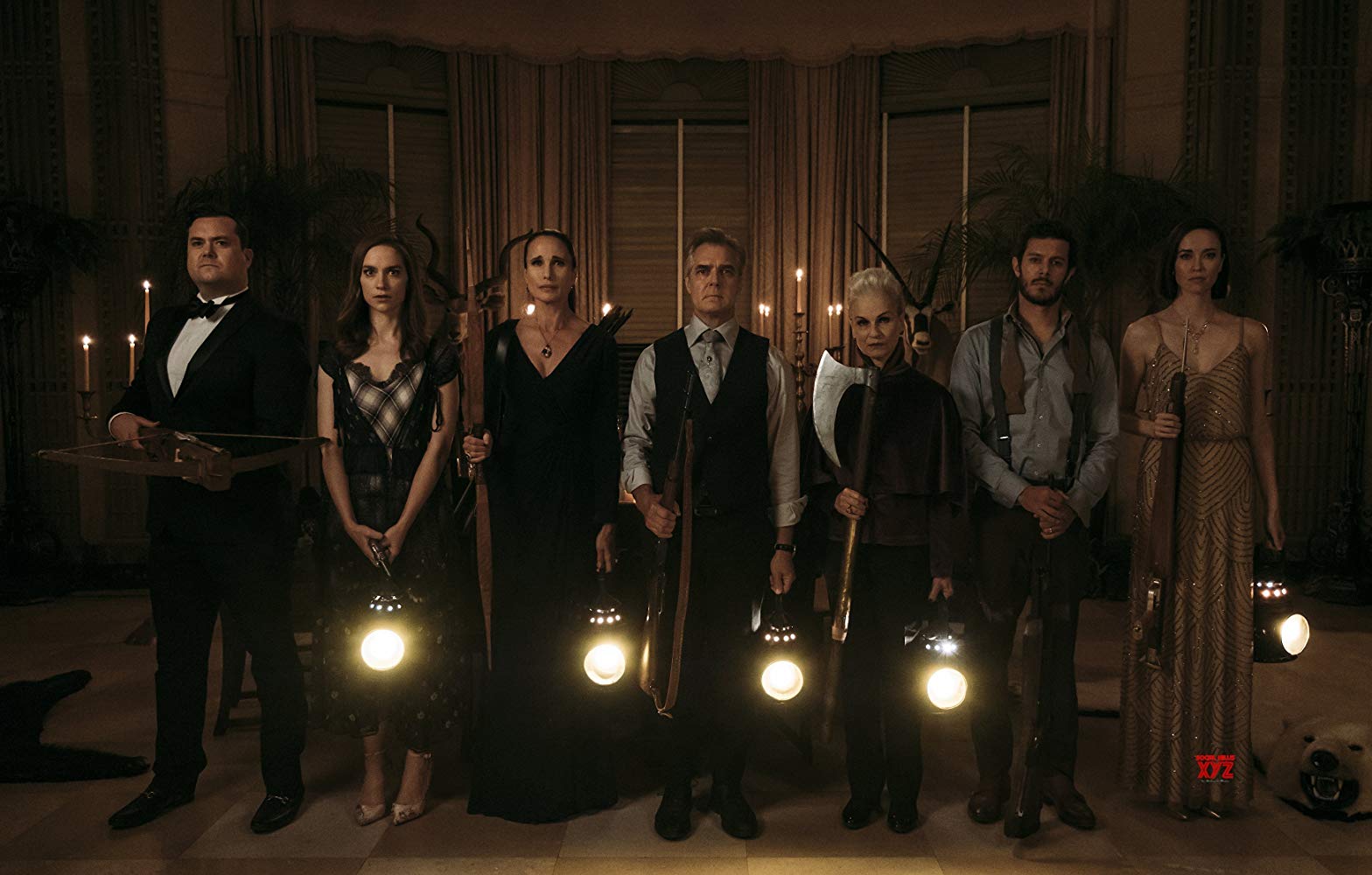
I don't think it was due to my already being a fan of Adam Brody that made Daniel my favorite. He hit the movie's dark wit most consistently and took the best character direction. I also liked the direction Alex took; and Andie MacDowell's mom character. Then quirk characters like the hyper sister or grumpy aunt worked great to keep all the characters straight and keep the humor going. And like I said the lead was super solid; the thing about this movie that lingers in the mind once it's over. Even though she shoulders much of the film's flaws, she takes it all like a champ.

It reminded me at times of The Cabin in the Woods, and I wish they'd gone even further in that direction.

Not up to the standard of its greatest peers, but no slouch either, Ready or Not is a mixed bag that doesn't jive with its either/or, black and white title. Neither a winner nor a loser; but at least genre fans can be happy the game was played.

Saturday, June 29, 2019

The Dead Don't Die

Spoiler-free!

*Puts some Sturgill Simpson on Spotify*

In this plotless and super dry zom-com, Adam Driver, Bill Murray, and Chloë Sevigny are small town cops in way over their heads when the dead come back to life... due to the Earth being thrown off its axis... due to fracking on the poles. It's always the fracking. Tom Waits as a woods-dwelling hobo man and a strange-acting Tilda Swinton seem to know what's going on though. And Adam seems to get it too: This is gonna end badly.

Doesn't mean you can't have a good time until then...

To say it's dry and has no plot isn't a criticism, though. I quite liked director Jim Jarmusch's last film (also with Adam Driver) Paterson, which was similarly dry and similarly without much happening plot-wise. Where that movie excels though, is in character. The Dead Don't Die is more about the zombies' character than the living people's. And that's where it falls apart for me. The movie wants to draw a parallel between the fictional zombies and real humans who are slogging through life, not much more than animated bodies. Sure; 90% of zombie movie in existence make that comparison. This movie only seems to believe that the only viable solution is to... not... be... human... anymore.

Like as humans we're doomed to be "zombies." And it's cool for a horror film to be fatalist of course, even a comic one, but it sure does put a lot of effort into showing the fate without showing the alternative. Of the three people who can "see behind the curtain" which is the role-model? If there is no role model, then how is the message expected to come across? There's a warning sermon, but no helpful applications offered. The characters are completely undeveloped to the point of self-awareness when the movie point-blank refuses to give one a backstory. Other times you think relationships and dynamics will be developed... but then the zombies intervene.

It's like the whole movie was a neat set up that ends before it ever gets going.

Still the cast is great fun as they have a competition over who can make their face the most dead-pan as they deliver punchlines. For my money, Adam Driver wins, but Bill Murray is never second-rate in a dry delivery either. The real problem with the comedy is that there simply isn't enough of it to go around. With such a big cast and so many irrelevant characters but a normal shortish run time, you barely get a taste of your favorite before the credits roll and it's all over. Plus, only about a third consists of comedy when there's a gruesome zombie murder quota to fill and a message to chuck across.

Overall it was very much what I expected so I was able to enjoy it as it came -- only one point was a surprise, and that was an element of the tone. It gave off an impression of being a project done out of a desire to goof around and have a little fun over trying to be a "real" movie. Basically no story, no character arcing; just a lot of wandering around and seeing where you are, then going off the rails to try something else. With that in mind, it's hard to blame it for not being a serious movie that plays by the rules. If it didn't even want or try to. It's not saying, "I'm great because I'm different"; it's saying, "I'm different because I was doing my thing," and never claims any level of greatness at all.

So I'll take what I enjoyed and forget the rest!

The Dead Don't Die has a reputation for being politically charged, and it's clearly made out of frustration over the current Presidency, but goes so far over the top that no particular ideology is required to enjoy. Fracking is an easy fictional troublemaker, and Steve Buscemi's hat hilariously and nonsensically reads, "Keep America White Again" as he awkwardly explains to Danny Glover that when he said the coffee was too black, he meant it was too strong. When he bites the dust, Tom Waits muses that you reap what you sow, and then takes a bite of a chicken he stole from him. Political satire? Or parody of political satire? Take it as you like.

When you're a movie character in the zombie apocalypse, you let off steam by killing zombie heads; when you're a film director, you do it by writing it into your movies starring your friends. When you're famous, the finished product gets into theaters. And when you're a film fan, you can see it, and maybe get a kick out of it too. It might end up badly, but even so, it's not the end of the world.

Tuesday, June 4, 2019

Slaughterhouse Rulez

Spoiler-free!

After careful consideration, I have decided that this movie would've been significantly improved by the inclusion of an exclamation mark in the title. Or, as others have pointed out, the words, "Edgar Wright" in the writing credits.

Not that I'd have minded his inclusion, but it's not THAT bad. It's just a British teen horror comedy... on the raunchy side.

It's easy to jump there since Edgar Wright's go-to comedy duo Simon Pegg and Nick Frost both appear in this horror comedy in supporting roles, but really, this movie didn't need him to be involved; all it needed was to put a little more effort into the writing on its own. In the first scene it starts off strong -- introducing its lead in Don (Finn Cole), a middle-class teen from the North of England whose mother convinces him to attend a supremely posh private school that's he's inexplicably been accepted into. There's a briskness to this scene that suggests an urgency to get to the good stuff -- all the crazy, humorous horror the title promises.

And that's why it's weird that the movie doesn't actually get going until about 45 minutes in. And at that point the thing is almost half over. There's a lot of introductions; introducing the massive school, Don's pent-up roommate Will (Asa Butterfield), the headmaster (Michael Sheen), teachers, the school bully (Tom Rhys Harries) and the girl (Hermione Corfield) and the idea that something sinister is going on. But each one of these basically take up a whole scene each to introduce, and they invariably end with some kind of ominous hint of what's to come. We really wish it would just arrive already, but not all the time is wasted; we do get a good sense of all the characters relationships and the hierarchy of the school.

It's good stuff, just over-explained and over-dwelt on when we're here for mysterious horror goods.

Finally you think the horror will get going along with the introduction of the plot -- that some greedy company is fracking near the school and accidentally opens up a giant sinkhole. This is paired with a fantasy-horror type legend of dragons or monsters living in a labyrinth under the school. Cool. Then the movie piddles around some more. Around then is when people as dense as I am will finally pick up on the truth -- this movie doesn't actually have much of an idea for the meat of its events. It spends all its time avoiding the monsters and chasing down dead-end side-plots until it just can't put it off any longer.

Then it gives the action its best shot and it's only marginally better than the piddling. Because the piddling is piddling, sure, but it's still funny, and it's nice seeing the lead make friends and chase an out-of-his-league romance. Once the action starts everything else essentially is done and all that's left is lots of running around from one okay set piece to another, losing one or two people along the way, until the movie finds the finish line and sprints over it like it was scared of the monsters. Overall a bewildering pace, but rarely not amusing. On the cheaply budgeted side, but not noticeably held back by that.

Unless of course the movie was scared of the action because it couldn't pay for too much of it.

I think this movie could've used an exclamation mark in the title to convey a more accurate and low-grade vibe. But the "Rulez" with a 'Z' does a decent enough job at that. Movies with exclamation marks also seem to possess an extra boost of boldness, and in the end that's what this movie needed to sell itself. It did what it wanted and did it decently; I applaud and enjoyed it for that. But it did what it wanted while constantly promising something else -- something it never fully delivered. Either follow your own rulez or throw them completely out, I say. This sloppy British horror romp is a low-expectations-only kind of deal.

Wednesday, February 6, 2019

Velvet Buzzsaw

Spoilers are marked.

This movie is literally a critique of critics who are too pretentious to approve of anything released by Netflix, simply because of the casual, readily-available nature of Netflix automatically denotes them as low art, whether they're well-made or not. And the irony is, this movie is getting exactly the kind of criticism it condemns.

Written and directed by Dan Gilroy.

It's about the art world -- much like film art world -- run by the rich and influenced by the pretentious. Morf Vandewalt (Jake Gyllanhaal) is a critic and one such influencer. His reviews can make or destroy. He makes pretentiousness his signature style. Rhodora Haze (Rene Russo) runs an art gallery. Josephina (Zawe Ashton) is her assistant. Jon Dondon (Tom Sturridge) runs another gallery. and Gretchen (Toni Collette) represents collectors who lend their pieces to the galleries. Piers (John Malkovich) and Damrish (Daveed Diggs) are artists. Coco (Natalia Dyer) is a low-level assistant/receptionist, and Bryson (Billy Magnussen) is a technical repair guy.

One day, Josephina goes home to find her neighbor has died suddenly, and that his possessions are to be destroyed per his request. She happens to get a look inside his apartment and find that he was an artist -- and that his eerie work is exceptional. She takes it and hatches a plan with Rhodora to claim ownership and sell and show the work. Morf loves it. Everyone loves it. But the art is possessed with something. It moves; it burns itself; it infects other art and kills, Final Destination-style. It is, perhaps, possessed by the restless spirit of its creator, who wished it to be destroyed, not fawned over and sold for exorbitant prices by people who only care for it as a new, marketable commodity.

Just a couple artists appreciating some art...

On surface-level it is a fairly standard horror flick. Characters do bad things, and die in some kind of harsh justice or retribution exacted by the supernatural entity. Their interactions are mostly to establish what cold, backstabbing thing they're doing. Twists come along in their due time, and there is the natural, expected ebb and flow of drama and mystery. Pacing is exact; cinematography purposeful but not overly-showy or experimental -- it gives moments of simple subtle beauty. Death scenes are practically announced as they open, and then are played out in interesting but not particularly disturbing or overly-gory ways. The overlay of comedy these scenes take diffuses the horror too.

But then, dialogue is brilliantly hilarious, as everyone speaks in an artsy, highbrow way, so much so that I had to become accustomed to the way they spoke in order to understand what they were saying. Fortunately, the opening sequence is used to introduce characters and establish this hyper-language, so that once exposition is given through it, we've hopefully gained an ear for it, and don't get lost in extravagant articulations. This then flows into line delivery, which is every bit as brilliant, especially coming from Gyllanhaal, who continually made me laugh with his exact timing and detailed mannerisms. Meticulous, but relaxed. And Collette was almost equally good with far less time to work with.

"Kisses!"

Not everyone can be such extremes, but they were all excellent bits of casting, from the simple look that screams "douche" the moment you lay eyes on Jon Dondon (even the name is all you need!), to the subtle blank soullessness of Josephina. And they all have such unexpected moments of hilarity when they embody these caricatures of art world inhabitants. On this surface level, the film is odd, yet plays by the rules. The poking fun at stereotypes and absurdity of modern art has a dark humor flavor; yet the plot plays out by the numbers. You could almost say it doesn't take risks. But its point wasn't to be a risk-taking plot, or to break new ground within the horror tropes it uses, but to make a commentary using the medium, if you will.

See, this movie is very competent, and does exactly what it wanted to do, then it released through Netflix. I've long held the opinion that some critics tend to frown on any Netflix film simply because of its nature, and in the film Rhodora comments that they don't sell eternally viable commodities, but a mere perception. Netflix is a taboo that decreases the value of the art is distributes. In the film, they lie about how many pieces exist because the price rises if there are less. Netflix distributes to all; exclusivity increases value. And the film punishes characters who value the art only by what it's worth instead of what it means to them -- as art.

It deliberately sacrifices creativity to become the thing it is defending. It practically invites shallow criticism. It's kind of brilliant. 

At the end of the film -- mild spoiler here -- these paintings that had been fought and fawned over are being sold on the street for $5 a pop. But the fact remains: if it was good art before, it still is then. A lady and her man come by, are impressed by one, and very willingly fork over the few bucks for it; and you get the impression that they will suffer nothing for having it hang in their house, to appreciate as they walk by, day by day. Because that's what art is for.

As a horror flick, or even as a satire of the art world, this movie can't reach the standard expected of it. It perfectly well made, paced, filmed, and acted; but lacks that new, fresh quality that might denote it as Worthy Art. As a commentary on critical prejudices and defense of film as artful entertainment rather than something to own, boast of, and give prestigious awards to, it transcends itself. No, it's not Worthy Art -- for that is exactly what it despises.