Pages

Showing posts with label 3.5 star movie. Show all posts

Sunday, January 1, 2023

The Banshees of Inisherin

Spoiler-free!

Ireland, 1923. As a Civil War takes place on the mainland, a smaller Civil War begins on the secluded island of Inisherin—between two friends. Pádraic and Colm. Former friends now—Colm decides he doesn't want to be Pádraic's friend anymore, and though the squabble may sound like the petty whims of a five-year old, Colm takes his decision seriously. Very seriously. And Pádraic is left to wonder what went wrong.

Written and Directed by Martin McDonagh

McDonagh is one of those directors with a small but incredibly rich filmography. He's made three other feature films besides this one, and each is brimming with a je ne sais quoi that I can only call his "style." All directors have a style, some easier to spot, and some easier to describe. McDonagh's is easy to spot—his movies are dark comedies and involve bizarrely bold plot and character choices—but almost impossible to describe when it comes to the sense he evokes. For me, anyway, which is probably why he interests me so much. I often find myself returning to movies where I felt like I understood it, but then can't prove it to myself in words. I keep coming back until I can. And if I continue this trend, I'll be revisiting The Banshees of Inisherin soon.

It's a more complicated case than McDonagh's previous films though. Putting aside my comprehension skills, I didn't enjoy The Banshees of Inisherin as much as I have his other work. There were sections of the movie that felt like a bad dream, or a horror movie that I wasn't expecting to be a horror movie. There was a terrifying feeling of dread—which I have to admit is a great compliment to the craft and creativity here—that I didn't know what would happen. That doesn't sound scary, typed out. But imagine the most extreme, unnerving feeling of the unknown. Walking through pitch black in your house, thinking you know where you are, but doubting. And then that doubt coming true. That's how parts of this movie felt. And I didn't like it. 

Great location. Wild, beautiful, and haunting. Very appropriate.

From an artistic standpoint, that can't really be anything but a compliment. But I can't judge movies on objective artistry alone, because how a story moves me is important to defining its quality. Yes, this story moved me; but often in a negative way. I felt a lot of emptiness, a lot of sadness, and hopelessness. And as I write this I think back and I think there was supposed to be hope. And certainly there was meaning. And maybe if I just watch it again knowing what is going to happen will allow me to feel those positive elements better, and understand the hope of the story in my heart, not just my head. Maybe, maybe, maybe. 

What I know is objectively great, and what brought out the entertainment of the piece for me was the writing and the acting. There are individual scenes in this movie that achieve a sort of storytelling version of laminar flow—unbroken surface, everything in perfect alignment with everything else, everything working toward the same clear goal. McDonagh's writing skills are masterful, both in characterization, and in dialogue that is like eating an entire platter of a delicacy. Most good movies have one or two bites of such precise work; here they can occur one scene after the other, until it's rare to find a moment that isn't uniquely captivating. 

McDonagh is one of few directors who allow Farrell to be Irish, and it brings out wonderful facets of personality.

The cast falls into this aforementioned laminar flow without disrupting anything, and bring their characters to full, colorful life. Absolute masterclass performances for characterization and brilliant, unforgettable line delivery. Colin Farrell and Brendan Gleeson's easy chemistry is good to watch, and both also give tight, complex performances. Farrell carries the film though, and makes the plot's strange twists and turns feel plausible, bringing out the dark comedy tone. Without him hitting the right notes, this story easily could have felt downright unredeemable. He holds the line between the sincere and the absurd. Smaller standouts are Kerry Condon and Barry Keoghan in supporting roles. I especially loved Condon because her character reflected my feelings in witnessing the story unfold.

Of them all, I was rooting for her the most. And, I think that was intentional. I think Martin McDonagh made me think and feel everything that he intended to. And that deserves accolades. I respect it. And yet, I can't shake the feeling that there's something wrong here. Whether it be some misstep of reason which means the truth of the story is a mistake, or whether it's simply a distaste for the way the truth is exposed—either way, I think it's best if this review goes unresolved. 

Sunday, November 6, 2022

Mrs. Harris Goes to Paris

It's always nice to see a good lead role come around for a talented character actor to take, but it's more than Lesley Manville's winning turn as the larger-than-life title character that makes this twee Paris adventure worth the admiration.

Adapted from the book by Paul Gallico.

Mrs. Harris is a war widow and cleaning lady. She has a slightly sad and woefully average existence, and sentimental, hopeful side that's too big for her circumstances. She decides she wants to go to Paris and buy a Christian Dior dress. She thinks it's meant to be. And maybe it is—her faith is rewarded with some good financial luck, and off she goes. Of course, it's not going to be so easy as to plop down some cash and grab a dress—but neither is it going to be so hard as to not be a fun and airy ride. 

The balance between difficulties that arise and their sometimes magical solutions is what made this movie work as a whole for me. I'm not the biggest fan of twee entertainment simply because there never seems to be real stakes and all the conflict is simple misunderstandings. Pack on top of that characters who only exist to live out the wish fulfillment plot, and the affair turns boring fast. Mrs. Harris skips over that. First of all, she herself is an interesting and three-dimensional character. The people she meets are also more complex than "good guy" or "bad guy" and the movie takes turns in developing them, too. And while some conflict is resolved through luck or "magic" here, that does have a thematic reason, not just resolving things because they need to be resolved. 

Great romantic subplot. But I'll get to that later...

I suppose it is very twee to say that things work out for Mrs. Harris because she's a kind and giving person who reaps as she sows. There is truth in that, but in real life perhaps not quite so overt. At any rate it satisfied both my taste for cozy entertainment, and my critical eye against lazy plotting. Lesley Manville shines in the role, big, warm, and delightful, and could have held my attention alone. She is joined, though, by a large and fleshed-out supporting cast. From her best friend, and her clients at home, to the Marquis in Paris who befriends her, to the dressmakers and models, right down to the politely nervous Air Force officer who brings her one of her bits of luck.

Every cozy adventure needs romance. And no, Mrs. Harris isn't too old for it herself, but a young couple in a movie like this will never be a waste, and in this case, they were my favorite aspect of all. Natasha, model, enormously pretty and face of Dior, who doesn't want the limelight or the job of entertaining top clients. And André, Dior's mild-mannered accountant. It is very much a side plot, but hits every note of the romantic arc with perfect ease simply by setting up the characters the right way. It is brief, and familiar, but full of strong moments that pushed all the right romantic buttons. And I rarely mention something like this, but it's vastly important here, and the best aspect along with Lesley Manville and the two adorable French lovebirds. Costumes. 

I feel like such a girl, but it's true. The costumes were practically a character themselves.

It's a movie about buying a Dior dress, after all. The scene that shows the collection is pivotal, and for more reason than that Mrs. Harris picks out the dress she wants. We get to see it all, as if we're invited to pick our favorites as well. As a girl, it worked on me. Even as a girl who likes story and character more than pretty costumes. The pretty costumes got to me. They were great. Vital. And extended beyond the Dior collection, too. Everyone is dressed with expert attention all the time, fitting and enhancing their character. It's the focus of the movie, which I might raise an eyebrow at in other circumstances, but here it bolsters the production quality, and doesn't get in the way of character or story either. An ideal balance.

So maybe it's not my typical kind of movie in theory—but it turns out that any story can be well-made, hit satisfying beats with well-developed characters, and make itself worth its existence as more than eye candy. Mrs. Harris Goes to Paris is an all-around treat. 

Wednesday, September 7, 2022

The Black Phone

Spoiler-free!

After dodging the bullet that was Doctor Strange and the Multiverse of Madness, writer/director Scott Derrickson returned to doing his own thing his own way, and that's what The Black Phone is. A horror movie; with dark lighting and his signature uncomfortable tone. It plays out like a writing exercise for practicing setup and payoff, and I fully approve.

Adapted by Derrickson and Robert Cargill from a short story by Joe Hill.

The plot is set in the 70's, in an anywhere town with anybody families, where a pedophile serial killer is on the loose—Ethan Hawke, taking his usual charm and twisting it to creepy effect. 13-year-old Finney (Mason Thames), and his sister Gwen (Madeleine McGraw) see the missing posters, hear the news, and see empty seats appear in the school classrooms, but no one really knows what to do about it. Gwen has dreams where she can see the kidnapped kids, and she thinks they may be clues sent to her from Jesus, but their dad (Jeremy Davies, a great role for him, though not heavily featured) doesn't want her turning out like their mom who thought she was psychic but was really just crazy. He forbids her from talking about the dreams.

But then, Finney gets taken. In the basement of the Grabber's house is a phone with the cord cut. Sometimes it still rings, though. And when Finney answers it, the disembodied spirits of the Grabber's victims give him advice on how to survive; and how to escape. Each time he tries a plan and it fails, another kid calls with another plan. On the outside, Gwen dreams clues as to his whereabouts, and a detective, believing in her abilities, helps her search. You can see where this is going. It builds, and builds, and builds, and we wait for the inevitable showdown. It's simple; basic, even. And I suppose that might be a criticism in some eyes, but not to me. 

I think the best, most thrilling horror movies are the simple ones. Simple can be hard to pull off.

It impresses me when a movie shows me what it's doing and yet I'm still anxiously hoping I haven't been tricked when those last twists and turns come down the pike. We're made to think we are in the know about everything, but we aren't really—and once we're wrong once, then comes the thrill of worry that we're wrong about everything. Derrickson isn't making high art here, but he has respect for his craft and knows what's winning about his genre. So he packs his work full of horror thrills. Extreme situations, menacing villains, dread, suspense; the dark, twisted implications left just unsaid, weak protagonists who find strength, and even casual musings on spiritual elements.

The only thing that's "missing" is gore, or reveling in violence, and that makes me like it even more. It may not be high art but it's tasteful. And thoughtful. You get the sense that it spurs from the uncomfortable fears and nightmares of its creators, rather than a lazy penchant for jump-scares and splashing blood. The supernatural brings a handful of frightening moments, but unlike most supernatural horror, the supernatural here is a force for good. Gwen's down-to-earth faith in Jesus is mixed in and at home with the more typical supernatural horror elements of ghosts and psychicism. 

If you like to mull over on movies, this one isn't lacking there either, though it doesn't demand it

What underlying beliefs or fears inspired the plot can be interesting, but the main appeal lies, simply, in the plot itself. It's sharp structure, classic themes, efficient pacing, and ever-patient planning. Plus characters to root for, be sad for, see change, or just plain despise—all packed together in a premise and tone that unnerves, unsettles, and thrills. The performances are roundly good, and the production quality high, but the strength of writing is what brings the winning concept home. The Black Phone is a simple, focused effort of pure entertainment.

Wednesday, July 6, 2022

The Outfit

Spoiler-free!

The Outfit is a movie set in the 1950's, inside a single tailor shop, where the bad guys are mobsters, and no one can be trusted, and it stars Mark Rylance, Johnny Flynn, Zoey Deutch, and Dylan O'Brien, which reads to me more like a fantasy football lineup for movie stars than a cast list that would ever actually happen. And yet—somehow—it misses the mark on feeling like a film that was made just for me. 

I can't say that makes it a bad film at all though. Far from it. It has a concise and thought-out structure to it that gives it a very intentional feel. Much like the suit that Mark Rylance's character cuts and sews throughout the story. It treats filmmaking as a structured craft more than a freeform art, and the tone that sets goes well with a plot set inside a tailor's shop. It has strong bookends, gently interwoven themes, and conversations that are deliciously subtextual and often subtly intense. And despite its neat structure, it does many things that you won't expect, that turn the plot into new and interesting directions. The overall picture is as neat and trim as a new suit. 

And yet... when you look closer, things begin to, shall we say, unravel. Some of the twists and turns may feel so completely unexpected because they couldn't reasonably happen in reality. In small things, only ever little details, the writing skirts by, making important plot changes happen on the flimsiest of foundations. Sometimes characters will tell lies that make no sense at all, yet the characters being lied to buy it without question. We the audience might notice at first but then be lulled back into the story by the character's belief, or another lie or another twist that makes us forget the last one. On and on it goes until it neatly wraps up the ending and hopes you won't remember the skimping that happened in the middle.

And as much as I enjoyed the conversation-heavy thriller aspect, and as much as I generally go for single-location stories, those things here often felt to be a waste of the cast's talent. They do a lot—particularly Mark Rylance in the lead—but never reach a point where the roles seem to be a challenge. The learning and dedication required for Rylance to become a convincing "cutter" (as he calls himself) seems like a normal Tuesday for him. Same for Johnny Flynn's underperformed and cool villainy. Same for Zoey Deutch's sweet, but tough, but sweet, but tough receptionist. Same for Dylan O'Brien's tendency to lean into the physicality of his roles. I'm a fan of all four, particularly Rylance and O'Brien, so seeing a film that exists to highlight performance keep them to this "comfort zone" was a little disappointing. But maybe that's not fair of me.

I think at the bottom of this mystery, the disconnect I feel with it is in the plot itself. Perhaps a little in the skimping of plot turns, but mostly in the turns themselves, that took the story further and further from where I wanted it to go. Maybe it's not fair to claim this as a complaint either, or maybe the story really would have served itself better by taking more predictable but more manageable turns. Regardless, the craft is undeniable, often fascinating, and worth a look.

Sunday, January 2, 2022

Spider-Man: No Way Home

This review has SPOILERS concerning what characters appear in this movie. Plot-wise, it's spoiler-free. 

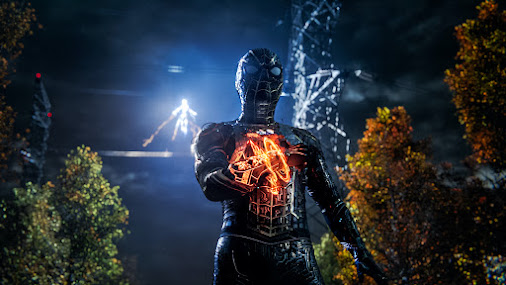
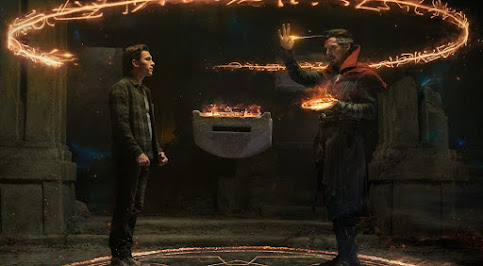
When the whole world is told that Peter Parker is Spider-Man, that doesn't turn out so well for Peter. But it's not until his best friend Ned and girlfriend MJ are tainted by association—rejected by MIT for reasons of "controversy"—that he decides to act. What he does, with help from Dr. Strange, doesn't turn out so well either. They open a rift in the multiverse, and people start filtering in who know that Peter Parker is Spider-Man. Strange, villainous people who Peter doesn't know. (But we do!)

Time for Peter to make some choices and mistakes of his own.

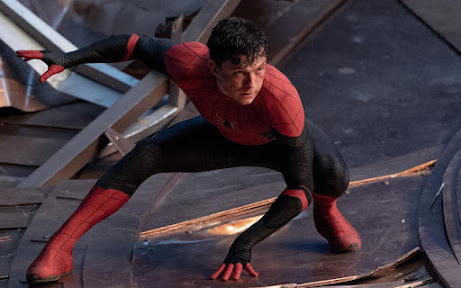
I've long been on the outs with the MCU. But I have maintained a hope (a faint and fading hope, as Gandalf would say) that Tom Holland could make a great Spider-Man under the right circumstances. So even though I'm not interested in the interconnected Marvel universe anymore, I wanted to continue giving Spider-Man a chance—and I'm glad I did. My favorite aspect of Homecoming was that director Jon Watts seemed to be working hard to keep Peter grounded, even through the over-sized stakes and "bigger is better" and "connect everything" worldview that the MCU brings. In this third installment, Watts connects things, makes it bigger, and ups the stakes like he's supposed to, but he also has reason to. He uses the required method to give me what I want—a Spider-Man that isn't under the thumb of the MCU.

At least, not as much. This story asks the question, "what does it REALLY mean, to be Spider-Man?" and then it answers it, by using past Sony Spider-Man's (Spider-Men?) Spider-Men as the standard to be measured by. Tobey Maguire and Andrew Garfield make real appearances, not just cameos, and they're treated with reverence and respect. Holland's Peter makes well-intentioned mistakes and tries his best and then learns from the Spider-Men that his good intentions and trying his best is the Spider-Man way. He learns that bad things happen despite his efforts but is encouraged by them to keep going, because "with great power comes great responsibility." And his efforts cease to be a joke or some fun side-gig where he gets his suits made by Iron-Man, his missions from Nick Fury, and team-mates from the famous Avengers roster. He grows into a full-fledged Spider-Man, and it's a little bit glorious. 

Holland has always been the best thing about this iteration. This movie aspires to be worthy of him.

The path taken to get him there... is a little bit messy. One by one the past hang-ups are put to rest. No more Stark glasses. No more voices inside suits. No more adults making decisions for Peter. No more villains whose real beefs are with Iron Man. No more double life. And with every step taken, the movie feels more and more like a classic Spidey film, and less like a Marvel drone. The jokes are funny sometimes. The characters are like real people, not awkward or unfunny on purpose. There are dramatic moments that aren't undercut by humor. There are humorous moments that have underlying pathos. There is an end goal throughout besides "make money with CGI." Gosh, even the more blatant fanservice moments didn't make me angry, because they were calling back to the old classics with genuine glee. 

It feels messy because the movie is about cleaning up a mess—in the storyline, and in real life! The process is not streamlined. There are moments when it's a chore, but the end result is satisfying in the same way all things are when they're clean and used to be messy. And as the mess dwindles, we get a look at how Holland's Spidey works unencumbered. And he's fantastic. Peter uses his fast thinking in creative ways during the fights, and Holland's physicality plus the magic of modern effects and choreography make the action land in real and entertaining ways. And the character dynamics between him and his friends and family take on a more serious edge as he weighs the consequences of his actions and relationships. 

One of few MCU films that actually needs most of its 2 & 1/2 hour runtime. It's a big mess to clean.

The returning villains weren't my favorite thing ever, but I appreciate that they were not turned into jokes (which was what my cynicism expected) and instead added real value to the story. Especially Alfred Molina's Doc Ock and Willem Dafoe's Goblin. Spider-Men Maguire and Garfield steal the show, so I'm glad they aren't in the whole thing. Most of the movie's best, most engaging emotion comes from them—maybe because of nostalgia, maybe not. All I know is they leave the current Spidey in a place I'd like to see more of. It feels like a set-up for a fresh start. One that already has a good cast in place, and has proved it understands the Spider-Man mantle better than past endeavors indicated, and is ready to take the character in some more conventional, classic, SPIDER-MAN directions. 

No Way Home is a messy, sprawling, fun, and ambitious film with a determined goal, real stakes, real consequences, and a real end result. It stops trying to reinvent the character and embraces what's always been this version's strengths, while bringing back some of the classic strengths of Spider-Man, as well. It has brought our friendly neighborhood Spider-Man back to his friendly neighborhood life.

Monday, December 7, 2020

The Personal History of David Copperfield

Dev Patel is well-off, then bad-off, then well-off, then bad-off, and then well-off again in this brisk and charmingly color-blind adaptation of Charles Dickens' novel.

I wonder if they thought, "Dev Patel would make a great David Copperfield" and then decided to ignore race in the casting, or if they decided to ignore race, and then realized Dev Patel would make a great David Copperfield.

Two hours of screen time is not long enough for an 800-page novel. I've yet to read it, but I don't need to know what was shortened or cut out to know that it was done. Severely, I expect. And that's why I'm glad I saw this before reading it. Because I enjoyed it immensely, and though I know I'm missing something, I haven't a clue as to what. Well—I do in a general sense. But more on that later. At first brush, David's journey of growing up and becoming a writer, surrounded by a rollercoaster of ups and downs, and an even more wild ride in the forms of eternally kooky supporting characters, feels like Dickens 100%. If you get a Dickens itch, this will scratch it.

It speeds along through the plot at sometimes too great speeds, although it never gets exhausting and has good pacing. The only thing I waited for was for young David to grow into Dev Patel—and once he did the film came alive and found its lively and comfortable groove. I don't know what David's personality is supposed to be like, but Patel seems to me a Dickens hero through and through. Easy-going, energetic, funny and sincere with occasional outbursts of anger and naïve stupidity. Ideal. Tilda Swinton, Hugh Laurie, Peter Capaldi, Rosalind Eleazar, Benedict Wong, Aneurin Barnard, Morfydd Clark, and Ben Whishaw all added to it, but it was Patel who made the movie sing.

There are some first-rate scene transitions in this thing.

The problem comes in when the movie reaches the dramatic parts that are meant to have stakes, and you realize that they were skimmed over so quickly that it's tough to figure out what bad had happened, let alone care about it. This movie hits the colorful, charming, and fun notes remarkably well; but in order to be fully satisfying, a story needs the audience investment that serious drama brings. And while it's not lacking in it completely, it was frustrating when the movie ended, and I realized the film had only included us in half of David's experiences. We get a full sense of his happiness, but the trials are cut short and brushed aside. I grasped that Ben Whishaw was the movie's main villain in the same scene in which he's defeated. I had no time to care. Without the downs of a story, how can an audience fully appreciate the ups?

So it left me fully charmed, but only partially invested. And that's too bad, because while I like being charmed, it's getting into the nitty gritty of caring about the characters that ultimately most important to my falling in love with a story. Still, you can hardly blame The Personal History of David Copperfield for focusing in on what it did. It may have left me a little empty, but it clearly wanted to focus on the brighter side of everything and have fun, and that's what it did. All in all, its shortcomings left me wanting to read the book—and that's a compliment in itself. 

Friday, August 14, 2020

The Raid: Redemption

Spoiler-free!

This energetic and brutal Indonesian action flick centers around Rama (Iko Uwais) who's a newbie member of a SWAT team tasked with infiltrating a 30-story apartment building that's run by a ruthless drug lord.

Written and directed by Gareth Evans.

The plot is simple so you can get to the action fast. But it doesn't jump straight into it either. It takes the first act to set up things. Like stakes. Rama has a wife and unborn child at home, so you don't want him to die—bam. He also has a secret secondary motive for going into the building. Bam. And, the movie wants us to see exactly how dangerous this mission is before it lets loose—resulting in some slower moments earlier on of dramatic tension-building. Bam! None of it is as deep as it might be were the film longer, or a straight-up drama; it's there to support the action. Knowing, I suppose, the tendency of people like me to tune out when there's a fight scene going on in which I don't actively like AND worry for the characters involved.

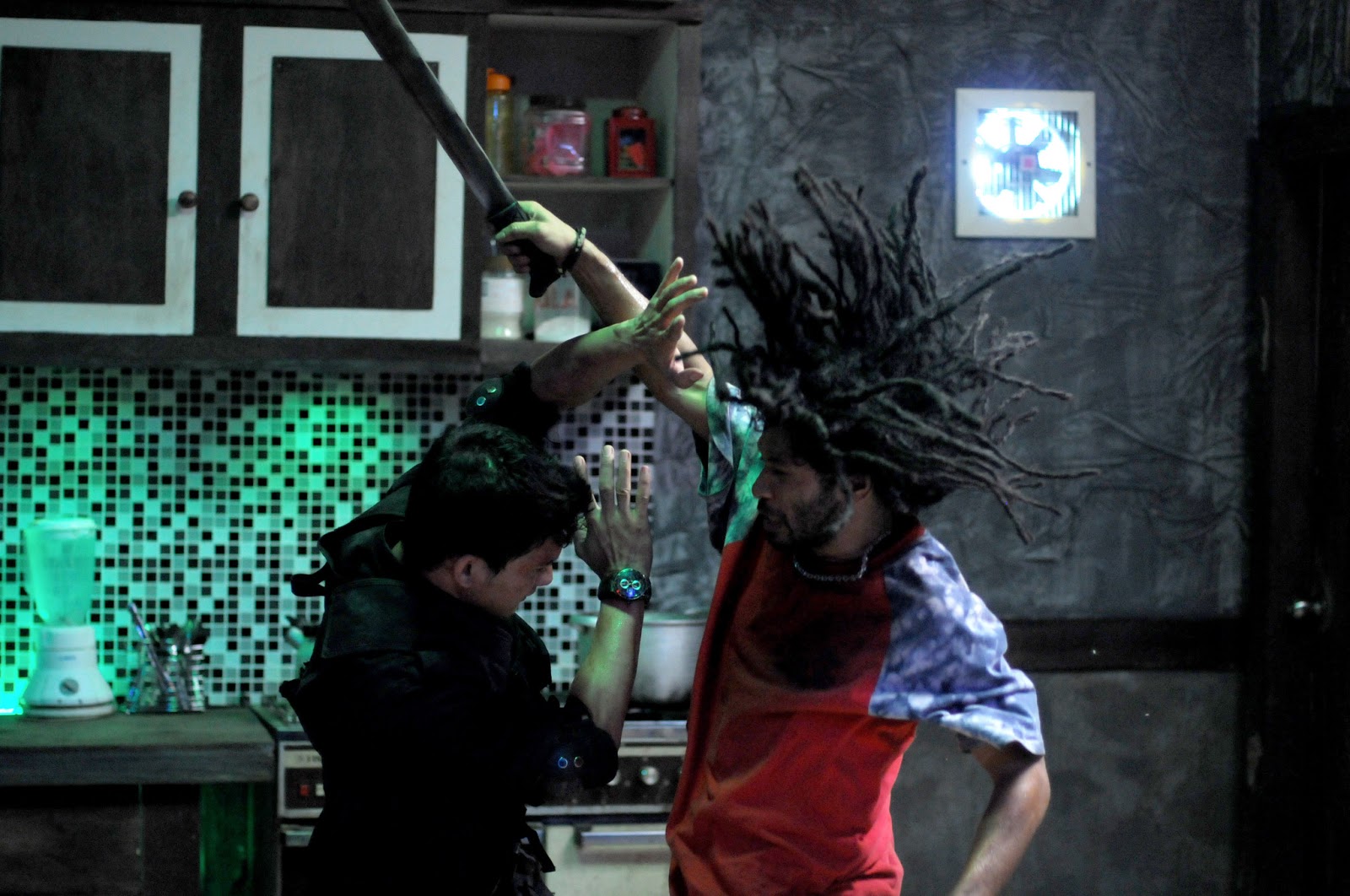
Once you care about Rama and the stakes are built properly, it's basically wall-to-wall action from there to the end—punctuated by a few breathers and moments to mount up more tension. And this is the meat of the film; the reason it exists. And I know; there are so many action movies that exist on their action and are terrible. For a recent example, The Old Guard. I cannot stand movies that rely on their middling action to be entertaining. I hate them. I do not hate this movie. The action here is phenomenal. Firstly, filmed in an accessible manner because we have to be able to properly appreciate the talent put into these fights. Then performed by actual trained fighters. I'm not sure what the style is, but it's a brutal and entertaining martial art.

You've probably seen Iko in a movie before even if you don't know it. He was wasted in a bit part in Star Wars: The Force Awakens

Iko Uwais is also one of the film's choreographers, and basically everyone in the film is a highly-trained stunt man playing an acting role. Because the choreography is fast, difficult, done in-camera, and impossible to fake. The speed at which these guys can punch—or pretend stab each other—is stunning. Dizzying. Mystifying. Perfect glee-inducement for any action fan. At one point a guy is slammed into a table and the table doesn't break. If you're not as tired of rote American action tropes as I am you might not even notice things like that. A table behaving the way a table would in real life? Novel! And I suppose this flick has its own share of clichés—Indonesian-brand ones—in there somewhere. The shake-up is refreshing, that's all. And you'll never find an American action flick that's this kinetic and full of hand-to-hand combat talent.

American films can be good at faking it, or maybe building around one skilled performer; this is clearly the real deal—and that's what pushes this film into must-see territory. Without the outstanding choreography and remarkable implementation of the same, The Raid could be any number of decent stabs at action filmmaking. It's got the basic but solid plot, self-contained to one main location to streamline the story and help the budget; and it has a decently fleshed-out main character to keep things grounded. But then. BUT THEN. It uses that simplistic set up, and it absolutely KILLS. Pure action is often a hard-sell for me, but I recommend this one unreservedly.

Saturday, July 11, 2020

Palm Springs

Spoiler-free!

It's the wedding day of her little sister, and Sarah (Cristin Milioti) isn't feeling it. She's saved from a maid of honor speech she didn't know was required of her by a strange guy in swim trunks and a Hawaiian shirt who gives a speech that she feels like is directed at her. Then he dances through a crowd as if he knew every move each person would make. Weird, but funny. He's Nyles (Andy Samberg) and the day only gets weirder from there, once they go out in the desert together and a man with a camo-painted face starts hunting Nyles with a compound bow. Sarah follows Nyles into a cave where there's a weird orange light -- and then wakes up on her sister's wedding day. Again.

Now available on Hulu!

Yep! It's a time-loop movie. With the slight twist that people can share the loop. Nyles has been there a long time, and so has bow-hunting man (J.K. Simmons), and naturally, Sarah's mad that she got stuck too, even though Nyles definitely told her not to go in the cave. How to escape the loop? And what to do to fill the days until they figure it out? Well, the movie has a fun answer for the first question. It's answer for the second is a mixed bag.

Since the death of the 90's rom-com, every rom-com now must have an explanation for when there's a slightly fantastic element needed to create the situation. Bill Murray's time-loop had no explanation, nor did it need one. But this movie does. I find that unspoken requirement worryingly limiting, but this flick takes good advantage. It's scifi streak is one of the better things it has going for it. The movie is strongest when the streak is more prominent. It's mostly at the beginning and the end, when you feel the weight of the weird, impossible circumstance, and the characters have a clear goal in front of them -- of escape.

Without a goal the movie begins to sprawl distractedly.

In the middle, particularly the earlier middle, it's more about having fun with the loop and doing all the things you'd do if you knew what will happen every day. This is where mediocrity creeps in. Perhaps slightly because both our main characters are aware and make different choices every day, so the looping doesn't feel as present. But they're also put away from the wedding party too often, which gives their days unwanted variety. The repeated moments are limited to one or two lines, never entire scenes or even conversations. Instead they get to know each other through the days. Almost like a normal rom-com. But the film does insert some character mysteries for the audience to pick up on during that time, too.

These "mysteries" were my favorite thing because of the slight way they were introduced, and then handled to bring some genuine depth to the characters. The film still leans heavily to the comedy side, but a little drama and a tad of darkness rounds out the tone. Even more rounding would have been welcome if handled well. But Andy Samberg is far more suited to comedy anyway. He ranges from charming to cynical, but it's all for humor. Cristin Milioti isn't as effortlessly funny, but also digs in deeper for the dramatic moments. Their chemistry was bubbly and warm, which sets a pleasant, light-hearted feel for the film. Even when the movie went too far for me, it was hard to be irked for too long.

I didn't fall in love, but I was charmed enough to not care.

Palm Springs doesn't waste its time trying to stand out from the pack of movies that took inspiration from Groundhog Day. Instead, it embraces the comical situation, feeds the expected romantic side without too much cynicism, and doesn't neglect pondering a little on the deeper side of life, with a lightly life-affirming message. It throws a few new elements at us to keep us on our toes, but at its core, it's classically done. And though the execution isn't without missteps or unnecessary rabbit trails, it clearly understands the appeal of this niche and always fun premise. Like a familiar and cozy place that you can visit again and again.

Sunday, March 8, 2020

Emma (2020)

It is my firm belief that Jane Austen's books should see a new adaptation every ten years or so, and so far, filmmakers have been very dutiful in humoring me with this work in particular. Emma is the most broadly appealing of the Austen works, playing out as a sharp and lively rom-com in regency-era settings. It has been adapted to film five times by my count, and this fifth one, with Anya Taylor-Joy in the title role, is keen to not feel repetitive.

And so, it's directed with style, by Autumn de Wilde.

It is a faithful adaptation. And honestly that's all it needs to be to earn my seal of approval. But it goes beyond that, too. In its eagerness to make itself stand out from the pack, it puts much effort into its visual style, and also focuses down on a few key emotional and thematic elements to make the story stick; which as a side-effect means that elements that don't involve those key parts can be left wanting. Attention is mostly given to the character of Emma; to see how far into her flaws you can delve before she loses her appeal and charm. In that case Anya Taylor-Joy was the perfect choice to play her -- at least for me, since I am already biased to like her. The movie is upfront about her flaws, but successfully allows us to also see the good heart underneath too, as she works tirelessly, yet misguidedly, to improve the lives of those around her.

And yet, little of the film's focus is on acting. Casting was done, it seems, with stress on appearance, and the result is mixed; characters who look right on surface might occasionally feel out-of-sync with the characterization. I wasn't enraptured by any of the performances but think positively of them all. The characters that were explored deeper sometimes seemed squished to fit a mold that the direction laid out, but worked beautifully when the natural charm of the actors would shine through. Especially with Mia Goth as Harriett. Taylor-Joy is a commanding and charming lead, but some of the emotions Emma expresses are intentionally simplistic. The only way I can account for this is in the assumption that the film cared more about being different from other adaptations than it cared to be natural or instinctive about the character's thoughts and reactions.

It didn't want to copy anything -- but that's a hard task when so much has been done already.

And then some characters were only explored on surface level. This isn't any fault of the actors, but the result of a script that simply doesn't have time for them all. That's the eternal problem with Austen adaptations: you can't reasonably expect any theatrically released romantic comedy to be over two hours, but unedited, Emma's plot is too complex to fit into less. So, adaptations rise and fall on what they choose to leave out. This one leaves out a few things I would have wished to see -- like more of the truth behind Frank, or a more groan-inducing look at the detestable characters such as the Elton's -- but it also includes at least one part that none other adaptations have as I recall, and some small, original moments that serve to build the film's emotional core in the desired direction.

If it lacks one thing for sure, it is cheerfulness. While often funny, the humor is more cynical than light and gleeful, and moments of negative emotion are handled with more care. Again, intentionally directed focus. It's more interested in seeing the error of these people's ways than basking in the humorous ridiculousness of human folly. I love that Jane Austen was able to take things lightly, and I missed that sense of unadulterated enjoyment here. Small quibbles involve some bizarre choices made: the men's collars coming too high on their faces, an unexplained moment where someone's nose bleeds for no reason, and one or two off-putting moments of undress. I will always find that kind of thing unnecessary in Austen films -- but will likely never escape them.

I wasn't wowed by the style, but didn't need to be. Style or no style, it hits the right notes when it should.

The camera placement is hard and bold; sometimes to the detriment of the scene, when it cannot find a reason for its actions. Too often the style was done for the sake of style itself and contributes little to the overall quality -- as nice as uniquely pretty costumes and bright green fields are to see. It doesn't integrate itself into the story. Lines are often ripped from the pages which I love, but then occasionally there were silences between those lines, meant to be charged with emotion and context, that came up dry. And Austen's dialogue, ready-made and sparking with wit, was sometimes delivered almost as a side salad to the high-brow slapstick comedy the film invents for itself. A bizarre disconnect.

The scenes that do meld, and do connect -- which make up the majority -- are wonderful and innate. I wish the film could have found that stride throughout its run time, but I think it opposed itself too often and tripped itself up from time to time. It is funny, it does have moments of great charm, thoughtful sincerity, and smile-inducing romance -- but most importantly, it's a solid adaptation of Jane Austen's winning story. Not quite perfect, but no matter: we can't all be as perfect as Emma.

Wednesday, February 5, 2020

Parasite

Spoiler-free!

This Oscar-nominated South Korean dark comedy tells the story of the Kim family. It all begins when the son, Ki-Woo (Choi Woo-Sik) is approached by his friend who's hoping he'll take over tutoring a rich girl he likes. He trusts Ki-Woo not to steal her out from under him, and doesn't care that he technically isn't qualified to tutor. Ki-Woo's sister Ki-Jung (Park So-Dam) forges university papers for him and he's off. But the rich mother also has a son who she considers a budding artistic genius. Ki-Woo sees an opportunity for his sister to get in on the enterprise too, and soon she has become a "prodigious art teacher." The next steps are to get their also unemployed father (Song Kang-Ho) and mother (Chang Hyae-Jin) into the household, but that may take more than some white lies and the slope keeps getting slipperier...

The Kim family! Pleasant, charming, devious, criminal.

The big appeal of this story is how unique it is. A poor family that literally lives halfway underground in a cramped and stink-bug infested home, slowly and steadily infiltrating a rich home that sits high up on a picturesque hill. While they're on top of the world, the Kims talk of living in the house as theirs -- and in a way they do. And when they're low, they're literally existing in the gutter with sewage surrounding them. It's fascinating to watch their plans and schemes unfold, especially because plans never go the way they're planned to. The plot is like watching a slow-spiraling plane crash and a beautiful rocket launch at the same time.

Bong Joon-Ho of Snowpiercer fame is the writer/director, and his craftsmanship is tight and full of unique style. He excels at creating unprecedented situations and placing characters into them that are interesting and different so as the navigate the situations in an entertaining and unique way. Here I especially liked the family dynamic, where they all just kind of accept the criminality of the scheme from the get-go, and work together like gears in a clock to get it all done. Bong creates instances of darkness and comedy that exist together perfectly. There's moments of joy, tragedy, horror, and thoughtful fascination. The look of it is rich and sticks with you. It's all-around a beautifully crafted piece.

But a well-crafted film doesn't equal a universally great film on its own. 

And yet, despite all this, I didn't love the movie. I was entertained, amused, horrified, and fascinated by it, but I could never cross the threshold into love. I've thought about why, and have concluded that I couldn't care about the story and characters in the way I need to in order to love a story. And it's not because the characters are bad people, per se -- that makes investment harder but isn't a deal-breaker for me. This movie asks its audience to sympathize with the Kim family, and I could. Especially Ki-Woo, who participates the least in the wrongdoing and who the story somewhat centers around. He has a naive hopefulness to him that invites pity more than blame. And you do feel for the situation the family begins in. They are poor, but talented, and have grand aspirations. What's not to sympathize with?

However, in their pursuit of riches and comfort, they bulldoze anyone in their way -- not only their elite targets. It's also worth mentioning that the rich Park family are not bad people. They're aloof and careless in how they deal with people, but never "cross the line," as it were, into law-breaking. And the Kim family are equally as careless of anyone not a part of their clan. So I found it hard to root for them, as their redeeming qualities dwindle over time. I don't think the film needed me to root for them, but without the investment that caring for characters brings, the impact of the film's later events is severely lessened. They're merely interesting, which the movie always was. There's no switch in which I became engaged on a personal level -- something vital for me to care about a film, if not to appreciate or admire it.

We all feel inferior from time to time. We all get that sense that people can smell that which we want to hide. Most of us already know that it's no excuse.

It frustrates me the more I think of it, because with the right tweaks I could have easily invested -- but I'm beginning to doubt that's what the film wanted at all. Ki-Woo is who we understand best, but once Ki-Jung enters the house, she overshadows him completely. She's that kind of person -- fascinating, and captivating to watch, but fake. We never know her. We know the father, Ki-Taek, and once he comes along he overshadows both the kids, but his motivations never sat well with me. I wanted to understand the kids better, but we never get a real chance, and by the end I didn't know any of them well enough to care what happened to them. Being hard up is not a character trait. It's a circumstance; and one that isn't automatically deep enough to forge a connection that would inspire me to look past certain behaviors.

So in the end, interesting is all it could ever be for me. For other people it was more, and I can see why. I want to mention that, because perhaps you reading this may be one of those people. Or maybe you're the sort of person why doesn't need to care about a film's characters in order to love the film itself. Either way, if you love dark comedy that is both rich with seriousness and light with wit, and if you like to see a unique plot unfold that you've never seen before, Parasite may be well worth your time, and your riches -- such as they are.

Monday, November 4, 2019

The King

Spoiler-free!

A Netflix film about King Henry V -- not the Shakespeare version, though it's certainly equally as speculative. Timothée Chalamet stars as Hal, who reluctantly takes the throne after Henry IV dies and Hal's brother who wants the throne (and Hal wants him to have it too) is killed in battle. The film then speculates on the reason why Hal decides to conquer France. And it's an interesting plot in the end, though I couldn't say whether it's based on truth. I expect not.

Directed by David Michôd (The Rover, Animal Kingdom), co-written with Joel Edgerton.

Any film about Henry V would be boring if it weren't speculative and even this one toes the line. But before I turn you off from it accidentally, I have to say I'm writing this review because I enjoyed it much more than I was expecting to. It's a flawed movie, but my ultimate goal here is to recommend it. With that noted, its main flaw from my perspective is a severe lack of personality. You almost don't notice all the great things that happen because the film has either no idea or no intention of serving them up in a cinematic, dramatic storytelling way.

Maybe it was trying to be subtle. It was certainly trying to be subdued, with its lingering shots on expressionless faces and dulled color palate. But more it seemed like it didn't know where to put the dramatic emphasis. Early in the movie there's a slow-mo section of Prince Hal and his degenerate bar friends getting drunk and laughing. The scene is played up and accompanied by dramatic music, but there was no emotional weight within that scene that would benefit from the enhancement. Later, moments that do carry emotional weight and could have used a stylistic pick-me-up are comparatively breezed by and left less effective.

Every time a character dropped an F-bomb it completely threw me back into the modern world. That may have been the biggest flaw of all.

Now, this is a flaw that could render the film boring to casual viewers, but if you're interested in getting a good story out of this, it is there. You just have to pay a little closer attention because the film isn't going to serves the highs and lows properly. The characters are the highlight. Chalamet underplays Hal in a way that works with the movie's dulled and subtle tone, giving enough detail to the performance that the character isn't lost. And he is written well, which is most important. Joel Edgerton is back in form with his endearing portrayal of Falstaff. And the other characters that weave in and out fill out the tapestry nicely. Ben Mendelsohn, Dean-Charles Chapman, Sean Harris, Robert PattinsonTom Glynn-Carney, Lily-Rose Depp, and Thomasin McKenzie all bring their brief characters to life.

The secondary problem is that the narrative has little structure. A flaw that can be traced back to lack of emotional rise and fall, and the brief interludes of characters. They are too brief, populating the story for moments, then fading away without having accomplished anything relevant to an overarching story, as good as their individual scenes may be. I quite liked Thomasin McKenzie as Hal's sister; but can't figure why the movie thought her a necessary or relevant inclusion. Once the end is reached you can see a trace of structure looking back, but in the thick of it the story seemed nothing more than a collection of irrelevant scenes and neat vignettes.

At 2 hours and 20 mins, you need to be able to dive in and appreciate that it takes its time, or else you'll just be counting down the minutes until it's over. 

The best of these moments were the battles. They were few are far between but were built up to and executed shockingly well. The one-on-one combat had a scrappy and unchoreographed feel to it that I appreciated, and the main battle against the French was planned and set up fascinatingly. The siege, though brief, looked incredible; in general, the effects and staging were of impressively high quality. If I had to recommend this film for only one reason it, would be the combat, though it takes up perhaps 20% of the film at best. The rest is lackadaisical-but-good character drama and emotionless-but-dedicated building to the fights.

Of Netflix-distributed products these days, it's far easier to do worse than The King than it is to do better.

Thursday, September 5, 2019

Time Lapse

Spoiler-free!

In this 2015 science fiction indie, a waitress (Danielle Panabaker) her starving artist boyfriend (Matt O'Leary) and their shady roommate/friend (George Finn) band together to improve their collectively unfulfilled lives when they discover that their missing neighbor across the way has a camera that takes pictures of them through their window -- pictures of them 24 hours in the future.


It's a simple scifi premise. Prefect for the low-budget, low-fi indie endeavor that this movie is. It doesn't attempt anything beyond its ability, and doesn't need to because of how small, contained, and practically doable the story is on a penny. It's a premise ripe for character dramas and dilemmas, and for pondering on causality, and the effects of something even so small as 24-hour future-prediction has on a person; how far they will go to use it to their advantage, how dangerous it could be, and the natural degradation of humanity it would easily bring.

And that's where the movie delivers most and finds its worth. It may look at first glance like an everyday scifi indie that's decent but ultimately forgettable, but with a sturdy script that focuses on one great idea, it separates itself in the end and sticks in your memory. I've seen it perhaps four times now, and I still lie awake in bed at night from time to time, pondering on it. It's the conclusion that brings everything together in a superior way. Your mileage getting to that great end may vary however, as the middle section is the most obvious direction-wise and the quickest to dull.


And while we're on questionable content quality, you may expect, and be correct about it -- that the acting isn't the greatest, nor the visuals anything to write home about. They get the job done, and that's all. They don't cut any corners, and the main pair of Panabaker and O'Leary (two fairly recognizable faces especially for anyone who watches The Flash and Agents of SHIELD) they are capable and clearly give it a good effort. It's just not exceptional. And I say that to point out that it doesn't matter; the exceptionalism comes from one specific place, and elevates the rest from fine to great.

I watch smaller flicks that don't provide anything more than mediocrity all the time, especially in the scifi genre because I can't get enough of scifi of any sort. So I don't mind the bits of lower quality this film brings. I wanted to mention it anyway in order to encourage you to give it a change even if you usually wouldn't. Some may predict mediocrity as first glance; they would do the movie a disservice. I can't tell about the impact it has, or specifically about the brilliance it brings because I don't want to spoil anything. But it's there; hidden and waiting to be discovered.


So what if this movie only had budget for two decent actors and a photo of John Rhys-Davies? Good stories are more than the tools used to tell them, and this movie makes the tools work for it; making an admirable and dedicated effort, focusing down on the core elements to make the story impactful, and pulling it off magnificently. A small budget must-see for fans of scifi and time-travel!

(Currently streaming on Amazon Prime.)

Friday, June 7, 2019

The Ash Lad: In the Hall of the Mountain King

Spoiler-free!

In a fairytale kingdom, there is a legend: if the princess doesn't marry by her 18th birthday, a troll will steal her and make her marry him. Well, the headstrong princess, Kristin (Eili Harboe), doesn't want to marry. And no one believes the legend anyway. With a pompous idiot Prince Fredrik (Allan Hyde) as her only option, she runs away. In the forest, she runs into Espen (Vebjørn Enger) and he gives her food. When he goes home to his father and brothers Per (Mads Sjøgård Pettersen) and Pål (Elias Holmen Sørensen) with all the food eaten, we learn that he has a bad habit of being unable or unwilling to get anything done. His family leaves him home alone while they go hunting, and by morning the house has burned down. Oops.

About time I found another gem in the less-explored corners of Amazon Prime!

Then the pompous Prince Fredrik comes by asking if anyone's seen a beautiful girl. The king has offered a reward for her rescue: her hand, and half the kingdom to rule. Espen's father sends Per and Pål to search for her -- it's their only hope of saving their farm -- and he tells Espen to go and never come back. But Espen knows the girl he met was the princess. He thinks he can find her, and if he saves the farm, perhaps his father will forgive him for burning down the house; for being an Ash Lad. So, he sets off after his bothers, determined to do something for once, and determined not to mess it up. Grand and fantastic adventures ensue.

In a way it's very comparable with The Voyage of the Dawn Treader. And more the book than the film adaptation. Though there's no sailing, there's a similar fantasy flavor, and the adventures are done in little vignettes where the brothers get into a situation, get out, and then get into another. And they all have that exclusive fairytale quality -- helping an old woman whose long nose is stuck in the crack of a chopping block -- escaping enchantments -- finding a magical sword -- and map -- and of course dealing with Prince Fredrik. Eventually shifting into troll territory in the third act. Throughout, the brothers' relationship is explored as Per doubts Espen's ability. Slowly, he proves himself.

Turns out he's a pretty great adventurer!

That was the main highlight of the movie for me. Much of the traditionally styled plot you can see coming, but their dynamic propelled the whole story. Stories with that extra effort are great by themselves, and this movie couldn't have been the gem it is without that meaningful personal side. But in the end, if the surrounding world of production doesn't work, neither will the story, and it's the winning combination of those two sides that makes this flick worth its praise. The performances are entertaining and energetic, making the characters easy to love or hate (depending on intent), and the world is beautiful; saturated richly, and filmed on locations to give a sprawling sense of adventure.

The troll is kept hidden mostly but not in a blatant, we-don't-have-enough-money-to-show-it kind of way. The effects on it are noticeably CGI, but not any worse than, say, the giants in Jack the Giant Slayer, and the troll design has more personality, too, not looking like a mass of flat brown lumps. In short, this movie is made of good quality material. No, it's not a multi-million-dollar Disney project, but all that means is it doesn't look flat and dull or have its heart and soul green-screened out. Visually this movie is wonderful; bright and lovely, not flashy or overdone, just as real as possible. I love that. And ja, it's in Norwegian. I love that, too.

I found it in December but couldn't watch it until Amazon added an original, non-dubbed version. 

They just don't make satisfying fantasy films in America anymore. They're all scifi without the science, not magic and myths, or are too serious, or real-world, or trying to reinvent the genre. I've been feeling a horrible deficiency of highly adventurous fantasy -- the kind of fantasy that soars, and transports you, pure and clean and with a heartfelt message on the side -- and The Ash Lad fills that void to perfection. A grand, magical, and uplifting adventure.

And there's a sequel coming! I have no idea when it'll be available to me, but I anticipate the day with glee.

Monday, May 13, 2019

Pokémon Detective Pikachu

Spoiler-free!

I am not educated in Pokémon, so forgive me for the following. That's the thing about this movie though -- it trusts its audience to know, or to be able to pick up with minimal exposition, and that opens up a ton of space for expansive storytelling. Also, wise-cracking one-liners and fuzzy yellow adorableness!

And old-fashioned mystery!

In a city where humans and Pokémon live in equality, Tim (Justice Smith) gets the news that his estranged detective dad has died. When he goes to clean out his apartment, he finds a deer-stalker-wearing Pikachu, and is surprised to find that he can understand what he's saying. (I suppose it wouldn't occur to him to be surprised that he sounds like Ryan Reynolds.) Pikachu claims to be Tim's dad's Pokémon partner, and though he has amnesia he's almost certain that Tim's dad is still alive. They join forces (reluctantly on Tim's part, who used to be obsessed with Pokémon but now wants nothing to do with them) to track down the trail of clues in search of him.

Instantly you get an old detective noir vibe which pairs perfectly with the cyberpunk world. They lean into it more than is required, and as a noir fan I appreciated that. It's mostly present visually, with the apartment buildings and Venetian blinds and neon cityscapes, but there's also a hardboiled interrogation (through mime for a good laugh), dramatic plot twists, a secret laboratory, and shady characters. And an intrepid, spunky reporter girl (Kathryn Newton) who knows something sinister is going on. The plot is easy to follow and if you were inclined to think ahead you might figure out the destination fairly quickly, but I was simply too swept up in the story and fun atmosphere to even try and predict anything.

Bill Nighy and Ken Watanabe are also there. And another Deadpool vet, Karan Soni has a cameo type role.

In cases like this it helps to be like a kid, oblivious to tropes and probable outcomes. It is a kid's movie after all. But it's also good nostalgia fodder for adults too, who grew up with the game. I didn't myself, and felt a warm welcome stepping into the Pokémon world for the first time. It's good nostalgia because it doesn't draw attention to that aspect. It doesn't even appear to be made with adults in mind, just age-appropriate at such a high quality that anyone can enjoy. It deserves to have fun with silly tropes and to not worry about a complex plot or trying to avoid cliches. Those things are naturally included, and it does justice to them instead of attempting to circumvent them out of fear or misunderstanding.

It's like a throwback to before tropes were taboo -- and to a time before the Great Franchise Push. This movie attempts no sequel-baiting, and leaves no ends loose. It's a complete, stand-alone story, and that may be my favorite thing about it of all. Fully rendered; leaves nothing off the table; explores as far as it can as fast as it can, knowing this is its one shot to satisfy. The world building is effortless because of how much ground is covered. It doesn't dawdle but is eager to move further, and forward, to the next cool place and the next fun and informative scene. Plentiful fun and plentiful content, existing together instead of distracting from the other.

As it should be for a no-holds-barred entertaining time!

For instance, there was one action sequence that I found incredibly boring, but they moved on from it so quickly that it barely made a dent in my enjoyment. And I know there were one or two jokes that I didn't find at all funny, but since none of the jokes are overplayed (hello, Marvel) I simply forgot them, and there was no ill effect. The whole movie seems to exist because of how funny Ryan Reynolds can be, so scene-stealing might be expected, but he doesn't. Certainly not from Justice Smith, even though I expect he could have without proper control. The characters are crafted to work together and play off each other, so there aren't distracting rabbit trails of one-upping humor.

The story is Tim's, and Smith carries the movie more than you'd expect, and does it well. The best work I've seen him do. And Reynolds isn't solely for comedy though that's where he shines. Tim and Pikachu's developing friendship has all the ups and downs that a good story needs, and the movie doesn't shy away from drama. It pulls off a winning theme to hold together all the adventuring, detecting, action, and comedy with the glue of deeper meaning. And the structure is very solid. I feel silly being impressed that it didn't fall apart in the end, but that's just the standard of late I suppose. All my issues are in details and are less missteps than things that didn't work for me personally.

There was basically nothing that detracted from the movie objectively. Even the bits I didn't care for are hard to recall.

It's not going to turn me into a Pokémon fan or anything, but since I've always been a fan a solid and meaningful stories, with engaging characters populating vast and fantastic imaginative worlds with devotion and humor -- it did all it needed in order to leave me happy as a Pikachu getting his chin scratched!