Pages

Tuesday, May 28, 2013

The Great Gatsby (2013)

Baz Luhrmann's The Great Gatsby starts out exactly as F. Scott Fitzgerld's stupendous, classic book -- "In my younger and more vulnerable years..." Nick Carraway, who is now apparently depressed and alcoholic stares dramatically out the snowy window, and relays his story to his doctor. The story of how he moved to West Egg, just outside NYC, into a tiny cottage squeezed between two huge mansions, one of which was always alive with wild parties and belonged to a man called Gatsby, and what happened there that summer of 1922.

Spoilers ahead, sweetie. If you haven't read the book, you shouldn't be watching this movie. Or reading this review!

The movie, also like the book is (almost) always in Nick's perspective. His doctor encourages him to write everything down, and he narrates as he does throughout the whole film. Often, ruining a moment he should be only witnessing by jumping in and whacking us over the head with the subtlety that we would apparently never understand without his helpful insight. If you beat someone to death with subtlety, is it still subtle? Tobey Maguire plays Nick, and reminded me very little of his Peter Parker, and when he wasn't smashing his "insights" over our heads, or (over) dramatically quoting the book word for word, I liked him. Still, he was too involved in the story, not a simple observer who reserves judgment. Somehow he was inserted too much into the story, but simultaneously removed, as his entire relationship with Jordan was completely cut.

Nick trying to work. He didn't spend ALL summer observing other people's drama.

Gatsby is the main guy here, obviously. Rich, mysterious, personable Jay Gatsby. Hopeful to a fault. And Leonardo DiCaprio is just as good as he should be in the role. Let me just go ahead and point out that everything in this movie is overdone, most obviously the acting, and if I can, I blame the director, not the actors. That being said, there are some very good things about DiCaprio's Gatsby, and some not-so-good things. The way he said his catchphrase, "old sport" for instance, feels unnatural. It's either because that's how the director wanted it, to emphasize that Gatsby wasn't naturally that way, or, DiCaprio just couldn't pull it off. You guessed it; I've decided to lean towards the former. In general, DiCaprio's performance is very good; he does especially well with Gatsby's mysteriousness, and the desperate way he pursues his dream. His Gatsby is also obviously a man who has worked hard to make himself appear to be someone he naturally isn't.

The mysterious Gatsby.

Now Daisy Buchanan, that beautiful, conflicted girl whose voice is probably the most perfectly described in history. I knew from the moment I saw who was playing her that if anyone could do her justice, it was her; Carey Mulligan. Not only does she fit the part physically, but her voice seems to naturally be exactly what Fitzgerald heard as he wrote those lines about murmuring, music and money. One thing I didn't consider though was the character, and after the movie was over, I realized that Mulligan's Daisy was too likable. I shouldn't be surprised, it's very hard to make Carey Mulligan dislikable, and I doubt that Luhrmann wanted to make her so -- who'd want to watch a romance between two dislikable people? At times she sounded like she was trying too hard to get the voice right, and she didn't murmur enough for me, but otherwise she was exquisite, and I still maintain that she is the perfect choice for Daisy. Luhrmann just didn't know how to use her correctly.

Beautiful Daisy.

Her husband Tom Buchanan is the main character I have the least complaints about. He is undeniably a dislikable character, and played wonderfully well by Joel Edgerton. He lends a kind of tenderness to the character that I saw in the book, and was very pleased when it not only showed in the movie, but wasn't overdone -- I credit it solely to the actor. And of course his violent, racist, and other dislikable traits were there, and done very well. The only thing concerning his character that I missed was when Nick runs into him on the street at the end and shakes his hand. I thought it was an important scene that helps give the story its conclusion, and completes the character arc of both Tom and Daisy. But hey, what do I know, right?

Tom. "One of those men who reach such an acute limited excellence at twenty-one that everything afterward savors of anti-climax."

At first I thought Tom's mistress Myrtle Wilson was strangely cast as the young, cute, sweetly voiced Isla Fisher, but she impressed when she got the chance, which was basically just her introductory scene, but still. She may not have been like I imagined her, but she got the job done admirably. Same goes for her husband George Wilson played by Jason Clarke, except his appearance was considerably more like I imagined him. I would have been happy to see both of the characters get more development, and I think it would have been good for the movie.

Myrtle makes her grand entrance as her men have a chat.

Newcomer Elizabeth Debicki plays Jordan Baker the elegant golf star and fellow observer with Nick. I thought she was a good choice for the role and really enjoyed her part, but her character seems to be the one that ended up mostly on the cutting room floor. She's really only used when needed to develop the story, or is there when she's supposed to be because the novel dictated it. And as I mentioned her and Nick's relationship was almost totally missing; it only progressed as far as it needed to, to develop Gatsby's plot, then was left hanging there uselessly, disappointingly.

Lovely. If only she could have played her part to it's potential.

Now I'm probably going to shock you, and say that I thought that Jay-Z's rap score was a very bold and surprisingly fitting move. I liked the way the cool, upbeat modern music blended with the cool, upbeat music of the twenties, it was very sharp. And speaking of sharp, the costumes! I love twenties costumes, and these, mixed with high fashion, "vintage" tends of today were particularly suave, bold and zesty. I fell in love with Jordan's lavender hat, and Gastby's wardrobe was spot-on and immaculate. Neither the score nor the costumes were truly authentic, but they fit in the style of the picture, making it more relevant to modern times, and really helped amplify the spectacle.

And what a spectacle it was. Nick never describes Gatsby's parties in the movie, (though he describes plenty of other obvious things) for one very good reason; he really doesn't need to. The parties are alive with bright colors, music, noise and people, nearly overwhelming the senses... and I didn't even see it in 3D. The problem occurs when the party is over, and a particular sequence is supposed to be mellower, but attempts to make it more upbeat and dazzling only annoy. The party in Tom and Myrtle's apartment got that treatment and was made way wilder than the book's description implied. During that scene I sat wondering what in the world was going on, hoping the rest of the movie wasn't going to be changed like it, and missing Fitzgerald's description of no one being able find each other in the thick cigarette smoke.

People party at Gatsby's place!

During other sequences, the "glitz-y treatment" results in some weird, distracting computer effects, like flash-backs appearing in the clouds, or Nick speaking lines as they appear in the falling snowflakes. It really snaps you out of the experience. So while they're putting text on the screen, they might as well have put some in flashing red that proclaims "THIS PART IS STRAIGHT FROM THE BOOK" because someone was obviously very proud of the fact, (whenever it was a fact) and it's already being screamed out as loudly as subtext can be -- just go the extra step, and it'll even be ironic!

This Gatsby is soaring in glamorous fashion and overflowing with unique style, but the only way it's like the book is that it's literally (word for word) like the book! Practically everything happens, yet almost nothing is right. Where are the intricacies and subtleties, the real life, the laid back humor, and the wonder? Gatsby and Daisy's over-the-top romance take precedence over everything that really resonates and makes you think when it's all over. Just before Gatsby dies, and falls slow-mo into his pool, he whispers, "Daisy" and words appear on the screen one last time -- "You can start crying now." (Okay, not that last part) Gatsby was obsessed with Daisy, but if we know better, we then begin to miss everything that was brushed aside for some pointless tragic romance. And in that last glimpse of his handsome face floating under digital water, there is no realism; no grim epiphany that Gatsby wasted his life chasing that dream that was already behind him, and died carelessly, alone and friendless; nothing more than a briefly dazzling carnival attraction. That's what this movie is too -- a two-hour showcase of digital beauty, fireworks and parties, and romance. A dazzling, hollow shell.
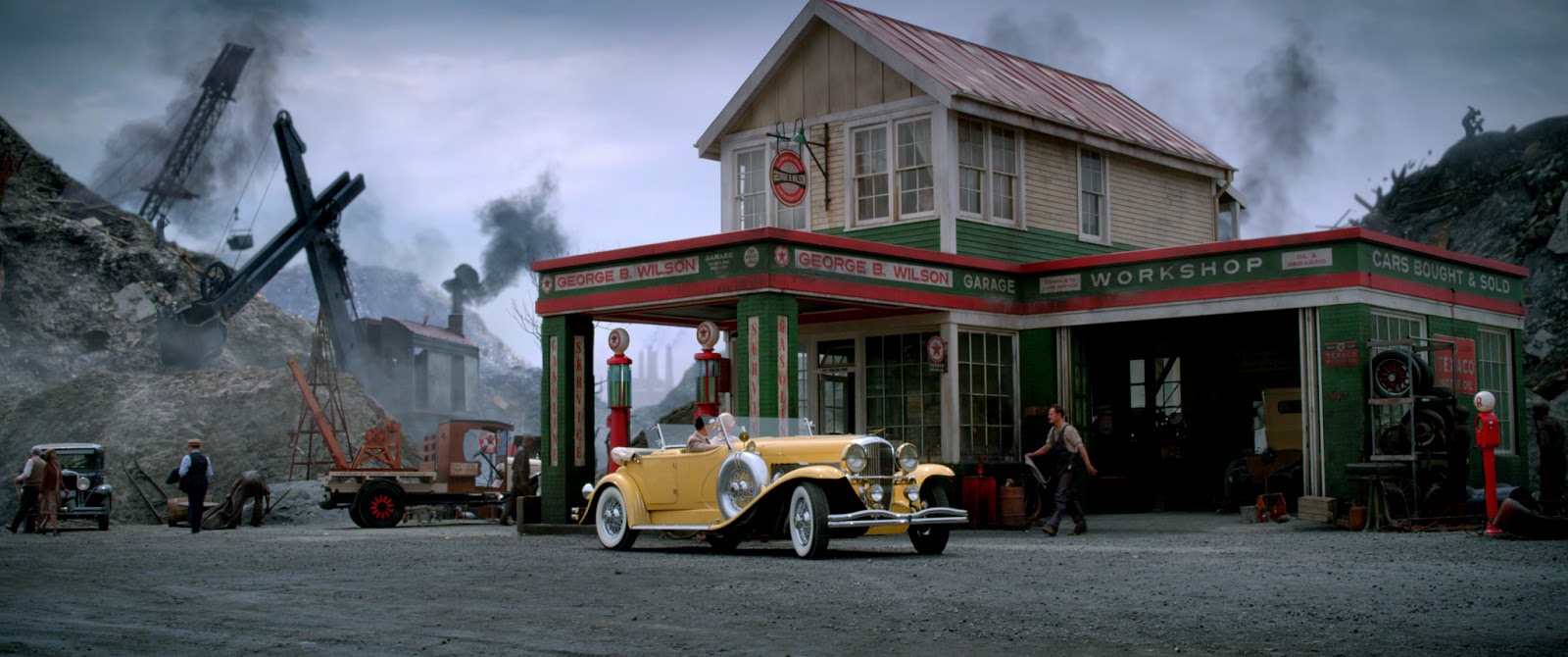

It's hard to live up to such standards as Fiztgerald set, and this movie does get it half exceptionally right, with its near-flawless cast, and breath-taking sets. I also give them the credit of at least attempting to capture the complexities of the novel, but I've come to the conclusion that The Great Gatsby is just an un-filmable book. What would the book be anyway, without "Carraway's" thoughts and observations, and our unlimited access to his mind? But including them in the movies is next to impossible. Nothing has worked yet, but so far Luhrmann has put in the best attempt. When it wasn't bothering me, I enjoyed it, and if the title wasn't The Great Gatsby, I would dismiss it satisfied, as an incredibly dazzling, slightly depressing film.

Number 7!

Tuesday, May 21, 2013

Star Trek Into Darkness

Ah, space. The final frontier. Four years after the original reboot, J.J. Abrams and co. are back continuing to boldly breathe new life into the beloved franchise. Not exactly going where no one has gone before, but certainly presenting it like we've never seen it before.

So I don't give away anything that might be taken for spoilers, I'll not try and sum up the plot, but just say this: the stakes are high, as are the emotions, and Kirk and his crew set out to make everything right, pitted against the stupendous Benedict Cumberbatch as the terrorist John Harrison. Epic, action-adventure stuff ensues. Big time.

Kirk, Uhura and Spock loose the colored shirts and go full-fledged-leather-and-guns-action-hero-y on us.

The cast, if you can believe it, has actually improved from last time. Not just in additions, like the fore mentioned stupendous Cumberbatch and other newcomer Alice Eve as science officer Carol Marcus, but the returning cast shows improvements as well, and considering how impressive they were at first, that's really something. The actors found their footing in the loved characters very quickly and gave solid, wonderfully nostalgic performances in Star Trek; now, they've really settled in. Now, they own their characters, and have slightly re-molded them to fit perfectly, so the character complements the actor, who in turn complements the character, with heightened results.

I was especially impressed with Spock (Zachary Quinto) in this case. Spock's struggle with emotions is pretty much the only struggle he ever has, and therefore it can easily be overdone and I imagine could get annoying very easily. I have to imagine, because Spock's character this time around is one of those improvements I was talking about. I have never liked him more than I did in this movie, and Quinto's performance was at times, breath-taking.

"Epic Spock" is in a volcano.

The only performance more powerful than his, was that of Benedict Cumberbatch in the role of the villain. He continues to blow me away everywhere I see him. You would think I would get used to it, but no, he gets me every time. Even scene after scene he only gets more and more impressive. And I can't even begin to describe my excitement at seeing and hearing him being casually mentioned almost everywhere. I feel like a total hipster -- "I was a fan of the Cumberbatch before he landed starring roles..."

"You being all mysterious with your... cheekbones. And turning your coat collar up so you look cool." "I don't do that." "Yes you do." Oh Watson, you have no idea.

Chris Pine has found the right balance between Kirk's heroic, leading side and his more skirt-chasing, rule-breaking side. Kirk will never be a perfect, Captain America type hero, but seriously, who would like him if he was? Pine's Kirk is a great flawed hero, and a great leader for his crew and the franchise, and is another name to my list of great performances in this film. He is also undeniably amazing at getting beat up, and hanging over very long, deadly falls.

See? I love this pic. Also, this whole sequence.

Scotty (Simon Pegg) made up for not being introduced until halfway through the first movie by having a rather big role this time, and adding some seriousness to the character as well... not too much though -- he still gets the funniest bit of the movie, just as he should.

Zoe Saldana's Uhura is now officially one of the boys, er, as close as she can get. Uhura is quite the action star now, and by my reckoning has moved up a couple notches in terms of character importance. I don't want to seem like I'm complaining, because I like her, and she adds wonderfully to the film in every way -- action, humor, emotion...

But, I really wish Bones (Karl Urban) had a big a role as Uhura this time around. When there are so many characters, and only about two hours of film to put them in, it's hard for anyone (except Joss Whedon) to give everyone the time and development they deserve. Unfortunately, Karl Urban and Bones didn't get as much as I thought they deserved. His character was overshadowed by Harrison, Uhura and even Scotty a little, and was limited too much to punch lines for my taste, but maybe I'm a bit too biased; he is my favorite character currently. Still, whenever he was there, he was as good as he could be, and I was happy.

What's he doing here? Being awesome of course.

Chekov (Anton Yelchin) got the same treatment, though I suppose I really shouldn't have expected his character to get any more important. He had his moments, fleeting as they were, and I relished them. The same mostly goes John Cho and Sulu too, though I don't care as much for the character, so I didn't mind as much. He got his moment too, and boy, was it a good one.

I'm actually really surprised I found a nice promo photo of just him!

Well. That's a lot about the characters. In the end, they are absolutely my favorite feature in this movie, even though my two favorite characters never got all the screen time I was hoping they'd receive. Still, I should probably touch on a few more topics before I wrap up.

What would a Star Trek movie be, after all, without some knockout visuals? If you saw the '09 Star Trek you know what to expect, but you'll still probably get blown away by some really stunning moments. Some, they show in the trailer, but they can't show them all early; there's way too many. I was a little afraid going in that it's self-proclaimed "non-stop action" would be too relentless, but it's well-paced at one step below "overwhelmingly fast" with tons of energy distributed evenly throughout, even into the slower moments, just under the surface.

Bones: "I hate this!" Kirk: "I know you do!" Yeah, but we love it.

I may have a complaint now, or at least something that comes close to the category; this movie is a near exact replica of it predecessor. Of course it's not if you look at the details, and of course the plot is way different, but in a broad sense, many things needlessly reflect the last movie, like the opening format, the closing format, and at least one all but re-used moment. Nevertheless, it was a great opening, the ending made me smile, and before I noticed that re-used moment was re-used, it took my breath away. So really, how could I complain? It's the principle of the thing that slightly bothers me, and I can't help but enjoy the product simultaneously.

So I guess you could say J.J. Abrams has done it again (Literally). It took four years, but the wait was absolutely worth it. Star Trek Into Darkness has "summer blockbuster" written all over it; it's thrilling and stunning and smart, laugh-out-loud funny, powerful and moving, all wrapped up together in an explosive package. A dazzling contribution to what will hopefully continue along this path to be a very long-running reboot/parallel universe of a really great franchise.

Friday, May 17, 2013

Ender's Game -- Trailer

I stumbled across this film while looking at the cast of Iron Man 3, specifically, Ben Kingsley on Rotten Tomatoes. I was intrigued by the inclusion of Asa Butterfield in the cast list, cast for the second time as the title character in a film that also stars Kingsley -- the other being the impressively acted lead in Hugo. As I scrolled through the rest of the cast, I became more and more impressed and intrigued -- Harrison Ford, Hailee Steinfeld, Abigail Breslin, and Viola Davis make up the rest of the big names splashed through the cast.

Butterfield and Kingsley in Scorsese's 2011 film, Hugo. Great movie.

The interest continues to grow. I discovered this science fiction adventure is being adapted from a novel written in the 80's. I researched the book, and (along with many more discoveries I won't mention for time's sake) decided the book could be worth a read. I gave me the impression of being the space version of The Hunger Games, but written before The Hunger Games of course.

That impression came from the fact that the story is basically one kid versus the world. Ender is the kid, molded influenced and manipulated since birth by mysterious people who hope he will one day save the earth and humanity from an alien race. Something he doesn't seem to have much of a choice about.

Hailee Steinfeld and Asa Butterfield in the movie.

Though I was only mildly interested in the book, I ended up getting my hands on a copy pretty quickly, started reading a day later, and finished it two days after that. I don't want to go too much into what I thought about it, as it could easily be an entire blog post itself, and I don't want to give away any spoilers, but it was a very interesting read. And I enjoyed it, though (since I've already compared it to THG) not as much as I enjoyed The Hunger Games. After having read it though, I realize that's not a very fair comparison. So forget that. I'll just say I didn't love it, but I did read and finish it happily, and most importantly, it consumed my thoughts during the read and for several days after.

I suppose it goes without saying now that I'm very interested in seeing the film. The trailer conveniently released the day before I finished reading, so I watched it as soon as I was done, and from the little information I gathered from the one-and-a-half minutes I think that it will at least be as good as the book. I optimistically imagine it will be better, mostly because the story demands creative and amazing visual sequences... and they're looking good.

Have a look.


I knew as soon as I started reading the book that Asa Butterfield was the perfect choice for Ender, and the rest of the cast looks equally great. I'm very interested to see how it's adapted, and if I'm right as I hope I am, and the film is equal to or better than the book, I will happily consider myself a new fan of the franchise. It's scheduled to release on November 1st this year.

Tuesday, April 30, 2013

Midnight in Paris

 To set mood: Push play, and start reading.


Gil is a self-proclaimed Hollywood hack who never took his chances with anything. He writes movie scripts and wishes he'd tried novels first. He lives in California and wishes he'd given Paris a shot. He also wishes he lived during "the Golden Age" -- the 20's, but that's not his fault. He's engaged to Inez, who is beautiful, and can be charming, but never seems to be while around him. Maybe she's just annoyed with him currently; they're in Paris for her dad's business, and he's talking about staying permanently; he's trying his hand at a novel, faltering, and stubbornly refuses help or advice, and he keeps mentioning how amazing Paris must have been in the 20's... in the rain. What's up with that?

"What's wonderful about getting wet?"

Gil is certainly a romantic. Longing for a time when he considered everything to be better -- and who could argue with the 20's in rainy Paris? Paris is still beautiful in the 21st century of course, so when faced with the decision of wandering the streets by himself at night, or spending another couple hours tagging along with Inez, and her friends Paul and Carol who they met by chance earlier, the answer is easy, and the answer is "alone."

A little while later, he's lost and sitting on some steps somewhere, watching the city, listening to the clock strike midnight. A vintage car pulls up. Heavily accented people call him to hop in, then he's at a party. The guy playing Cole Porter at the piano actually looks like Cole Porter. That's not possible. A feisty American lady introduces herself as Zelda, and then calls over her husband, Scott. Fitzgerald. Gotta be a coincidence.

The Fitzgeralds!

No, Gil Pender has somehow time-traveled, and that was just the beginning of his experience in that allegedly perfect time that is 1920's Paris. He muddles through the day with Inez and her increasingly annoying friends in 2011, then spends his nights living it up in the 20's with the likes of Hemingway, Picasso, and a breathtaking French girl, Adriana.

Adriana and Gil at a surrealist's wedding. Hence the taxidermy birds. ...That makes sense, right?

This little Woody Allen film starts out with various lovely, saturated shots of Paris slowly progressing day to night as a soprano sax belts out a jazzy tune. An easy, effortless artistic feel flows from there through the rest of the movie. None of the shots look really "composed," but if you pay attention, you begin to appreciate the scenes composed of a single shot, drawn out over several minutes as characters walk about and interact with each other realistically; competing to get a word in, and having to make an effort to express themselves intelligently.

And who exactly is in this movie? Everyone. Okay, maybe not, but it certainly does seem like it at times. Owen Wilson is our protagonist Gil, and is his usual charming, goofy, funny self. Rachel McAdams is Inez, and is great at being, well, dis-likable (to put it nicely), but you can see her appeal as well. Michael Sheen is Inez's "pedantic" friend Paul, perfectly described with one word. Then there's the crazy coroner Woody from Psych, Kurt Fuller, being normal as Inez's dad, and the assassin girl from MI4, Lea Seydoux, playing a local girl.

Paul, Carol, Inez and Gil touring Paris. Paul serves as tour guide, and says "if I'm not mistaken" a lot.

In the 20's side, the ever-lovely Marion Cotillard is the equally lovely and sweet Adriana. When Gil says she has "one of the most interesting faces ever" I couldn't agree more. Adrien Brody gets a single, memorable scene as Salvador Dali. Kathy Bates plays Gertrude Stein. Corey Stoll is Ernest Hemingway, and this movie's scene-stealer, which is really saying something when there's also Tom Hiddleston there, playing F. Scott Fitzgerald with a great "20's American" accent, and his classic, but (as of then) not-quite-yet discovered charm.

Gil, Ernest Hemingway, and Gertrude Stein examine Picasso's latest painting.

I must briefly mention a kind of technical aspect here. The film is rated PG-13 for "some sexual references and smoking." As to the smoking, I just wonder why they don't mention all the drinking as well, but the sexual references are scattered around the film, and are not especially crude like some PG-13's can easily be, but are inappropriate enough to warrant a warning.

Loose morals abound just as you'd expect from the 20's and 2000's, but the moral of the film goes in a much different direction.

First we are drawn in with simple, delightful appeal, to fall in love with a place we've perhaps never been to, and feel nostalgia for a time we never experienced. It's easier than it seems; I don't get all the references to the time, and I don't know all the famous people of the 20's introduced or mentioned, but when nostalgia is this contagious, it doesn't make a difference. I think Woody Allen could make me nostalgic for last week if he presented it like this.

Because I really, really like this still.

Midnight in Paris is pleasingly sentimental and nostalgic. But instead of ending there and letting us wallow in our new-found disappointment of having to live in the here and now, it says it doesn't matter; everyone wishes their lot was different. Paris is still here, so if you want to live there, go. If you want to write a novel, take the risk and try it. Walk in the rain if you can appreciate it. It encourages us to love the past if we want, but to live in the present.

And then, when paired with the easy artistic delivery and cute wry humor, it becomes much, much more than a typical comedy. Instead of cheap jokes and meaningless romance, you actually get to think while watching. And sure it doesn't go as deep as some serious thinking movies, but that's not bad -- it simply doesn't presume to be anything it's not, and doesn't take itself too seriously. Because what it is, is plenty good; lighthearted, fun, genuinely charming... like a walk through Paris in the rain.

-- 4.5/5 stars
Old-Fashioned Charm
My sixth review for this!

Bonus -- because I can't resist. Tom Hiddleston is being interviewed for The Avengers and Midnight in Paris, and does the most perfect Owen Wilson impression. (Start at 3:55 to avoid The Avengers part, which is mostly the smitten host flirting awkwardly anyway.)

Friday, April 26, 2013

The Illusionist

It's the classic story. Poor boy meets rich girl. Girl's parents forbid them from seeing each other. Boy promises to run away with girl. Boy leaves alone instead. Fifteen years later, boy returns, a skilled illusionist, and meets girl again, ready to make good on his promise, just as she's about to marry the Crown Prince of Austria.

Alright, so maybe that's not that classic, but every good story needs a good twist, right?

He remembers her, but does she?

Edward Norton plays Edward, or Eisenheim - what he is known as when he becomes an illusionist. Eisenheim's show becomes very popular when he returns to Vienna. So popular, in fact, that he attracts the attention of the Crown Prince Leopold (Rufus Sewell). Leopold is one of those not-so-nice princes, for instance, he plans on overthrowing his father, the Emperor, and his plan hinges on his marriage to the Duchess Sophie Von Teschen (Jessica Biel). When Eisenheim discovers his childhood sweetheart's impending marriage, he not so inadvertently humiliates the Crown Prince, prompting him to retaliate. He uses the Chief Inspector Uhl (Paul Giamatti) -- who is more his personal assistant than anything else -- to that purpose. When he is instructed to shut down Eisenheim's show, Uhl is conflicted, as he is fascinated by Eisenheim and his tricks, but loyal to the Prince; suddenly he finds himself caught in the middle of their two-man war.

The Crown Prince doesn't know what he's getting into.

Eisenheim is certainly meant to be the main character here, but he's a pretty classic magician; mysterious, unreadable. We only get glimpses into his mind as often as other characters do - not often at all. Thank goodness then that Uhl is there to carry the movie. You think the main character is the one who carries the movie? It is an illusion. Paul Giamatti is us; trying to keep up, trying to piece together the mystery - enjoying it immensely. He is our connection to the strange world of The Illusionist. He is also convincingly British.

Inspector Uhl brings the story to life.

Not quite so much for fellow Americans Norton and Biel. Thankfully though, they both under-did the accents; much smarter than overdoing it, and it works out fine. Otherwise, they are very fine. I'm not a fan of Jessica Biel, but I don't mind her in this movie at all, and her costumes are so gorgeous. Norton is a great brooding magician. Subtle and... I want to say "deadpan" but that gives a bad impression... is there a way deadpan can be good? At any rate, it gives me the impression that the character is putting on an act, and that's a good thing. Rufus Sewell is definitely a good thing. He always makes a wonderful villain, but here he's especially good. Best of the bunch though, is certainly Giamatti, the only truly involving character, with his perfect subtleties, and the second best eye-roll ever.

Edward Norton looks the part, and performs some impressive illusions.

Much further than this, I cannot go, for fear of exposing too much of the plot that you should just watch for yourself. This pic is rated PG-13 for some sexuality and violence, and besides one scene which I always easily skip through, it's a pretty clean, if dark and mellow movie. Visually, it's very unique, using sepia tints and vignetting to create a pleasing old-fashioned feel, and early 1900's costumes, buildings, and scenery are all very pretty to look at. And the story... mysterious, magical, and... well...

I will leave off with this: highly recommended.

-- 3.5/5 stars
Review number five for this!

Sunday, April 21, 2013

Wreck-it Ralph

Wreck-it Ralph
Being the "bad guy" has never been so popular. You can hardly go wrong as a baddie -- if you're a totally evil psychopath, people love to hate you, and love to see you defeated. If you're misunderstood, or have a sympathetic back-story, people fall in love with you, and wish you over to the good side. Everyone knows who their favorite villain is. Very often they get more attention than the hero. Sometimes they are the hero.

Too bad Ralph (John C. Reilly) doesn't know that. Of course for him, "bad guy" is just his job description. He works inside the video game Fix-it Felix Jr. dutifully wrecking a building so that title character Felix (Jack McBrayer) can fix it again. The other characters in the game, however, don't see it like that. To them, he is the bad guy his job says he is, and that's how they treat him. Ralph is tired of being the bad guy, and wants to fit in with the rest of the characters of his game. Thinking they'll accept him if he had a medal (something Felix is rewarded with at the end of every game) he leaves his game in search of one.

"Ralph raises the roof at a party" or, "Ralph crashes a party." I can't decide...

Such is the premise for this Disney animation, and it holds up well as the plot unfolds. It's a classic plot, so while you might find it a bit familiar, it's tried and true. Safe, but I didn't mind that. The mere fact that it's a movie about video game characters was unique enough for me. But being classic/typical Disney as it is, I can see how its safety (high-quality as it is) could easily land Wreck-it Ralph squarely into that category of movies for some viewers. "'It's great', but it eventually fades from memory." Of course, by the time this movie begins to fade, the sequel will be coming out... oh... smart move there. Anyway, I want to remember it. It made me laugh. In fact, Wreck-it Ralph wins the medal for being the very first movie to make me laugh during a potty humor sequence. Granted, I didn't exactly laugh at the actual potty humor, but still...

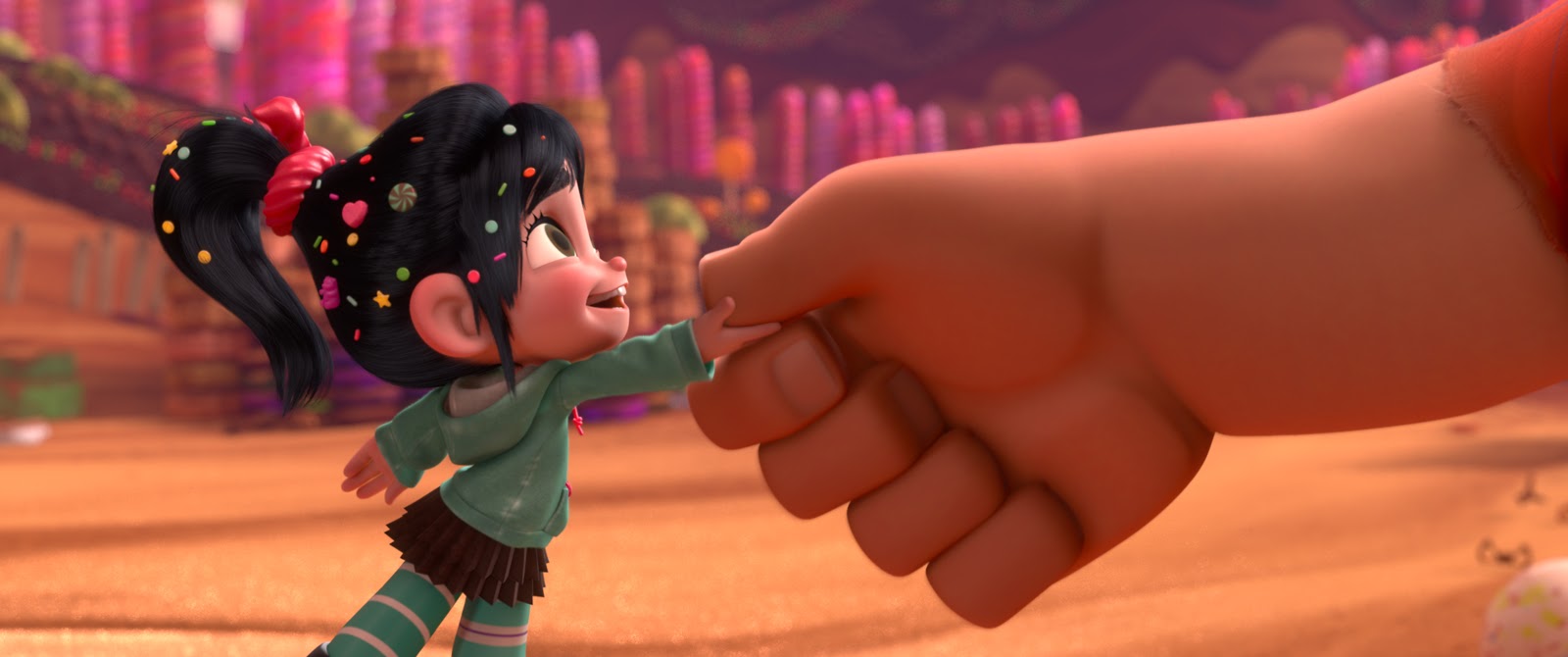
The point is, the humor was good, and when it wasn't making me laugh, it was still keeping me amused. And when I wasn't amused I was interested by turning plot points; never ground-breaking, but still thoughtful. And when I wasn't interested in thoughtful plot development, I was being moved by some top-notch character development... for an animated flick at any rate. Ralph's character arc was satisfying, and his relationship with Vanellope - (Sarah Silverman) of the racing game Sugar Rush - was sweet. Pun... unintended, but appropriate.

"Why are your hands so freakishly big?" "I don't know, why are you so freakishly annoying?"

Actors are usually what draws me to a particular movie, but for this movie that wasn't the case, there wasn't anyone I was especially interested in seeing, er, hearing. So when I praise the cast, I do it without bias... Though, after I decided I wanted to see this, I discovered that Alan Tudyk was in it, (playing King Candy) and got pretty excited. Ironically, I then forgot he was in it until after I watched the thing. Still, with my not remembering, he had my favorite line; after someone notes that he must like pink: "Salmon! Sal-- that's obviously salmon."... So, not much bias. With help from a clever and truly funny script, the actors delivered - on more than just punch lines too, though the punch-lines were the best. I also particularly liked Jane Lynch as Sergeant Calhoun, a tough girl from a serious sci-fi shoot-em-up game; she belts out snarky one-liners in her usual style with every breath. And it's epic.

"This is it, ladies! The kitten whispers and tickle fights end now!"

I must mention the animation, because it was pretty wonderful. With the varying arcade characters, the style of animation changed as well, according to the quality and style of the game that character is from - definitely one of my favorite of the tons of little details in the movie. But shiny bells and whistles aside, at game over, Wreck-it Ralph has what it needs; the hallmark message and feel of classic Disney animation, a little bit of retro, a little originality, and a memorable, funny script. All these elements put together, it actually lived up to its potential and turned out to be what it was meant to be; a good movie. And that is not bad. Not bad at all.

-- 3.5/5 stars.

And I must add one more thing; a Owl City/Wreck-it Ralph music video! "When Can I See You Again?" The song plays during the movie credits. It's also very catchy.

Wednesday, March 27, 2013

Northanger Abbey (2007)

Since Northanger Abbey is the Austen novel I have most recently read, it is certainly my favorite. It is satirical perfection! But today I am here not to gush over the amazing wit and charm of the novel; I am supposed to be reviewing the 2007 film adaptation, which I now realize is a pretty difficult challenge. Hopefully, it will be less difficult than I imagine, and since I find it easy to talk about things that I love, I'll start there; with the cast.

"I cannot speak well enough to be unintelligible" -- Catherine

Felicity Jones as Catherine, the young naive heroine is just as she should be. Her expressions and demeanor perfectly portray that innocent seventeen year old girl who imagines life to be like the Gothic-horror novels she reads, causing her to do and think some very stupid things, but, her sweetness and good-heartedness are portrayed equally well, and make her real and loveable. Comparing her to her book counterpart, I have no complaints whatsoever. Austen described her as, "when in good looks, pretty" so I'm inclined to think that Jones' absolutely adorable looks are a bit much, but one could argue that she's simply always in good looks, and to me that seems a perfectly acceptable explanation.
 
"Yes, I know exactly what you will say: Friday, went to the Lower Rooms; wore my sprigged muslin robe with blue trimmings -- plain black shoes -- appeared to much advantage; but was strangely harassed by a queer, half-witted man, who would make me dance with him, and distressed me by his nonsense." -- Mr. Tilney

On to Henry. J J Feild plays Mr. Tilney, and also balances the character very well. His goofy, teasing side as well as his serious, instructing one equally qualifies him as an ideal hero, and a perfect match for the heroine. Though both are good, his teasing side is my personal favorite - he gets the full amount and best of Austen's cheerful wit, and even though Field never gets to say some of my favorite book lines of his, the ones he does say are great, and it's easy enough to read the excluded ones and imagine him saying them. And Mr. Tilney's book and movie versions match wonderfully - appearance-wise as well. I also love that Austen said he only begins to love Catherine because he knew she was partial to him. It isn't made obvious in the movie, but it's easy to assume when you know it.


No matter how impressed I might be with those two main characters though, I will always be more impressed with Isabella Thorpe. Carey Mulligan is a brilliant actress and does a brilliant job with this conniving, falsely sweet character - so perfectly annoying, yet when Catherine says she feels sorry for her, somehow you do too. Mulligan is also gorgeous, and while her costumes might sometimes be a bit much, she looks every bit the part. Her last scene is great - her change of expressions as she begins to narrate her letter to Catherine says it all. I think this is the first film I noticed Mulligan in, and have yet to be unimpressed with her in anything since.

Carey Mulligan is probably one of few actresses that can make Felicity Jones look plain by comparison.

Thus concludes my favorite characters, but there are still a few left worth mentioning. James Morland (Hugh O'Conor) doesn't get much screen time, but take good advantage of what he gets. Eleanor Tilney, (Catherine Walker) is lovely and stylish and pleasing; Mrs. Allen (Sylvestra Le Touzel) is obsessed with her gowns, and amusing. Mr. Thorpe is extremely annoying and creepy, so, mission accomplished for William Beck. Captain Tilney makes me laugh with all his... swagger, and General Tilney is very scary - not quite handsome enough to match Austen's description, but his overall impression is intimidating, and that's close enough.

All that to say, the cast and their characterization of their particular characters is my favorite part of the film; you'd really have to start nit-picking to find any differences between film and book. Unfortunately, not so in other areas of the film, even in general plot points. Why, for instance, did they decide to just leave out the fact that eventually, General Tilney gave Henry and Catherine his consent to their marrying? And Catherine's parents wouldn't give their consent until he did? Perhaps because in the book a big factor to his giving the consent was in his discovering that Catherine was by no means poor - "Catherine would have three thousand pounds." says Austen, and this movie portrays her and her family as being rather poorer than that. I am also disappointed that we never get a look inside Mr. Tilney's house, and quite a bit more from her stay at Northanger is left out.

The last scene is so silly, and doesn't follow the book, or the time, yet somehow, I can't help but smile at it. It's very annoying.

But what is truly annoying is the change that makes Catherine read The Monk, instead of just Udolpho, which causes a couple of inappropriate scenes. Also, at only a hour and a half, it's just too short, even for Austen's shortest novel.

Still, I love this movie. I love and enjoy the characters, and whenever something goes wrong, I just remember how it goes in the book. The book, of course, will always be my favorite version of the story, and that's the case with all of Austen's novels, but this film version is very well made, and perfectly cast, so I will continue to watch it, and enjoy what I enjoy, tolerate what I don't, and block out the rest.

"To begin perfect happiness at the respective ages of twenty-six and eighteen is to do pretty well..." -- Jane Austen

There; not too difficult at all. I hope I have conveyed my impression intelligibly. If your conclusion after reading all that is that I find that the perfection of the cast and characters makes up for any imperfection elsewhere, (not that there is only imperfection elsewhere) you would be exactly right. And if it wasn't, well, I guess it is now.

-- 4/5 stars

My fourth review for this!