Pages

Sunday, November 6, 2022

Mrs. Harris Goes to Paris

It's always nice to see a good lead role come around for a talented character actor to take, but it's more than Lesley Manville's winning turn as the larger-than-life title character that makes this twee Paris adventure worth the admiration.

Adapted from the book by Paul Gallico.

Mrs. Harris is a war widow and cleaning lady. She has a slightly sad and woefully average existence, and sentimental, hopeful side that's too big for her circumstances. She decides she wants to go to Paris and buy a Christian Dior dress. She thinks it's meant to be. And maybe it is—her faith is rewarded with some good financial luck, and off she goes. Of course, it's not going to be so easy as to plop down some cash and grab a dress—but neither is it going to be so hard as to not be a fun and airy ride. 

The balance between difficulties that arise and their sometimes magical solutions is what made this movie work as a whole for me. I'm not the biggest fan of twee entertainment simply because there never seems to be real stakes and all the conflict is simple misunderstandings. Pack on top of that characters who only exist to live out the wish fulfillment plot, and the affair turns boring fast. Mrs. Harris skips over that. First of all, she herself is an interesting and three-dimensional character. The people she meets are also more complex than "good guy" or "bad guy" and the movie takes turns in developing them, too. And while some conflict is resolved through luck or "magic" here, that does have a thematic reason, not just resolving things because they need to be resolved. 

Great romantic subplot. But I'll get to that later...

I suppose it is very twee to say that things work out for Mrs. Harris because she's a kind and giving person who reaps as she sows. There is truth in that, but in real life perhaps not quite so overt. At any rate it satisfied both my taste for cozy entertainment, and my critical eye against lazy plotting. Lesley Manville shines in the role, big, warm, and delightful, and could have held my attention alone. She is joined, though, by a large and fleshed-out supporting cast. From her best friend, and her clients at home, to the Marquis in Paris who befriends her, to the dressmakers and models, right down to the politely nervous Air Force officer who brings her one of her bits of luck.

Every cozy adventure needs romance. And no, Mrs. Harris isn't too old for it herself, but a young couple in a movie like this will never be a waste, and in this case, they were my favorite aspect of all. Natasha, model, enormously pretty and face of Dior, who doesn't want the limelight or the job of entertaining top clients. And AndrĂ©, Dior's mild-mannered accountant. It is very much a side plot, but hits every note of the romantic arc with perfect ease simply by setting up the characters the right way. It is brief, and familiar, but full of strong moments that pushed all the right romantic buttons. And I rarely mention something like this, but it's vastly important here, and the best aspect along with Lesley Manville and the two adorable French lovebirds. Costumes. 

I feel like such a girl, but it's true. The costumes were practically a character themselves.

It's a movie about buying a Dior dress, after all. The scene that shows the collection is pivotal, and for more reason than that Mrs. Harris picks out the dress she wants. We get to see it all, as if we're invited to pick our favorites as well. As a girl, it worked on me. Even as a girl who likes story and character more than pretty costumes. The pretty costumes got to me. They were great. Vital. And extended beyond the Dior collection, too. Everyone is dressed with expert attention all the time, fitting and enhancing their character. It's the focus of the movie, which I might raise an eyebrow at in other circumstances, but here it bolsters the production quality, and doesn't get in the way of character or story either. An ideal balance.

So maybe it's not my typical kind of movie in theory—but it turns out that any story can be well-made, hit satisfying beats with well-developed characters, and make itself worth its existence as more than eye candy. Mrs. Harris Goes to Paris is an all-around treat. 

Wednesday, September 7, 2022

The Black Phone

Spoiler-free!

After dodging the bullet that was Doctor Strange and the Multiverse of Madness, writer/director Scott Derrickson returned to doing his own thing his own way, and that's what The Black Phone is. A horror movie; with dark lighting and his signature uncomfortable tone. It plays out like a writing exercise for practicing setup and payoff, and I fully approve.

Adapted by Derrickson and Robert Cargill from a short story by Joe Hill.

The plot is set in the 70's, in an anywhere town with anybody families, where a pedophile serial killer is on the loose—Ethan Hawke, taking his usual charm and twisting it to creepy effect. 13-year-old Finney (Mason Thames), and his sister Gwen (Madeleine McGraw) see the missing posters, hear the news, and see empty seats appear in the school classrooms, but no one really knows what to do about it. Gwen has dreams where she can see the kidnapped kids, and she thinks they may be clues sent to her from Jesus, but their dad (Jeremy Davies, a great role for him, though not heavily featured) doesn't want her turning out like their mom who thought she was psychic but was really just crazy. He forbids her from talking about the dreams.

But then, Finney gets taken. In the basement of the Grabber's house is a phone with the cord cut. Sometimes it still rings, though. And when Finney answers it, the disembodied spirits of the Grabber's victims give him advice on how to survive; and how to escape. Each time he tries a plan and it fails, another kid calls with another plan. On the outside, Gwen dreams clues as to his whereabouts, and a detective, believing in her abilities, helps her search. You can see where this is going. It builds, and builds, and builds, and we wait for the inevitable showdown. It's simple; basic, even. And I suppose that might be a criticism in some eyes, but not to me. 

I think the best, most thrilling horror movies are the simple ones. Simple can be hard to pull off.

It impresses me when a movie shows me what it's doing and yet I'm still anxiously hoping I haven't been tricked when those last twists and turns come down the pike. We're made to think we are in the know about everything, but we aren't really—and once we're wrong once, then comes the thrill of worry that we're wrong about everything. Derrickson isn't making high art here, but he has respect for his craft and knows what's winning about his genre. So he packs his work full of horror thrills. Extreme situations, menacing villains, dread, suspense; the dark, twisted implications left just unsaid, weak protagonists who find strength, and even casual musings on spiritual elements.

The only thing that's "missing" is gore, or reveling in violence, and that makes me like it even more. It may not be high art but it's tasteful. And thoughtful. You get the sense that it spurs from the uncomfortable fears and nightmares of its creators, rather than a lazy penchant for jump-scares and splashing blood. The supernatural brings a handful of frightening moments, but unlike most supernatural horror, the supernatural here is a force for good. Gwen's down-to-earth faith in Jesus is mixed in and at home with the more typical supernatural horror elements of ghosts and psychicism. 

If you like to mull over on movies, this one isn't lacking there either, though it doesn't demand it

What underlying beliefs or fears inspired the plot can be interesting, but the main appeal lies, simply, in the plot itself. It's sharp structure, classic themes, efficient pacing, and ever-patient planning. Plus characters to root for, be sad for, see change, or just plain despise—all packed together in a premise and tone that unnerves, unsettles, and thrills. The performances are roundly good, and the production quality high, but the strength of writing is what brings the winning concept home. The Black Phone is a simple, focused effort of pure entertainment.

Tuesday, September 6, 2022

Thirteen Lives

Ron Howard and true-life stories are a match made in heaven. Instead of reshaping the true and the real into fiction while adapting it to the innately fictional medium of film, Howard takes stories like this one—where a soccer team from Thailand gets trapped miles inside a cave when an unexpected rainstorm causes it to flood—and showcases what is already astonishing about the true story. 

As a rule, I don't care for movie based on true stories. Ron Howard overcomes that rule.

He changes as little as he can. He doesn't push fake emotions. He doesn't add drama to the situation. He finds the subtle drama in the true moments and points a camera at it—highlighting the right moments in the right order to bring out the natural story arc and themes that are already there. And he hires actors who can show that nuance in a casual and honest way—like Viggo Mortensen and Colin Farrell, playing two British rescue divers who fly in to lend a hand. Later they recruit Joel Edgerton, and Tom Bateman, and together they make an unfathomable plan to swim the boys out before monsoon season floods the entire cave.

My memory of when this happened in real life is brief. I heard they were trapped, and that people were working to get them out. Then a few weeks later I heard they'd been rescued, and I wondered why it took so long. Now, to see exactly how impossible the situation really was, and how great a feat it was that they all survived, how hard everyone worked, even the entire concept of how they were rescued—it completely blew my mind. I was still reeling from the fact that each day of swimming to the boys and back was a 12-hour dive when they threw out the rescue plan as the only and best option, and I still can't quite wrap my mind around everything it entailed.

There were many instances that made me protest aloud because of how crazy it all sounded.

People who are capable and willing to do difficult things astonish me. And I guess that's a universal thing. We have stories with heroes in fiction who do the impossible for a noble cause all the time. Superheroes, though, have superpowers. The men who swam hours and hours through muddy water in narrow tunnels just to have a chance at saving a few people they never knew—they were normal human beings. They simply had the drive, the skills, and the will to put themselves at risk for a good result. They did a job, and they looked at it as a job. And the movie understands that. It doesn't make them out as superheroes. It shows their weakness, and the mundane aspects of their humanity, and then it shows them do heroic things—impossible things—and then (and this is what I loved most about the movie) it shows how their experience affects them. 

The part that hit me the hardest was the first day they bring some of the boys out. The volunteers rush in and haul each kid away, leaving the diver alone and watching them go. Each actor they show do this has an incredible look on their face that tells of the physical and emotional gauntlet they had just come through, though they remained professional and stoic during the task. It absolutely broke my heart, and I love it because it wasn't shoved at me. Or slammed over my head. I just saw it. I know it was intentional, but the reservation of those moments is remarkable. Shown at a distance; not lingered on too long; or punctuated by overwrought music. You could almost think you're seeing something you're not meant to see. 

What must it be like, to volunteer your skills, your time, and your very person to become the difference between life and death for another human?

Any director can have style and flair, but it takes a master to create art that leaves no fingerprints. Howard's hand is invisible in this film, yet we still see what he's pointing to. Through his deft and discreet craftmanship, and cast full of equally dedicated performances, we get a beautifully nuanced glimpse of real-life heroes, and from the comfort of our homes, experience the mountain of hardships they willingly faced down for the chance to achieve something good. I'm grateful for men like that, and for the artists who, through their invisibility, make them visible.

Friday, August 12, 2022

The Cursed

Not your grandad's werewolf story. Actually, it's more like your great-great grandad's werewolf story, and that's exactly what makes it stand out. Watching it, I could almost believe that it was adapted from some gothic horror story written in the late 1800's, when the story is set.

Sean Ellis wrote, directed, and did his own cinematography work. 

Originally titled Eight for Silver, referencing the old nursery rhyme, because silver naturally plays an important role. But changed to the more mundane The Cursed because the plot also heavily features a curse set on an old English estate by a band of gypsies who are murdered when they try to stake a claim on the land. The movie takes its time in getting started, establishing the Laurent family and showing the ill-advised murders in grisly detail, as well as the set of silver wolf's teeth a gypsy witch fashions for the curse. It's not until the children dig up the teeth and one of them gets bitten, subsequently disappearing, that the story's hero comes on scene—McBride, a pathologist, who has experience in these strange circumstances.

From there McBride drives the story, the setup so thorough and detailed that the plot glides along effortlessly on its strength. We know many beats of the story already; people will be attacked, the survivors changing too, until McBride closes in on the beast and discovers how to stop it. A classic in many ways. There's appeal in a classic story told well for me, but there's also a fresh appeal in this one's approach. Details of the creature design, origin and behavior which bring out the eerie and bleak style of horror. The character of the family involved. And most of all for me, the period setting, and location. The house, the village and the surrounding woods all make for a memorable, creepy, and gorgeous visual for the story to live in—a crucial element for gothic tales.

The imagery of the silver teeth was a great touch. There are many good details like that.

I have a soft spot for the sort of low-tech horror that happens here. Someone taking the time to load their muzzleloader rifle before firing an important shot brings the same sort of suspense as a modern-day scene wishes it could when it makes characters suddenly clumsy in their panic to load something that should take two seconds. The army takes days to arrive unlike modern cops, so there is no need to fabricate a reason why outside help doesn't come. Suddenly a single threat becomes so monstrous that you wonder how it will ever be dealt with. A great example of how less is more. Without having to overblow the horror element to get attention, the film has plenty of spare time to spend on character and lore development. 

While it's not my new favorite movie or anything, I'm at a loss for any significant flaw here. The one thing that comes to mind is that Boyd Holbrook isn't British, and that is apparent when he speaks next to his British castmates. He errs on the subtle side mostly which is smart, but sometimes he'll say something that just plain sounds wrong. I enjoy watching Holbrook far too much to care though. And as far as performance goes, everyone hits the spot. Besides the spotty accent, Holbrook feels every bit the gothic horror hero, balancing that simple and able determination of old-fashioned leads with the undercurrent of past wounds that keeps audiences engaged. Kelly Reilly's soft strength is perfect for the mother, as is complex coldness Alistair Petrie brings to the father. The children are excellent, and the supporting cast a vital and winning addition.

The daughter's old timey accent was flawless.

The slow, depressed gothic approach to the horror element won't be for people looking for a more intense, action-heavy, or scream-inducing horror experience, but it gets the tone exactly right for my tastes. It's the sort of movie you can dig into—and one that digs into you right back. The ending seals it all into a neat and emotionally resonate package, leading me to the observation that this is a story of singular vision; written, directed, and even shot by the same man. And with minimal interference, his vision comes through with deft skill and purposeful heart. I would praise it for that even if I didn't find much personal worth in the story itself. The Cursed or Eight for Silver, whatever it is called, this monster movie of old-fashioned sensibilities is worth seeking out.

Wednesday, July 6, 2022

The Outfit

Spoiler-free!

The Outfit is a movie set in the 1950's, inside a single tailor shop, where the bad guys are mobsters, and no one can be trusted, and it stars Mark Rylance, Johnny Flynn, Zoey Deutch, and Dylan O'Brien, which reads to me more like a fantasy football lineup for movie stars than a cast list that would ever actually happen. And yet—somehow—it misses the mark on feeling like a film that was made just for me. 

I can't say that makes it a bad film at all though. Far from it. It has a concise and thought-out structure to it that gives it a very intentional feel. Much like the suit that Mark Rylance's character cuts and sews throughout the story. It treats filmmaking as a structured craft more than a freeform art, and the tone that sets goes well with a plot set inside a tailor's shop. It has strong bookends, gently interwoven themes, and conversations that are deliciously subtextual and often subtly intense. And despite its neat structure, it does many things that you won't expect, that turn the plot into new and interesting directions. The overall picture is as neat and trim as a new suit. 

And yet... when you look closer, things begin to, shall we say, unravel. Some of the twists and turns may feel so completely unexpected because they couldn't reasonably happen in reality. In small things, only ever little details, the writing skirts by, making important plot changes happen on the flimsiest of foundations. Sometimes characters will tell lies that make no sense at all, yet the characters being lied to buy it without question. We the audience might notice at first but then be lulled back into the story by the character's belief, or another lie or another twist that makes us forget the last one. On and on it goes until it neatly wraps up the ending and hopes you won't remember the skimping that happened in the middle.

And as much as I enjoyed the conversation-heavy thriller aspect, and as much as I generally go for single-location stories, those things here often felt to be a waste of the cast's talent. They do a lot—particularly Mark Rylance in the lead—but never reach a point where the roles seem to be a challenge. The learning and dedication required for Rylance to become a convincing "cutter" (as he calls himself) seems like a normal Tuesday for him. Same for Johnny Flynn's underperformed and cool villainy. Same for Zoey Deutch's sweet, but tough, but sweet, but tough receptionist. Same for Dylan O'Brien's tendency to lean into the physicality of his roles. I'm a fan of all four, particularly Rylance and O'Brien, so seeing a film that exists to highlight performance keep them to this "comfort zone" was a little disappointing. But maybe that's not fair of me.

I think at the bottom of this mystery, the disconnect I feel with it is in the plot itself. Perhaps a little in the skimping of plot turns, but mostly in the turns themselves, that took the story further and further from where I wanted it to go. Maybe it's not fair to claim this as a complaint either, or maybe the story really would have served itself better by taking more predictable but more manageable turns. Regardless, the craft is undeniable, often fascinating, and worth a look.

Tuesday, July 5, 2022

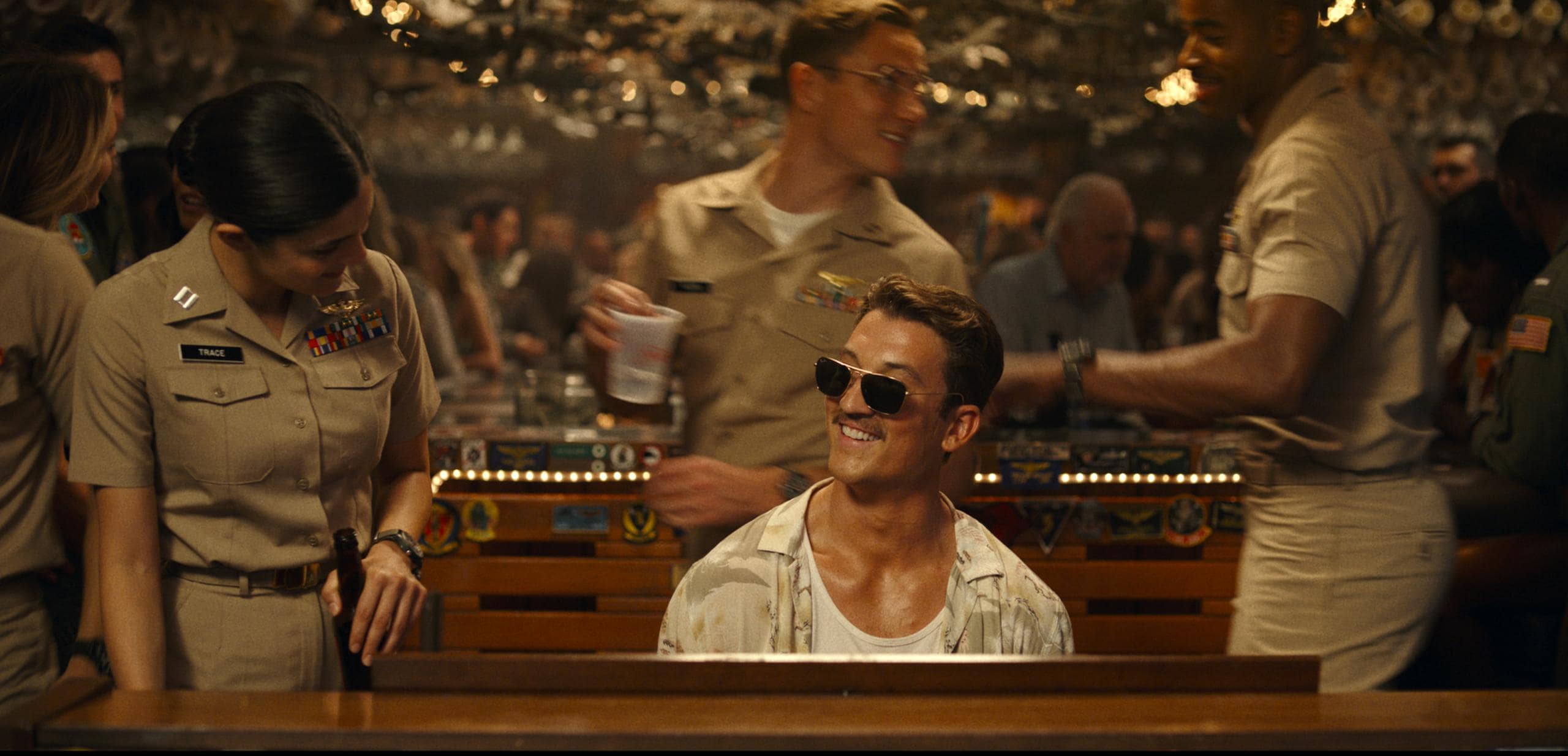
Top Gun: Maverick

Spoiler-free!

The phenomenon of Top Gun: Maverick isn't that it's an exceptionally good high quality summer blockbuster—it's simply that high quality summer blockbusters haven't existed for about five years. (And even then they were a dying breed.) Likewise, the magic of Top Gun: Maverick isn't that it's the greatest gap-sequel ever made—it's more that no other sequel made so many years later has ever been able to boast of having a worthy reason to exist.

And yet here we are, our socks knocked off by another one of Tom Cruise's filmmaking efforts. He may be the last person making movies who actually cares whether his products are entertaining or not. Here, he returns as his original character, Pete Mitchell, callsign Maverick, assigned back to Top Gun to train an elite batch of aviators for a specific, daring, and possibly deadly mission. One candidate, callsign Rooster (Miles Teller) is the son of Maverick's old co-pilot who died in the first movie, and tension rises between them as Maverick struggles between his job of picking the best team to risk their lives on the mission, and his own personal mission of protecting his friend's son.

It's a pretty sweet set up, ripe for drama, but not so complex as to take away time from the entertainment of training exercises, which range from aerial dogfights to playing football on the beach. For a side plot, Maverick takes up a romance with a former flame, Jennifer Connelly, and before you know it, I was wishing Tom Cruise wasn't in the movie so much—because the one thing left unfulfilled is the dynamics between the candidates. The loose definition of their unique personalities made me wish for more. And then Hangman, the Iceman equivalent, and his antagonistic relationship with Rooster is rendered pointless by Rooster's more convincing antagonistic relationship to Maverick—but even that is put on hold for too long. When it comes due is when the movie starts to really shine.

I would have liked the movie to split time between Maverick's antics and what the candidates are up to when he's not around, but at the same time I get it. It's the Tom Cruise show because the film wouldn't exist without him. You can't begrudge him taking the spotlight, or deny that everything he does is entertaining. I just can't help but wonder if it would have been better had it been more balanced. Just a tad. In that light, it was the third act that sold the film for me. When everything comes to a head, and it starts to feel like an equal character match-up between Maverick and Rooster. This section also has most of the thrilling flying action (on which a Tom Cruise movie will never, ever skimp) and the most real stakes and tension as they take on the deadly mission.

The whole movie builds to this point, and it doesn't disappoint in any aspect. It has the realness that Cruise is known for to make you feel it—the thrill that can only come when there's also a notable lack of CGI. I got a big kick out of seeing the actors react while inside actual, actually flying fighter jets. And because everything was set up previously, the whole act is a neat series of payoff after payoff after payoff, each one more satisfying and rewarding than the last. Character drama and fun action mix together to splendid results, and an old-fashioned magic of storytelling comes to life. It's all so simple and won me over so easily that I wonder how the art was ever lost in the first place.


So, if Top Gun: Maverick is great and a phenomenon just because every other modern film is bad and worthless, that doesn't change the fact. It has the magic, and it is a phenomenon. It's dastardly entertaining in ways I thought films had forgotten to be. Not exceptional in the big picture, but certainly exceptional for its time. My hope is this: that this rare blockbuster isn't a throwback to good and entertaining movies at all—but the instigator of a resurgence.

Monday, May 9, 2022

The King's Daughter

Some spoilers. 

I swear there's a good movie in here somewhere. The question is, does the lack of it even matter? 

It's about a French girl (Kaya Scodelario) in the 1600's who's taken from her monastery home to live in King Louis XIV's palace, unaware that she's his daughter. She loves music so when she hears a strange song at night, she follows it to an underground pool where a mermaid is being held captive, waiting on an eclipse so she can be sacrificed to give the King eternal life. The girl befriends the mermaid, as well as the handsome sailor (Benjamin Walker) who caught her, and a predictable series of romantic adventure ensues.

It certainly is... special.

Except the movie is quite a mess, and those appealing ideas of fairytale romance and adventure get a little buried in the jumble. The movie spends more time with the plotting King (Pierce Brosnan) his Priest (William Hurt) and the "scientist" who's going to kill the mermaid for him. They spend a lot of time bickering about God and science, or rambling about nothing much at all. Then there's the drama between the King and the girl as he doesn't tell her she's his daughter but hires her to play music for him outside his window every morning, and then once he tells her he immediately tries to merry her off to some simpering duke, which doesn't go over well of course but doesn't really go anywhere plot-wise either except to make her realize he's not so great a dad. 

It's like the movie understood what kind of tropes would be appealing, but had no idea how to actually use them. I loved the idea of her being engaged to a bad guy while falling in love with the sailor, but we never get to see the tension and conflict that situation should raise. I don't think she even sees the duke while knowing their marriage is arranged. And the sailor only finds out about it a minute before it's not an issue anymore. The movie touches on so many tropes that I enjoy that I wasn't disappointed, but it seems to have cinematic ADHD, hoping to and fro whatever topic pops into its head in real time. Scenes end abruptly, or cut in and out without apparent reason, and don't have the stamina to find the compelling content they're obviously searching for.

Fun fact, these two are married irl, and they met filming this movie, in... *checks notes* 2014?? It was released this year, so that's 8 years on the shelf. Wild.

If I were the actors involved, I'd probably wish it had stayed on the shelf. It's a bit embarrassing. But as a movie fan, I'm glad it was released, even with all the weirdness. Brosnan and Hurt phone in their stuff, but I'm not mad about it. There's nothing in the script that's worth getting worked up for and they're entertaining without trying. Scodelario tries, bless her, but her efforts only made me laugh when paired with the clunky lines she's trying to convey. Benjamin Walker's character is very much a K-Mart brand Will Turner but still somehow manages to be halfway dashing. The cheesy romance was probably the best aspect simply because cheesy romance increases in value the cheesier it gets. Still, I can't help but think there was a path here for something a step above—more real character development over empty platitudes to give the cheese a foundation on which to thrive.

The tropey appeal cannot overcome the mess. It's badly written, badly cobbled together with bad performances, laughably modern costumes, cheap CGI, and a smattering of sweeping wonder. I enjoyed it all, but only because swashbuckling fairytales like this barely exist at all—let alone in any better realm of quality.