Pages

Showing posts with label Period Drama Challenge. Show all posts

Thursday, July 4, 2013

Persuasion (2007)

Ah, another adaptation of a Jane Austen novel. Persuasion isn't as popular as some of Austen's other novels though. This one is more serious, dramatic, and (almost) despairing. Anne Elliot, at the ripe age of twenty-seven is resigned to being an old maid. Eight years ago she had the affections of a man, who she loved in return, but he was a nobody, and her high-ranking family would have nothing of it. She was persuaded to nullify the engagement, and Fredrick Wentworth left and joined the Navy. Now he is quite accidentally back in her life, a Captain, just as handsome as ever with a great fortune, and still not married. Will they get a second chance, or are they doomed to misunderstandings, and bitterness, secretly longing to rekindle the past?

The answer of course, is yes, to all. And that shouldn't be surprising even if you've never seen or read Persuasion before. It's a romantic drama -- what else could happen? It's not the destination after all, but the journey that we love, and with Jane Austen at the helm, you know the journey is going to be a good one.

Anne Elliot, heroine.

Persuasion is different from most of Austen's other novels in one major way; it's not very much of a comedy. It still has her wit, and there's still those moments to laugh at, but the wit is deeper -- mellower -- and you laugh very thankful that you're not in that annoying or otherwise unpleasant situation. This movie embraces all that drama boldly. The filming style is elegant and not overdone, with deep blue undertones matching and creating the mood. Simple shots let you take in the natural beauty of locations, and creative camera work and editing in the right spots embellish the story stylishly.

Interestingly, this is one period drama where I actually appreciate the men's costumes more than the women's. Not that the women's are bad at all, they are very nice and at times wonderfully ridiculous, but the men look really good and like real gentlemen in this film, and especially Captain Wentworth, though it doesn't hurt that he's actually very handsome anyway. And also acted very well by Rupert Penry-Jones -- he's a wonderful Austen hero.

Captain Frederick Wentworth, dashing hero.

They definitely got him right in the adapting process. And the rest of the cast looks good and right too. Sally Hawkins' appearance as Anne is good, she's past her bloom, but not ugly, but I don't enjoy the way she acts as much-- too timid and breathy, and it's slightly annoying at times. Anne's sisters Elizabeth and Mary are both also -- and much more often -- annoying, but they are supposed to be, so that's a praise. Anthony Head as her father, Sir Walter Elliot is brilliant. He's very good at being angry, but the way he preens in the mirror is what really gets me. Mr. Elliot is wonderfully pompous, though perhaps a bit too much, I begin to wonder how Anne could stand to be around him. As for the rest of the cast I have no particular praises or criticisms.

Anne's sisters, Mary and her husband Charles, and Elizabeth, and father Sir Walter.

The adaptation for the most part of the film is good, and follows the book well, but then near the end, as if by requirement, everything falls apart, for what seems to be no reason other than saving time. It's pretty disappointing, especially if you like the "letter scene" from the book as much as I do, and at only an hour-and-a-half, you'd think they could spare some time to make the end match the beginning and middle. But my biggest criticism has to be that kiss -- first of all, totally inappropriate for the era, but then good grief, it takes them what seems like hours to lean in, until I feel like yelling at them to just get it over with already. By then, I'm obviously kind of out of the romantic mood of the movie.

I guess it's a good thing, then, that it waits til then end to come undone; up until then I get to enjoy everything immensely, and that's exactly what I do. So much so, that I keep going back and watching it again, so I guess I must think that the good outweighs the bad. It is, after all, only about ten minutes of disappointing, to the hour and twenty of reserved, aching romance, thoughtful, real characters, and that wonderful, insightful, classic storytelling distinctive to Jane Austen's talented hand.

Twelve!

Sunday, June 30, 2013

The Prestige

Are you watching closely?

"Every great magic trick consists of three parts or acts. The first part is called 'The Pledge'. The magician shows you something ordinary: a deck of cards, a bird, or a man."


"He shows you this object. Perhaps he asks you to inspect it to see if it is indeed real, unaltered, normal. But of course... it probably isn't."

The magician is Christopher Nolan, visionary director of many mind-bending movies and everyone’s favorite superhero. The stage is 1890’s London; dark, smoky and bustling. Stage performances is the way to be entertained, and magicians and illusionists scramble along with the other performers trying to discover a trick no one’s ever seen before, and place themselves above the competition. But the business is a fickle one, and a dangerous one. The ordinary object is two men -- two magicians -- Alfred Borden (Christian Bale) and Robert Angier (Hugh Jackman). And of course they are anything but ordinary. Borden is a talented magician; his tricks are unique and hard to spot, but he doesn’t know presentation like Angier; he can present the simplest trick with a dramatic flair that makes it seem amazing.

Filling in the background for support are many more talented actors including, Michael Caine, Scarlett Johansson, Rebecca Hall, Andy Serkis and David Bowie.

"The second act is called ‘The Turn.’ The magician takes the ordinary something, and makes it do something extraordinary."


This may be a very short review. As interesting and complex as this movie is, almost everything want to say about it could be a spoiler. An incident causes these two magicians to wage war on each other throughout the film, and their rivalry is blown into enormous proportions.

The performance is immaculate. Filming sets the dark, suspenseful tone with a deep, rich, 1800’s beauty. The script is polished, and filled with mystery; every word conceals important clues. Nolan, as usual gets everything he needs out of his actors. Bale and Jackman stand out as exceptional of course, -- and I especially enjoy Jackman -- but no one stands out as giving any less than they should.

Every element of skillful movie-making falls into place with ease, and the result is a gritty, thoughtful, complex tale of magical revenge... and a little mind-blowing.

“Now you’re looking for the secret, but you won’t find it because of course you’re not really looking. You don’t really want to know. You want to be… fooled.”


I could nit-pick a few things that don't quite make sense if you really think about it, and the movie is very dark and sad; if you're all about sweet happy movies where you never have to worry if the ending is going to be a "good" one, this might not be the best movie for you... but still I would encourage you to give it a try.

This movie goes deep and dark, presenting its twists and turns masterfully, in a way that explains everything, yet lets you think you figured it all out yourself. It appears to be extremely complicated, but you always understand exactly as much as you should in the moment. Its thoughtful sobriety is the kind that usually makes a film a one-time deal -- except if you like downer movies as long as they're good -- but unless you absolutely loathed your first viewing, a second is all but required. The first time you understand it; the second time you get it.

Now I don't mean to say in any way that this is not an enjoyable film. It is dark yes, and sometimes melancholy, but it is also energetic, engrossing and sometimes astonishingly magnificent. The messages may not be the most uplifting, and they certainly don't teach through example, but they are honest and true. And there is plenty of excitement to be had -- if there's one thing Christopher Nolan is good at, it's making serious, seriously thrilling movies.


"But you wouldn't clap yet. Because making something disappear isn't enough; you have to bring it back. That's why every magic trick has a third act, the hardest part, the part we call 'The Prestige.'"


Eleven.

Friday, June 28, 2013

Stardust

Sometimes it seems that the best, most original premises for stories can be summarized in a single question. For instance, the question, "what if we aren't alone in the universe?" has sparked countless alien movies, and then "what if aliens aren't evil?" sparked countless more. The more simple and unique the question, the more interesting and unique the story could be.

So take this one; "what if the stars gaze back?" Simple and unique to be sure, and also a bit quirky -- it would be right if its story was quirky too, It's imaginative, so a fantasy, with magic and sword-fighting, and flying pirates and witches. It might be a bit cheesy, but it would also be funny, exciting and sweet.


Stardust is all these things and more. Stars do gaze back, and what more, sometimes they accidentally fall. (Shooting stars!) One star named Yvaine (Claire Danes) is unceremoniously knocked from the sky by a large gemstone set in a necklace when the dying king of the realm of Stormhold sends it flying into the night, telling his three sons that one must retrieve it to claim the throne. As the star falls, three sister witches see it, and one goes out to find it, so they can consume the heart and be young again.

"A toast! To the new king of Stormhold... whichever of you fine fellows it may be."

In 1800's England, in a small village called Wall (so named for a mysterious wall on its border), a boy named Tristan (Charlie Cox) is trying to win the hand of his beloved, the beauty of the town, Victoria (Sienna Miller). They see the star falling, and make an agreement; if Tristan can bring the star back to Victoria by her birthday in one week, she will marry him; if not, she'll marry that pompous rich fellow Humphrey (Henry Cavill, and almost totally, hilariously, unrecognizable). Tristan is determined to succeed, but no one ever crosses The Wall. Once that little hurdle is jumped there's an unexpected problem; Tristan had no idea the star would be... a woman. And she's not too keen a being a birthday gift.

Obviously, she needs some convincing. Maybe bribery.

If there is one movie that just screams "high-flying, full-throttle, incredibly fun fantasy adventure" it would be this movie. The story, based on a novel by Neil Gaiman, is wonderfully complex for a lighthearted fantasy, with basically three plot lines running simultaneously, and intersecting every now and then. Tristan and Yvaine, on a time limit, hurrying towards the wall, the witch Lamia, Michelle Pfeiffer, growing older and uglier the more magic she uses, in pursuit of the stars heart, and the youngest prince, Septimus, Mark Strong, a likable bad guy if there ever was one, in pursuit of her necklace. There's also a pirate with a fearsome reputation, Robert De Niro being unpredictable, a kidnapped princess, ghosts for comic relief, and what fairy tale would be complete without a unicorn?

Oh no! Not... unicorns!! Just kidding, everyone knows unicorns are nice!

Acting wise there's nothing special, in spite of the all-star cast, which lesser-known Charlie Cox as the unlikely, awkward hero holds up against very well. Claire Danes' sarcastic heavenly being is a little strange at first, but she grows on you. The two together don't click as well as they should, which is slightly disappointing, especially when I realized that a sweet moment between girl and mouse was just as romantic as a sweet moment between girl and boy. Still, I hardly noticed that enough to care; there's so much more to occupy your thoughts.

A star learns to waltz...

The quirky plot unfolds briskly and smoothly from beginning to end. Aided by active, sweeping cinematography moving from place to place and scene to scene seamlessly, tying everything together with style. It also showcases some beautiful, middle-earth-like locations, and some epic, magical sets. The humor is hit and miss, and as the rating says, some of it is mildly rude, but it is usually at least mildly amusing, and sometimes it hits and is downright funny. The cheesy-ness is sometimes laughable as well, but in a purposeful way. (Self-deprecating humor makes everyone like you!) The action is swashbuckling at times and magic-y at times, and is good and exciting all the time.

Yikes.

Stardust is the practically the definition of it genre. Yet I consider it to be extremely original. It succeeds in telling a fun adventure story and in making it funny, romantic and fantastic. It's very light fare -- never going deeper than about, oh, two inches, but it lightheartedness also makes it endearing... and cheesy. Still it has its "serious" moments and its fantasy action and violence. It may go overboard, but it does it whole-heartedly, making you want to join in on the craziness, the fun, the giddy enthusiasm. And with a unique, memorable story is told this well, I have nothing else to say except jump on in.

Number ten!

Monday, June 24, 2013

Jack the Giant Slayer

Not to be confused with Abraham Lincoln: Vampire Hunter, or Hansel and Gretel: Witch Hunters. Those are nothing like this movie; they have colons in their titles!

Okay, there is one pretty big difference I suppose... Jack the Giant Slayer, with a cheesy PG-13 rating, is more of a kid's movie. But does that really set it apart?

Fee fi fo fum. Ask not whence the thunder comes. For... giants-- giants make the thunder... yeah.

Jack starts out just farm boy, not a giant killer -- he doesn't even know that giants exist! When he was little, his father used to read him stories at night about the giants, but now his father is dead, and Jack lives with his uncle. One day Jack's uncle sends him to the market to sell a horse and cart, but Jack is distracted by the local beautiful princess making an appearance, and the cart is stolen. Then he sells the horse for a tiny bag of beans. Okay, so the horse was basically stolen too.

Later that night the free-spirited princess Isabelle -- whose now dead mother also used to tell her bedtime stories of giants -- runs away from the castle and her father, who wants her to marry his right-hand man Roderick. In the storm, she finds her way to Jack's house, where a few minutes later one of those beans gets wet, grows very large very fast and very high, taking the house and Isabelle with it. Jack, well... falls out. After he explains what happened to the king (and they have to believe him because there's a huge beanstalk towering right behind him) he volunteers to go with the search party assembled to find her, led by Elmont, who is the head knight, or personal guard to Isabelle, or, something important. Roderick and his henchman also come for devious reasons of their own, and the adventure begins!

Hero shot of heroes heroically climbing bean stalk!

So take an old fairy tale, take away anything "uninteresting", add epic elements, a dash of comedy, a smattering of romance, then smother in digital effects and blend thoroughly, and you have yourself a nice modern take on a classic tale that everyone will love. Guaranteed. Or so it seems every filmmaker is thinking now. Fairy tales have never been out of style of course, but the modern fixation on making them... epic -- at the expense of other things -- only seems to degrade them. Some worse than others; the two I mentioned at the top I wouldn't waste time on, but Mirror Mirror was cute, and I laughed my way through Snow White and the Huntsman. I'm even looking forward to Kenneth Branagh's Cinderella. But how does Jack do? Well there are good things, and there are bad things.

("The good thing don't always soften the bad things, but vice-versa, the bad things don't necessarily spoil the good things, and make them unimportant.")

Good things: The acting, and characters, definitely. Nicholas Hoult as Jack was a good hero, very sweet and brave, but his real acting skills were mostly underused I think. My "oh yeah, I have seen him before" moment: He kissed Jenifer Lawrence in X-Men: First Class, was killed by Medusa in Clash of the Titans, and (my personal favorite) was totally creepy in a Kenneth Branagh Wallander episode. I'm looking forward to getting around to watching him in Warm Bodies sometime, and hopefully in many movies to come.

Everything I think of to say here gives away the fact that I think this is a very cute photo... so I'll just admit it.

Ewan McGregor was the picture of charisma as Elmont, with his spiky hair, his charming smile, and his twirl-able mustache. His true talent was also not really used, but I really enjoyed his character, being heroic at every turn, and keeping the energy high. Without him, Jack (the person and the film) might have easily ended in dismal failure. He's the true hero of this tale.

You know that's right!

Then there's Isabelle, played by Eleanor Tomlinson, and I can't say if she was used to her full potential or not; I've only seen her before as a young version of Jessica Biel in The Illusionist. But she did impress me by not being a completely generic princess. She was, however, a completely generic damsel in distress, not the fighting princess who can take care of herself. I thought that was strange, but I'm definitely not complaining.

Jack and Isabelle take a breather for a "moment."

Stanley Tucci as the traitor baddie Roderick wasn't as good as I was hoping he'd be, but I guess my expectations were just too high. He was very good, just, again, underused. Lastly I'd like to mention Bill Nighy in the role of the two-headed leader of the giants. He was pretty much the only enjoyable thing about the giants. As my brothers said, "he sounds like... like, Davey Jones." Yep, and it's a good sound for him. He made the bad guy actually memorable.

Roderick and his... minion.

And that leads me perfectly into... the bad things. Deep breath. It seemed like the digital effects were the whole point of the movie, but they were no good. The opening sequence looked seriously like a video game. Lazy, I suppose? Everything looked cheap, and the giants were barely animated better than they appeared to be in the trailer (which was horribly). There was also too many gross-out moments with them -- too childish -- but, on the violent side, there was too much as well. Was this supposed to be a kid movie, or a teen movie? I don't think anyone decided; some ridiculous stunts and stupid "humor" didn't match the more mature PG-13 violence level.

Story/script wise, it was pretty mixed. There were some unique plot devices and details, but overall it was pretty lifeless, despite some valiant efforts from the cast. Interestingly, I thought it got better as it went along, unlike most movies that just give up about halfway through. And the ending actually surprised me very pleasantly. Even though it was immature and cheap at times, I enjoyed it thoroughly in its good moments, and there were plenty of them. Not to be taken seriously by any means, but it was a fun ride.

Number nine!

Thursday, June 20, 2013

War Horse

War Horse. Steven Spielberg. Good movie. Tom Hiddleston. Benedict Cumberbatch.
The end.

Okay, okay, that's my short version. I'll see if I can come up with something a little longer...

War Horse. Steven Spielberg's WWI epic based on a novel and a play about a remarkable horse named Joey and his journey through the war. Young and unbroken, Joey is bought by Ted Narracott (Peter Mullan) who was supposed to buy a plow horse. Ted's wife Rosie (Emily Watson) is obviously none too happy with him when he brings back the useless beauty as they need a plow horse to make the money they need to keep their farm.

The Narracott's have a nice family argument about Ted's latest foolish purchase.

Their son Albert, who has been watching Joey grow up, is already enamored, and convinces them to let him keep and train Joey -- which he does -- and the two become as inseparable as a boy and his horse can be. Albert even gets Joey to plow the field, which is nothing short of a miracle, and things are looking up... until a huge storm washes away the crop and the Narracott's are right back where they started. When Britain goes to war Ted takes the opportunity to sell Joey for much needed money. Captain Nicholls (Tom Hiddleston) buys Joey, but promises to return him to Albert... if he can.

Promises, promises!

This is definitely a Spielberg movie. There is one dead give-away to that fact; no matter how you look at it, the leading character is a horse. No human characters get enough screen time for it to be anything else. But Joey is a good lead -- I could even praise the many horses that played him as good actors if I felt like it -- even though he never speaks we come to understand him and pull for him as he witnesses the horror of war, and finds the silver lining.

Best buds Joey and Albert.

If "main character" requirements include being human though, the title would fall to Albert, played by the then-newcomer Jeremy Irvine. Since he's starred in a couple more movies, including a version of Great Expectations that I'm almost dying to see, and see if Irvine isn't just a one-hit-wonder. In spite of being a newbie in a big Spielberg film, Irvine does a great job, and puts in a pleasing, solid performance, and holds his own against some pretty big names.

Benedict Cumberbatch, don't-know-don't-care, and Tom Hiddleston.

These guys are my favorite. I mean, really, how awesome is it that Loki and Khan were in this movie together before anyone even recognized that they were talented enough to play those iconic characters so amazingly? I find it to be... epic. And though they have small roles, they really stand out in them, and bring so much to the movie. It's amazing how quickly I became attached to those two characters. And as for "don't-know-don't-care" I feel that I should apologize... but I still don't care.

That's better. :)

It's a very large cast after all; I can't keep track of everyone. Besides the Narracott's and my favorite villains being good guys, that remarkable horse Joey crosses paths with, and makes an impact on many, many people, each very different and memorable and important in their own way. A real ensemble cast, and everyone's performances blends together ideally.

Emilie, a young French girl played by Celine Buckens.

Now, Spielberg sometimes tells his stories at the expense of reality and logic, and this film is certainly no exception, faulty logic and plot holes make appearances, and if they bother you, well, they bother you... but the beauty of his movies never really lies in the realm of realism, does it? Spielberg makes movies magical, and again, I find no exception here. It that magic that I love, and in my book, it easily overshadows some silly plot holes.

And speaking of classic Spielberg, the cinematography! Oh my goodness... there's no way I could do it justice by description, but even pictures can only show so much. (For the full effect, you know what to do!)


He might as well have left his signature on it.

My favorite thing about Spielberg is his use of imagery to create the feelings he wants convey, and the story of War Horse is completely equal and complementary to this style. The best moments in this movie are either silent, or subtext, and they're enhanced beautifully by camera work that borders on surrealism it's so perfect. Through this unique sentimental style War Horse becomes memorable a tale of courage, honor, love, and sacrifice, told episodically and sometimes with extra sap, but beautifully, artistically, and boldly. Not perfect, but if you allow it, it can sweep you away along with its many brief characters, and its brave four-legged hero, on a journey that I say is certainly worth taking.

Review number eight!

Tuesday, May 28, 2013

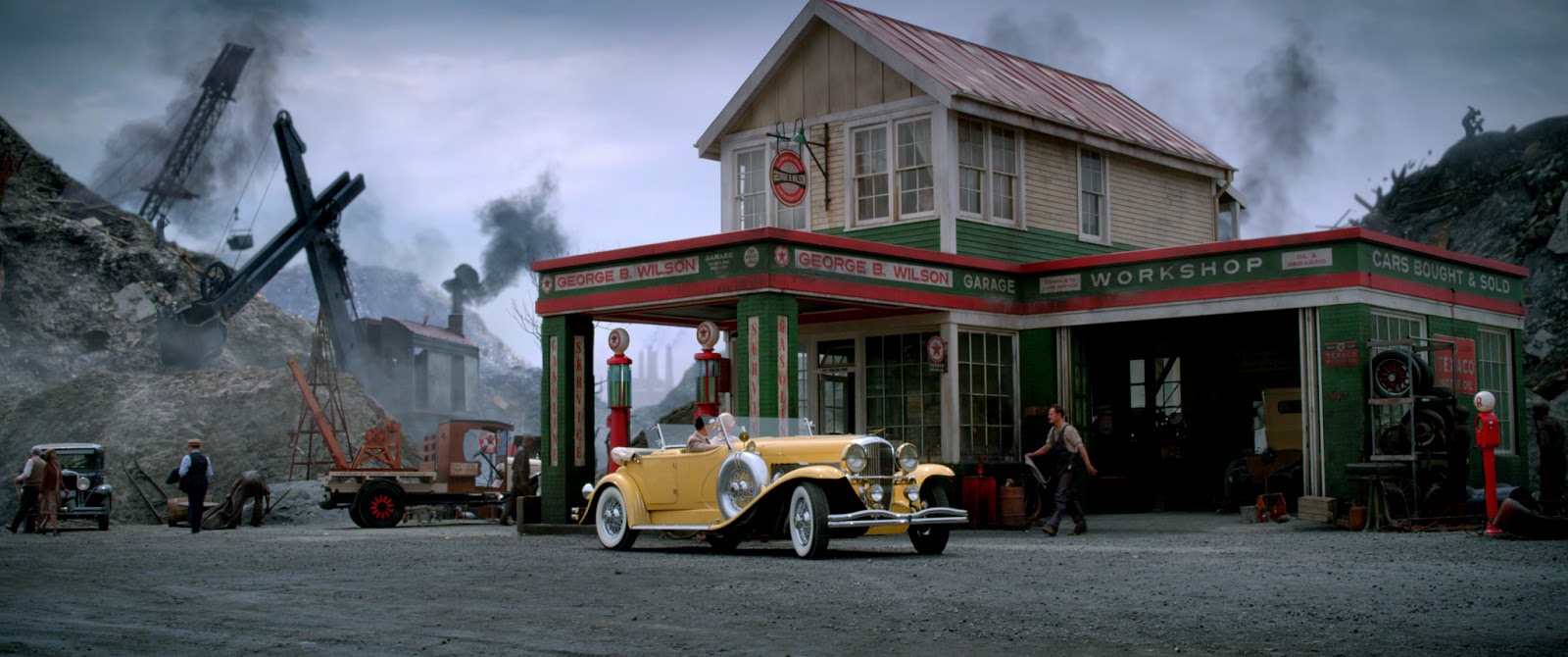
The Great Gatsby (2013)

Baz Luhrmann's The Great Gatsby starts out exactly as F. Scott Fitzgerld's stupendous, classic book -- "In my younger and more vulnerable years..." Nick Carraway, who is now apparently depressed and alcoholic stares dramatically out the snowy window, and relays his story to his doctor. The story of how he moved to West Egg, just outside NYC, into a tiny cottage squeezed between two huge mansions, one of which was always alive with wild parties and belonged to a man called Gatsby, and what happened there that summer of 1922.

Spoilers ahead, sweetie. If you haven't read the book, you shouldn't be watching this movie. Or reading this review!

The movie, also like the book is (almost) always in Nick's perspective. His doctor encourages him to write everything down, and he narrates as he does throughout the whole film. Often, ruining a moment he should be only witnessing by jumping in and whacking us over the head with the subtlety that we would apparently never understand without his helpful insight. If you beat someone to death with subtlety, is it still subtle? Tobey Maguire plays Nick, and reminded me very little of his Peter Parker, and when he wasn't smashing his "insights" over our heads, or (over) dramatically quoting the book word for word, I liked him. Still, he was too involved in the story, not a simple observer who reserves judgment. Somehow he was inserted too much into the story, but simultaneously removed, as his entire relationship with Jordan was completely cut.

Nick trying to work. He didn't spend ALL summer observing other people's drama.

Gatsby is the main guy here, obviously. Rich, mysterious, personable Jay Gatsby. Hopeful to a fault. And Leonardo DiCaprio is just as good as he should be in the role. Let me just go ahead and point out that everything in this movie is overdone, most obviously the acting, and if I can, I blame the director, not the actors. That being said, there are some very good things about DiCaprio's Gatsby, and some not-so-good things. The way he said his catchphrase, "old sport" for instance, feels unnatural. It's either because that's how the director wanted it, to emphasize that Gatsby wasn't naturally that way, or, DiCaprio just couldn't pull it off. You guessed it; I've decided to lean towards the former. In general, DiCaprio's performance is very good; he does especially well with Gatsby's mysteriousness, and the desperate way he pursues his dream. His Gatsby is also obviously a man who has worked hard to make himself appear to be someone he naturally isn't.

The mysterious Gatsby.

Now Daisy Buchanan, that beautiful, conflicted girl whose voice is probably the most perfectly described in history. I knew from the moment I saw who was playing her that if anyone could do her justice, it was her; Carey Mulligan. Not only does she fit the part physically, but her voice seems to naturally be exactly what Fitzgerald heard as he wrote those lines about murmuring, music and money. One thing I didn't consider though was the character, and after the movie was over, I realized that Mulligan's Daisy was too likable. I shouldn't be surprised, it's very hard to make Carey Mulligan dislikable, and I doubt that Luhrmann wanted to make her so -- who'd want to watch a romance between two dislikable people? At times she sounded like she was trying too hard to get the voice right, and she didn't murmur enough for me, but otherwise she was exquisite, and I still maintain that she is the perfect choice for Daisy. Luhrmann just didn't know how to use her correctly.

Beautiful Daisy.

Her husband Tom Buchanan is the main character I have the least complaints about. He is undeniably a dislikable character, and played wonderfully well by Joel Edgerton. He lends a kind of tenderness to the character that I saw in the book, and was very pleased when it not only showed in the movie, but wasn't overdone -- I credit it solely to the actor. And of course his violent, racist, and other dislikable traits were there, and done very well. The only thing concerning his character that I missed was when Nick runs into him on the street at the end and shakes his hand. I thought it was an important scene that helps give the story its conclusion, and completes the character arc of both Tom and Daisy. But hey, what do I know, right?

Tom. "One of those men who reach such an acute limited excellence at twenty-one that everything afterward savors of anti-climax."

At first I thought Tom's mistress Myrtle Wilson was strangely cast as the young, cute, sweetly voiced Isla Fisher, but she impressed when she got the chance, which was basically just her introductory scene, but still. She may not have been like I imagined her, but she got the job done admirably. Same goes for her husband George Wilson played by Jason Clarke, except his appearance was considerably more like I imagined him. I would have been happy to see both of the characters get more development, and I think it would have been good for the movie.

Myrtle makes her grand entrance as her men have a chat.

Newcomer Elizabeth Debicki plays Jordan Baker the elegant golf star and fellow observer with Nick. I thought she was a good choice for the role and really enjoyed her part, but her character seems to be the one that ended up mostly on the cutting room floor. She's really only used when needed to develop the story, or is there when she's supposed to be because the novel dictated it. And as I mentioned her and Nick's relationship was almost totally missing; it only progressed as far as it needed to, to develop Gatsby's plot, then was left hanging there uselessly, disappointingly.

Lovely. If only she could have played her part to it's potential.

Now I'm probably going to shock you, and say that I thought that Jay-Z's rap score was a very bold and surprisingly fitting move. I liked the way the cool, upbeat modern music blended with the cool, upbeat music of the twenties, it was very sharp. And speaking of sharp, the costumes! I love twenties costumes, and these, mixed with high fashion, "vintage" tends of today were particularly suave, bold and zesty. I fell in love with Jordan's lavender hat, and Gastby's wardrobe was spot-on and immaculate. Neither the score nor the costumes were truly authentic, but they fit in the style of the picture, making it more relevant to modern times, and really helped amplify the spectacle.

And what a spectacle it was. Nick never describes Gatsby's parties in the movie, (though he describes plenty of other obvious things) for one very good reason; he really doesn't need to. The parties are alive with bright colors, music, noise and people, nearly overwhelming the senses... and I didn't even see it in 3D. The problem occurs when the party is over, and a particular sequence is supposed to be mellower, but attempts to make it more upbeat and dazzling only annoy. The party in Tom and Myrtle's apartment got that treatment and was made way wilder than the book's description implied. During that scene I sat wondering what in the world was going on, hoping the rest of the movie wasn't going to be changed like it, and missing Fitzgerald's description of no one being able find each other in the thick cigarette smoke.

People party at Gatsby's place!

During other sequences, the "glitz-y treatment" results in some weird, distracting computer effects, like flash-backs appearing in the clouds, or Nick speaking lines as they appear in the falling snowflakes. It really snaps you out of the experience. So while they're putting text on the screen, they might as well have put some in flashing red that proclaims "THIS PART IS STRAIGHT FROM THE BOOK" because someone was obviously very proud of the fact, (whenever it was a fact) and it's already being screamed out as loudly as subtext can be -- just go the extra step, and it'll even be ironic!

This Gatsby is soaring in glamorous fashion and overflowing with unique style, but the only way it's like the book is that it's literally (word for word) like the book! Practically everything happens, yet almost nothing is right. Where are the intricacies and subtleties, the real life, the laid back humor, and the wonder? Gatsby and Daisy's over-the-top romance take precedence over everything that really resonates and makes you think when it's all over. Just before Gatsby dies, and falls slow-mo into his pool, he whispers, "Daisy" and words appear on the screen one last time -- "You can start crying now." (Okay, not that last part) Gatsby was obsessed with Daisy, but if we know better, we then begin to miss everything that was brushed aside for some pointless tragic romance. And in that last glimpse of his handsome face floating under digital water, there is no realism; no grim epiphany that Gatsby wasted his life chasing that dream that was already behind him, and died carelessly, alone and friendless; nothing more than a briefly dazzling carnival attraction. That's what this movie is too -- a two-hour showcase of digital beauty, fireworks and parties, and romance. A dazzling, hollow shell.


It's hard to live up to such standards as Fiztgerald set, and this movie does get it half exceptionally right, with its near-flawless cast, and breath-taking sets. I also give them the credit of at least attempting to capture the complexities of the novel, but I've come to the conclusion that The Great Gatsby is just an un-filmable book. What would the book be anyway, without "Carraway's" thoughts and observations, and our unlimited access to his mind? But including them in the movies is next to impossible. Nothing has worked yet, but so far Luhrmann has put in the best attempt. When it wasn't bothering me, I enjoyed it, and if the title wasn't The Great Gatsby, I would dismiss it satisfied, as an incredibly dazzling, slightly depressing film.

Number 7!

Tuesday, April 30, 2013

Midnight in Paris

 To set mood: Push play, and start reading.


Gil is a self-proclaimed Hollywood hack who never took his chances with anything. He writes movie scripts and wishes he'd tried novels first. He lives in California and wishes he'd given Paris a shot. He also wishes he lived during "the Golden Age" -- the 20's, but that's not his fault. He's engaged to Inez, who is beautiful, and can be charming, but never seems to be while around him. Maybe she's just annoyed with him currently; they're in Paris for her dad's business, and he's talking about staying permanently; he's trying his hand at a novel, faltering, and stubbornly refuses help or advice, and he keeps mentioning how amazing Paris must have been in the 20's... in the rain. What's up with that?

"What's wonderful about getting wet?"

Gil is certainly a romantic. Longing for a time when he considered everything to be better -- and who could argue with the 20's in rainy Paris? Paris is still beautiful in the 21st century of course, so when faced with the decision of wandering the streets by himself at night, or spending another couple hours tagging along with Inez, and her friends Paul and Carol who they met by chance earlier, the answer is easy, and the answer is "alone."

A little while later, he's lost and sitting on some steps somewhere, watching the city, listening to the clock strike midnight. A vintage car pulls up. Heavily accented people call him to hop in, then he's at a party. The guy playing Cole Porter at the piano actually looks like Cole Porter. That's not possible. A feisty American lady introduces herself as Zelda, and then calls over her husband, Scott. Fitzgerald. Gotta be a coincidence.

The Fitzgeralds!

No, Gil Pender has somehow time-traveled, and that was just the beginning of his experience in that allegedly perfect time that is 1920's Paris. He muddles through the day with Inez and her increasingly annoying friends in 2011, then spends his nights living it up in the 20's with the likes of Hemingway, Picasso, and a breathtaking French girl, Adriana.

Adriana and Gil at a surrealist's wedding. Hence the taxidermy birds. ...That makes sense, right?

This little Woody Allen film starts out with various lovely, saturated shots of Paris slowly progressing day to night as a soprano sax belts out a jazzy tune. An easy, effortless artistic feel flows from there through the rest of the movie. None of the shots look really "composed," but if you pay attention, you begin to appreciate the scenes composed of a single shot, drawn out over several minutes as characters walk about and interact with each other realistically; competing to get a word in, and having to make an effort to express themselves intelligently.

And who exactly is in this movie? Everyone. Okay, maybe not, but it certainly does seem like it at times. Owen Wilson is our protagonist Gil, and is his usual charming, goofy, funny self. Rachel McAdams is Inez, and is great at being, well, dis-likable (to put it nicely), but you can see her appeal as well. Michael Sheen is Inez's "pedantic" friend Paul, perfectly described with one word. Then there's the crazy coroner Woody from Psych, Kurt Fuller, being normal as Inez's dad, and the assassin girl from MI4, Lea Seydoux, playing a local girl.

Paul, Carol, Inez and Gil touring Paris. Paul serves as tour guide, and says "if I'm not mistaken" a lot.

In the 20's side, the ever-lovely Marion Cotillard is the equally lovely and sweet Adriana. When Gil says she has "one of the most interesting faces ever" I couldn't agree more. Adrien Brody gets a single, memorable scene as Salvador Dali. Kathy Bates plays Gertrude Stein. Corey Stoll is Ernest Hemingway, and this movie's scene-stealer, which is really saying something when there's also Tom Hiddleston there, playing F. Scott Fitzgerald with a great "20's American" accent, and his classic, but (as of then) not-quite-yet discovered charm.

Gil, Ernest Hemingway, and Gertrude Stein examine Picasso's latest painting.

I must briefly mention a kind of technical aspect here. The film is rated PG-13 for "some sexual references and smoking." As to the smoking, I just wonder why they don't mention all the drinking as well, but the sexual references are scattered around the film, and are not especially crude like some PG-13's can easily be, but are inappropriate enough to warrant a warning.

Loose morals abound just as you'd expect from the 20's and 2000's, but the moral of the film goes in a much different direction.

First we are drawn in with simple, delightful appeal, to fall in love with a place we've perhaps never been to, and feel nostalgia for a time we never experienced. It's easier than it seems; I don't get all the references to the time, and I don't know all the famous people of the 20's introduced or mentioned, but when nostalgia is this contagious, it doesn't make a difference. I think Woody Allen could make me nostalgic for last week if he presented it like this.

Because I really, really like this still.

Midnight in Paris is pleasingly sentimental and nostalgic. But instead of ending there and letting us wallow in our new-found disappointment of having to live in the here and now, it says it doesn't matter; everyone wishes their lot was different. Paris is still here, so if you want to live there, go. If you want to write a novel, take the risk and try it. Walk in the rain if you can appreciate it. It encourages us to love the past if we want, but to live in the present.

And then, when paired with the easy artistic delivery and cute wry humor, it becomes much, much more than a typical comedy. Instead of cheap jokes and meaningless romance, you actually get to think while watching. And sure it doesn't go as deep as some serious thinking movies, but that's not bad -- it simply doesn't presume to be anything it's not, and doesn't take itself too seriously. Because what it is, is plenty good; lighthearted, fun, genuinely charming... like a walk through Paris in the rain.

-- 4.5/5 stars
Old-Fashioned Charm
My sixth review for this!

Bonus -- because I can't resist. Tom Hiddleston is being interviewed for The Avengers and Midnight in Paris, and does the most perfect Owen Wilson impression. (Start at 3:55 to avoid The Avengers part, which is mostly the smitten host flirting awkwardly anyway.)

Friday, April 26, 2013

The Illusionist

It's the classic story. Poor boy meets rich girl. Girl's parents forbid them from seeing each other. Boy promises to run away with girl. Boy leaves alone instead. Fifteen years later, boy returns, a skilled illusionist, and meets girl again, ready to make good on his promise, just as she's about to marry the Crown Prince of Austria.

Alright, so maybe that's not that classic, but every good story needs a good twist, right?

He remembers her, but does she?

Edward Norton plays Edward, or Eisenheim - what he is known as when he becomes an illusionist. Eisenheim's show becomes very popular when he returns to Vienna. So popular, in fact, that he attracts the attention of the Crown Prince Leopold (Rufus Sewell). Leopold is one of those not-so-nice princes, for instance, he plans on overthrowing his father, the Emperor, and his plan hinges on his marriage to the Duchess Sophie Von Teschen (Jessica Biel). When Eisenheim discovers his childhood sweetheart's impending marriage, he not so inadvertently humiliates the Crown Prince, prompting him to retaliate. He uses the Chief Inspector Uhl (Paul Giamatti) -- who is more his personal assistant than anything else -- to that purpose. When he is instructed to shut down Eisenheim's show, Uhl is conflicted, as he is fascinated by Eisenheim and his tricks, but loyal to the Prince; suddenly he finds himself caught in the middle of their two-man war.

The Crown Prince doesn't know what he's getting into.

Eisenheim is certainly meant to be the main character here, but he's a pretty classic magician; mysterious, unreadable. We only get glimpses into his mind as often as other characters do - not often at all. Thank goodness then that Uhl is there to carry the movie. You think the main character is the one who carries the movie? It is an illusion. Paul Giamatti is us; trying to keep up, trying to piece together the mystery - enjoying it immensely. He is our connection to the strange world of The Illusionist. He is also convincingly British.

Inspector Uhl brings the story to life.

Not quite so much for fellow Americans Norton and Biel. Thankfully though, they both under-did the accents; much smarter than overdoing it, and it works out fine. Otherwise, they are very fine. I'm not a fan of Jessica Biel, but I don't mind her in this movie at all, and her costumes are so gorgeous. Norton is a great brooding magician. Subtle and... I want to say "deadpan" but that gives a bad impression... is there a way deadpan can be good? At any rate, it gives me the impression that the character is putting on an act, and that's a good thing. Rufus Sewell is definitely a good thing. He always makes a wonderful villain, but here he's especially good. Best of the bunch though, is certainly Giamatti, the only truly involving character, with his perfect subtleties, and the second best eye-roll ever.

Edward Norton looks the part, and performs some impressive illusions.

Much further than this, I cannot go, for fear of exposing too much of the plot that you should just watch for yourself. This pic is rated PG-13 for some sexuality and violence, and besides one scene which I always easily skip through, it's a pretty clean, if dark and mellow movie. Visually, it's very unique, using sepia tints and vignetting to create a pleasing old-fashioned feel, and early 1900's costumes, buildings, and scenery are all very pretty to look at. And the story... mysterious, magical, and... well...

I will leave off with this: highly recommended.

-- 3.5/5 stars
Review number five for this!